15 days of positive streak in ETFs suggest end of bitcoin price correction
The 11 bitcoin (BTC) spot ETFs in the United States have seen positive capital flow over the past 15 days, collectively adding more than $2.28 billion in inflows during this period.
The fund managed by the Fidelity company, Fidelity Wise Origin Bitcoin Fund (FBTC), led the entries with 77 million dollars, yesterday June 3.
The Bitwise-managed fund, Bitwise Bitcoin ETF (BITB), saw net inflows of $14 million, while ARK 21Shares Bitcoin ETF (ARKB) added $11 million.
Meanwhile, the VanEck Bitcoin Trust (HODL) and WisdomTree Bitcoin Fund (BTCW) spot ETFs recorded minimal inflows of less than $2 million.
The two largest spot bitcoin ETFs, managed by the companies BlackRock and Grayscale, did not register movements yesterdayaccording to data from the firm Farside Investors.
The ETFs’ consecutive 15-day inflows mark the second-longest positive streak since their launch last January, as seen in the following graph. Total accumulated net inflows to date reach $13.96 billion.
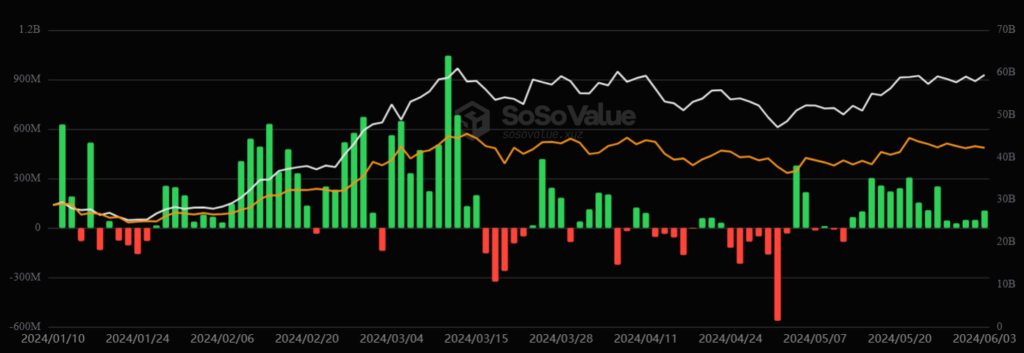
If this trend continues, will be favorable for the bitcoin price and could signal the end of the bitcoin correctionwhich in recent weeks has been in a lateralization phase.
The digital currency reached its new all-time high of $73,800 in March, driven precisely by spot ETFs due to their performance. These are backed by the underlying asset, and the fund management companies They must acquire and maintain bitcoin in their treasuries to support their actions.
Public funds see ETFs as a viable investment
As has been demonstrated, these instruments continue to be attractive for a variety of capitals, especially corporate and institutional, that seek to operate with instruments regulated by the United States Securities and Exchange Commission (SEC).
An example is the Wisconsin State Pension Fund, which invested $180 billion in one of the ETFs, specifically in IBIT and GBTC, as reported by CriptoNoticias.

For David Krause, a finance professor at Marquette University, although that amount of money represents a small part of what the fund holds ($180 billion), it is just an entry point, he said in an interview.
I think they are doing tests to see the public reaction on whether or not there is resistance to owning this. And they’re using it as a test, because it really won’t have a substantial impact on the portfolio, until maybe a 1% or 2% positioning is reached.
David Krause, professor of finance at Marquette University.
Krause believes that Bitcoin has shown a lot of volatility, but supply and demand are “starting to balance out”.
Therefore, he believes that the investment community is beginning to see this more as “a viable alternative investment.”
«Bitcoin, like other alternative investments, does not move in parallel with stocks and bonds. Therefore, it adds a nice diversification effect. The potential benefits are as high as they could be with any new technology,” he added.
The perspective of the university professor could be shared by different companies and funds in the United States, so capital inflows into ETFs are expected to continue increasingwhich would boost the price of BTC.
According to Colombian analyst Juan Rodríguez, investors added 29,989 BTC to the ETFs throughout May, reversing what happened in April, he mentioned on the social network X.
Rodríguez believes that the macroeconomy in the United States will continue to set the tone. Therefore he believes that Pay attention to the next meeting of the Federal Open Market Committee (FOMC)which will take place on June 11 and 12, 2024. There, the country’s interest rates and other financial policies will be deliberated.
The analyst explains that he has “favorable” inflation reports. However, although this data is positive for bitcoin, it does not mean that the currency will immediately assimilate it. For example, last Friday the PCE inflation index was released, and although it caused some momentary volatility, it did not end up being defined in a marked upward trend.