
4 years ago, El Salvador took the first step in Bitcoin and today the world follows
Exactly four years ago, on June 9, 2021, a fact occurred that marked a before and after in the history of Bitcoin (BTC): El Salvador, a small Central American country, granted this asset the legal currency status of legal tender, despite multiple criticisms both from politics and by multilateral organisms.
This milestone was specified with the approval of the Bitcoin Lawwhich forced all economic agents to accept BTC as a means of payment next to the US dollar. In addition, it implied the development of the state digital wallet Chivo to facilitate transactions, and the operations with the digital currency were exempted from capital gains.
Over time, The Salvadoran case has become a key reference for cryptoactive enthusiasts. Over the years, divided opinions have emerged: some consider that it is a failed experiment, pointing out the low levels of adoption within the country, while others believe that their true impact can only be measured in the long term, as cryptonoticies reported.
El Salvador’s decision placed the creation of Satoshi Nakamoto in the center of the institutional debate. It is not that BTC was sentenced to stagnation, but what Bukele and his team promoted a barrier loaded with prejudices.
From then on, several governments and companies began to take BTC seriously, which used to be evaluated from extreme positions: or as a niche technology, or as a purely speculative asset linked to illegal activities.
This motivated other nations to consider similar measures, intensifying the debate on the adoption of cryptocurrencies. Latin American countries such as Paraguay, Brazil, Argentina, Guatemala and Colombia began discussing bills linked to the sectorin many cases taking El Salvador as a reference.
The strategy of the Central American country attracted the attention of influential figures from the world of cryptoactive, such as Jack Mallers and Max Keiser – this last became a recurring advisor on issues related to BTC – who met Bukele and supported their vision. This has raised Bitcoin’s profile, motivating financial institutions to consider their adoption.
In the midst, companies such as Strategy, led by Michael Saylor, intensified their Bitcoin accumulation plan, accumulating more than 580,000 BTC today. In parallel, Fidelity Investments launched investment products in Bitcoin aimed at institutional clients in 2022, while Blackrock introduced a Bitcoin ETF in cash in January 2024.
Bukele’s approach took a new step in late 2022, when El Salvador announced that he would start buying 1 bitcoin per day to strengthen his strategic reserve. At the time of writing this note, the Central American nation has 6,202 BTC and has almost 120% of unrealized profits, according to the Dropstab explorer.
This measure promoted the debate on the inclusion of cryptocurrencies in national reservesan issue that won even more relevance in 2024 with the presidential campaign of Donald Trump, who not only returned to the White House in 2025, but signed an executive order to create a strategic treasury with about 200,000 BTC seized in criminal operations.
El Salvador’s strategy on Bitcoin has been changing
Although last December, Bitcoin’s mandatory status was ended as legal tender in El Salvador, before an agreement with the International Monetary Fund (IMF) to stabilize the finance of the Nation, officials like Stacy Herbert reaffirmed their long -term commitment to the asset.
In addition, although it was confirmed that the goat wallet will be discontinued as part of the agreement, the country’s authorities assured that the strategy of buying 1 BTC daily will continue and that the educational initiatives related to the digital currency will remain active. Both things have been maintained so far, with the occasional exception for purchases.
One of the less visible but equally relevant pillars of the Salvadoran bet for Bitcoin has been the incursion into the BTC mining using geothermal energy from volcanoes. This initiative has captured the interest of international miners, some of whom transferred their operations to the country to take advantage of renewable electricity at low cost.
In this way, the so -called “volcanic energy” became a powerful narrative to promote El Salvador as a destination with expanding energy infrastructure aimed at sustaining mining and future technological developments linked to Bitcoin City, an intelligent city project.
Nevertheless, Not all bets have had an immediate outcome. An example is the case of “volcano bonds”announced with great expectation in 2021 to finance part of the Bitcoin City. Although its broadcast has been repeatedly postponed, instead a similar instrument emerged in 2024: the HILSV debt token, a cryptoactive that offers an alternative microcredit route to boost the expansion of the real estate market in the country. Unlike volcano bonds, HILSV is negotiated in dollars and USDT on the Liquid network.
El Salvador: A global forum for Bitcoin debate
Over the years, El Salvador has become a meeting point to discuss the adoption of BTC at the globa levell. An outstanding example was the meeting of the Alliance for Financial Inclusion (AFI), held in May 2022, where representatives of 44 emerging economies analyzed Bitcoin’s potential to promote financial inclusion.

In December 2024, representatives of the National Securities Commission (CNV) of Argentina held an encounter with the National Commission of Digital Assets (CNAD) of El Salvador, and signed an agreement to share experiences and promote initiatives related to Bitcoin.
After the signing of this agreement, Juan Carlos Reyes, head of the CNAD, stressed that El Salvador and Argentina seek to lay the foundations for greater regional cooperation, which promotes a friendly scenario for the development of the cryptoactive industry.
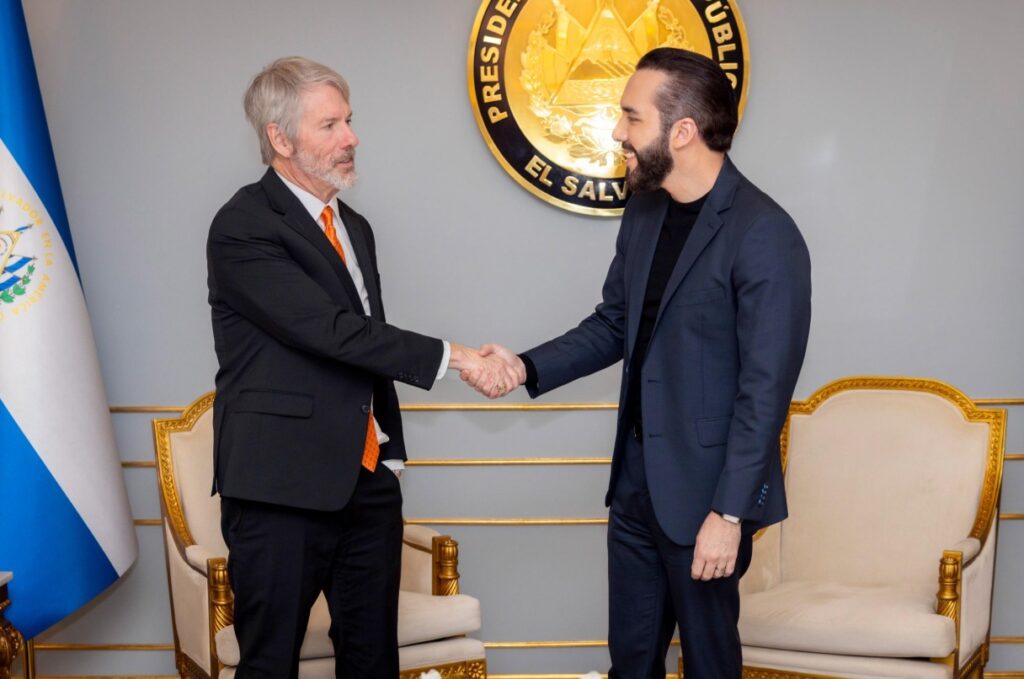
Later, in February 2025, Nayib Bukele met in El Salvador with Michael Saylor, CEO of Strategy And one of Bitcoin’s greatest corporate defenders, in a meeting that also included Stacy Herbert and Max Keiser. At that meeting they touched on issues about the next steps to strengthen the adoption of Bitcoin globally.
And this is something that continues actively. Without going any further, last week, Nayib Bukele met with BO HIES, executive director of the White House Digital Assets Advisory Committee, to explore possible collaborations between the United States and El Salvador in the field of Bitcoin and other digital assets.
Almost four years after taking the first step, El Salvador continues to consolidate as a state of state adoption operations in Bitcoin. Despite the challenges and criticism, the country has maintained a firm vision and long term that continues to capture the attention of governments, regulators and financial institutions around the world.
In a context increasingly open to the use of Bitcoin, Salvadoran experience is a key reference point to understand the possible paths of an integration real between decentralized finances and the traditional banking system.


