
A historical wallet will incorporate Bitcoin mini-application
-
For safety, Electrum will not allow automatic plugins update in the Wallet.
-
These plugins will allow connecting with external services or new ways of managing transactions.
Electrum, one of the most used Wallets to manage Bitcoin, has announced an update that seeks to expand the possibilities for its users.
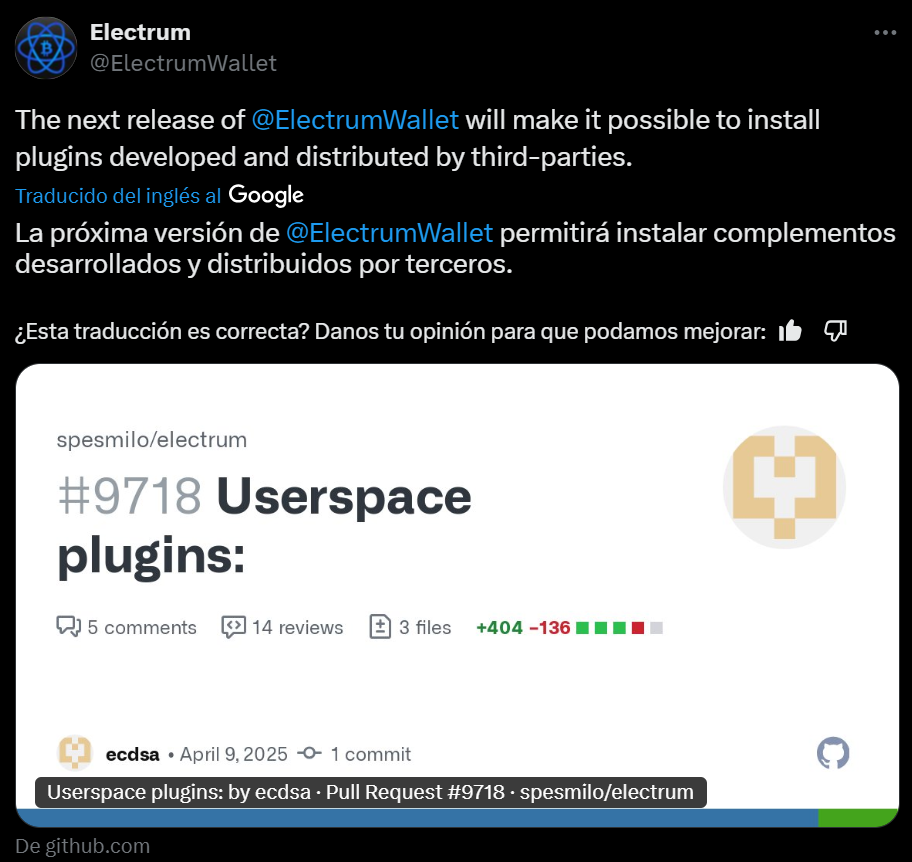
According to a message posted on April 15, 2025 by the official electrum team on social network X, the next version of the software It will allow the installation of plugins (called accessories, in Spanish) developed and distributed by third parties.
These plugins, which function as small programs or miniprograms designed to add specific functionalities, represent a change for electrum, opening new doors to customize the user’s experience, although also generating questions about the risks they could involve.
The purpose of including these electrum miniprograms is to extend the Bitcoin Wallet capabilities beyond its basic functions. Until now, Electrum has offered standard tools such as transaction management, hardware wallet compatibility and connection to Bitcoin Network.
However, by allowing external developers to create and distribute their own plugins, the team seeks to create a more dynamic ecosystem where users can adapt the wallet to specific needs. It is as if electrum, a traditionally simple tool, now it could be equipped with small specialized modulessimilar to how a miniprogram can add a new function to a larger application, allowing users to customize their experience without modifying the software nucleus.
The process of integration of this new feature, detailed in the Pull request #9718 of the Electrum Github repository, reveals the technical approach adopted by the equipment to implement these miniprograms.
Plugins focused on electrum safety
According to the developer Sombernight, author of the proposal, a system has been created that allows us to manage plugins through a manual installation mechanism that requires user authorization.
The details of Pull request They indicate that these miniprograms must be explicitly installed by the user, who will have to grant administrator permits to activate them. In addition, it has been established that The plugins cannot be updated automatically; Each new version of a miniprogram will require additional authorization, which seeks to reduce risks by avoiding non -supervised modifications.
The system also includes a graphic interface that allows users to visualize and manage installed plugins, with options to enable or disable them as necessary, similar to how the accessories work in the Google Chrome browser. This design reflects an effort to balance the flexibility offered by these miniprograms with the need to maintain a safe environment for those who use the Wallet.
According to the information available, third -party plugins in electrum will be aimed at adding specific functionalities to the Wallet, such as connecting with external services, implementing new ways of managing transactions or facilitating integrations with tools that interact with the Bitcoin network.
For example, a miniprogram could allow connection to a personalized server to improve privacy or add support for a specific Bitcoin -related protocol. However, the exact scope will depend on what external developers decide to create, since Electrum only provides the frame for these plugins to operate within their software.
What are the applications (DAPPS) in Ethereum with Electrum plugins?
Compared to Ethereum DAPPs, electrum plugins have a different purpose and structure. DAPPs are decentralized applications that are executed on the Ethereum network through intelligent contracts, which allows them to offer more complex services such as decentralized finance platforms, non -fungible tokens markets or games.
Instead, electrum miniprograms do not depend on intelligent contracts; They are extensions that are executed locally and are designed to interact with the Bitcoin network, but from the Wallet. While a DAPP can be a complete application with its own decentralized logic, an electrum plugin would be rather A miniprogram with a more limited approach, focused on improving or complementing the functions of the Wallet, such as nodes or data visualization.
Therefore, although both concepts seek to expand the possibilities of their respective platforms, their mechanisms and objectives are fundamentally different.
The incorporation of these third -party miniprograms in Electrum marks a notable change for a Wallet that has been valued by its lightness and simplicity. While this update opens the door to innovations promoted by the community, it also raises questions about the security and trust that users must deposit in these external accessories.
The electrum team seems aware of these challenges, as evidenced by the design of the manual authorization system by password described in the Pull request. However, the real impact of this new functionality will only be known once the community begins to develop and adopt these accessories.


