A new scheme could modify the inflation of the solana cryptocurrency (Sol)
-
The proposal was made by the analysis firm Galaxy Research.
-
This initiative would shorten the times in which Sol reaches the target emission rate of 1.5% per year.
After the rejection of the improvement proposal identified as ‘SIMD-0228’, which sought to address inflation and reform the Soon token emission system (Sun), a new initiative has emerged in that ecosystem.
And, a month later that the validators of the Net presented a new project to mitigate that problem linked to the native token of Solana.
The initiative was published in the Solana and called Improvement Forum ‘Multiple ELECTION STAKE-WEIGHT AGGGATION’ or aggregation of weight participation in multiple elections (table). There, Galaxy raises a technical scheme to gradually reduce inflation to reach a sustainable terminal rate. Goal that, according to its proponents, would strengthen the economy of the native token of the network.
What is the current issuance system and proposed by Galaxy Research?
The current Sun emission system operates under a model that combines an initial inflation rate of 8% with an annual reduction of 15% until it progressively reaches a 1.5% annual emission and stabilize there. In accordance with the estimates of the Galaxy document, if no change is made in the current model, Solana would reach that terminal rate within an estimated period of 7.4 years.
This current model has generated criticism for its impact on the circulating supply of sun, which could function as a pressure factor on its long -term value. According to Galaxy, there is “a shared belief that inflation is too high.”
The proposal of this company points to a new voting model to define the sun inflation curve with the objective of Accelerate the rhythm in which the network reaches that emission rate of 1.5%. In this case, according to the ‘table’ initiative, instead of binary decisions (that the validators have to vote for ‘yes’ or ‘no’ before proposals such as SIMD-0228), the validators would vote for multiple deflation rates and the result will be decided by an added average.
The following graphic, attached to the text of Galaxy’s proposal, reflects that Sol inflation is currently 4.6% annual levels and illustrates how different deflation rates (color lines) could significantly reduce the necessary time to reach the 1.5% target:
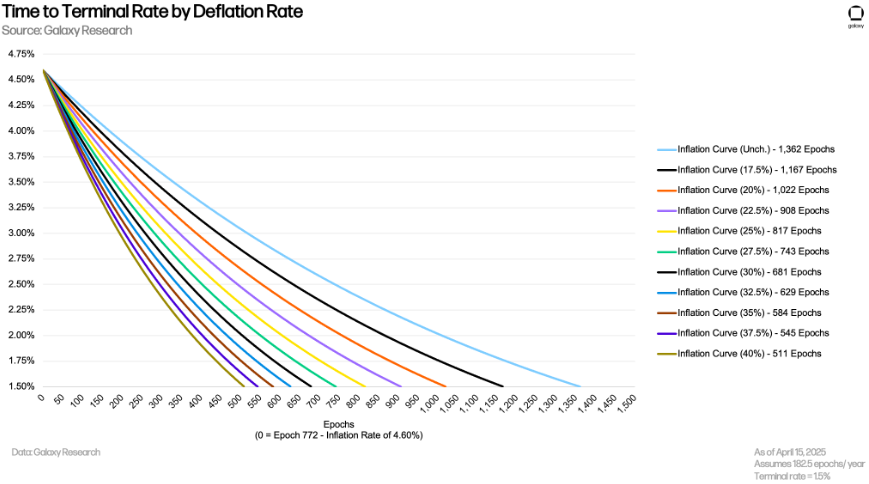
The table proposal would allow the validators to select one or more predefined options, such as maintaining the current rate of 15%or increasing it to 20%, 25%, 30%, 32.5%, among others. Each of these elections would be weighted by the stake of the validators that support itand the final result would be an average weighted rate.
For example, if 5%of the Stake votes to keep the rate by 15%, 50%vote to increase it to 30%, and 45%opt for 33%, the final result would be an annual deflation rate of around 30%. With a 30%deflation, The objective would be fulfilled in around 3.7 yearsaccording to Galaxy, almost half of the time it would take with the current issuance levels.
Galaxy Research considers that this new approach would allow more representative agreements to be reached without jeopardizing the predictability of the Solana emission model.
Being a proposal that maintains the structure of the inflation curve, but adjusts the voting mechanism, theoretically does not introduce abrupt changes that can generate much uncertainty among ecosystem participants.