Are the stablecoins the new monetary alcoholism?: Max Keiser
-
For Keiser, Stablecoins are the new face of the monetary expansion without control.
-
According to Friedman, fighting inflation is difficult because negative effects come first.
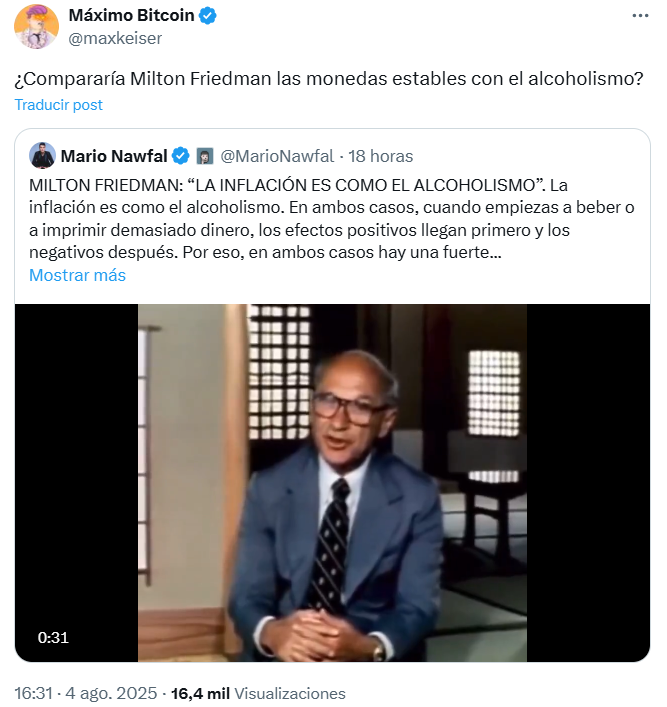
Max Keiser, a renowned defender of Bitcoin (BTC), again stirred the debate by suggesting that Stablecoins could represent a new form of monetary alcoholism. He did it by sharing a publication that refers to a video by economist Milton Friedman, who at the time compared inflation with the drink.
According to Friedman, the temptation to print money by politicians, as well as to continue drinking in the case of alcoholism, arises because immediate benefits hide the long -term consequences. And in both cases, the most difficult thing is to sustain the cure: when stopping printing (or drinking), the negative effects feel first, while the positive results arrive later.
For Max Keiser, Stablecoins are a new and more sophisticated way of printing moneywhich makes them even more dangerous. He warns that, although at first glance they seem harmless, they could be used as an undercover tool to carry out a large -scale monetary expansion.
As Cryptonoticias reported, the Bitcoin advisor of the Government of El Salvador argues that Donald Trump would have a plan to double the money supply through Stablecoins.
The objective would not be to strengthen the dollar, but to weaken it strategically to boost US exports. This maneuver, in theory, would allow you to overcome the Federal Reserve (FED), which currently maintains a policy of high rates to control inflation.
In this way, Keiser argues that, if Trump’s plan progresses, a massive Stablecoins emission could be promoted backed up in dollars or equivalent assets. Although these cryptocurrencies are issued by private companies, their generalized use in markets could generate an effect similar to printing money from the Central Bank, but without its direct supervision.
The result of this would be an accelerated devaluation of the dollar and a significant loss of the purchasing power of savers. But while many could be harmed, Keiser believes that Bitcoin will benefit.
Thus, the warning of Milton Friedman charges new relevance: what begins as a temporary solution – like the stablecoins – could trigger a deeper crisis.
In the midst of the situation raised, BTC is emerging as the only alternative with a fixed and predictable monetary policy. Unlike Fíat currencies, which can expand unlimitedly, Bitcoin has a maximum supply of 21 million units. This particularity makes it an deflationary asset and resistant to monetary manipulation.
From his role as an advisor in El Salvador, Max Keiser has not been warning that the collapse of the dollar is inevitable. In his opinion, the recent approval of the Genius Law (Guonding and Establishment National Innovation for Us Stablecoins), which regulates the issuance of Stablecoins to sustain the hegemony of the US currency, is nothing more than a desperate attempt to give continuity to a system that falls apart.
In his vision, Stablecoins as USDT – issued by the Tether company – will end up exposing the weaknesses of the dollar instead of supporting it, especially if their reservations begin to depend more on Bitcoin than traditional assets.