Argentina dismantles gang operating with “crypto dollar” in illegal casinos
Key facts:
-
According to the judicial investigation, the cryptocurrency transactions amounted to USD 7 million.
-
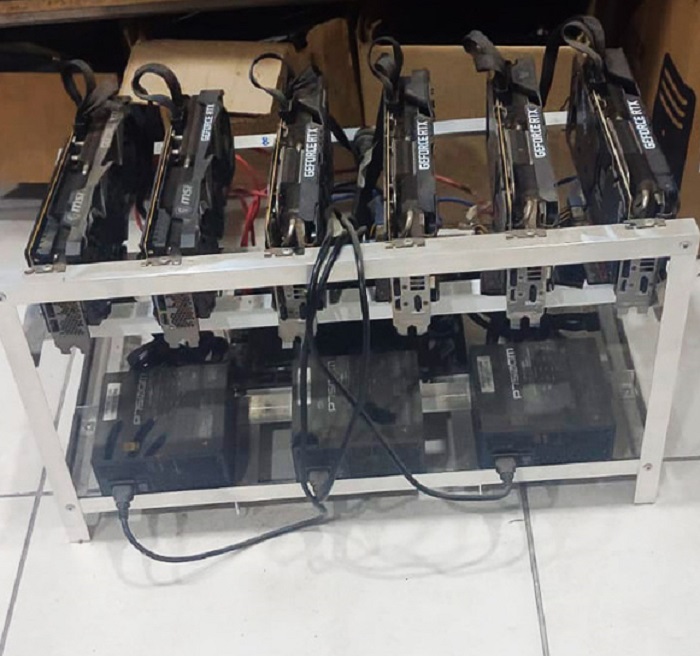
Among the seized devices are GPU rigs for mining cryptocurrencies.
Fabián “El Gordo” Di Julio had been on the run for two months in Argentina, accused of leading a gang that laundered money from profits obtained in illegal gambling and smuggling cell phones. To hide these operations, he used cryptocurrencies. Cornered, he turned himself in to justice on Wednesday.
What was the modus operandi of this criminal organization? It all started in September last year, from an anonymous complaint that reached the police. Argentine Federal Police (PFA) by email. There, illegal activities related to possible smuggling of telephone devices were reported, with an alleged connection to Customs officials.
The investigation led to suspicions of money laundering and the promotion of illegal casinos. on-lineBut this was not the only illegal activity. Within the framework of these maneuvers, there were other roles that were dedicated to putting illicit profits into circulation and justifying them with multiple multi-million dollar transactions with cryptocurrencies, at least since 2021.
According to the investigation by Federal Court No. 3 of Mar del Plata, headed by Santiago Inchausti, these maneuvers included multiple deposits and reciprocal transfers between them, which made traceability difficult and confused the assets.
These types of operations were also carried out with third-party accounts. For example, maneuvers were identified with the stablecoin USDT for amounts reaching 700 thousand, 1 million and up to 7 million unitsequivalent to those same amounts in dollars. The balances with this «crypto dollar» were transferred through exchanges.
These volumes were obtained from the profits of smuggling and from the management of an unauthorised gambling website. The brand of a publicly recognised gambling house, which includes sports betting, was fraudulently used.
According to the elements collected in the investigation, at least since October 1, they managed Facebook and Instagram profiles, where the illegal enterprise was promoted to attract gamblers.
The truth is that, as far as the asset recovery from illegal moneythe intervention is currently little known.
Despite the volumes examined, the Specialized Fiscal Unit on Cybercrime (UFECI), headed by Attorney General Horacio Azzolin, was only able to order the early seizure of the accounts of his virtual wallet from the leader of the gang. The amount was 28,589.26 USDT, “in order to guarantee the eventual reparation of assets and recovery of illicit money,” according to the resolution signed last June.
In contrast, the total of those arrested had their assets seized in Argentine pesos equivalent to 20 million dollars. It remains to be seen whether the total amount of illicit assets can be recovered.

An “unjustifiable” life with anonymous operations
The case came to light last May, after the realization of 22 raids in homes, shops and offices in the city of Mar del Plata.
Before the chief turned himself in, Franco and Gianluca Di Julio, Lucas Andrade, Nahuel Saraco, Gabriel Beain (the official who acted as contact within customs), Victor Alejandro Veron, Sebastian Ariel Coronel Olguin, Matias Ezequiel Cedron, Pablo Jose Tubio and Agustin Miglierina had already been arrested at different stages of the case.
During this intervention, relevant documentation, cash, computer equipment, telephones and accessories, as well as supplies and GPU rigs for mining cryptocurrencies were seized.
Yesterday, “El Gordo” Di Julio appeared before the courts of Mar del Plata, according to local press in that seaside city. He was then transferred to the federal prison in Ezeiza, located in the suburban areas of the province of Buenos Aires. Today he was to appear in a preliminary investigation to explain the operation of the illegal companies.
Di Julio was the last fugitive in the case to turn himself in, as his son Gianluca had done a few days earlier. The other member of his family, his wife, Verónica Scrosoppi, was summoned to appear before the court on suspicion of some kind of criminal responsibility in the maneuvers.
According to the assessment made by the Court, the money movements and the standard of living of all the accused were not justified from a legal and registered activitynor with the declared assets.
For Judge Inchausti, the facts analyzed fit into the crime of aggravated money launderingprovided for in the Argentine Penal Code. These are assets of criminal origin that are integrated into the legal economic system under the appearance of having been obtained legally.

In the set of crimes classified, the judge considered both the illicit association and those committed by the aforementioned organization, in addition to unauthorized financial intermediation, tax crimes committed in the transactions and violations would change.
In the May instruction, the magistrate pointed out the use of virtual wallets that are outside the traditional banking system. And he called attention to the lack of controls and the scant regulation in force.
“The use of cryptoassets (…) facilitates the pseudo-anonymity of the operations carried outthe difficult traceability and the possibility of operating transnationally with the funds without any type of restriction,” Inchausti indicated in its resolution.
As CriptoNoticias reported, there were regulatory changes in Argentina this year regarding money laundering that affect cryptocurrencies. The judge took into consideration some of these modifications in his investigation, noting that the definition of “virtual asset” in this economic crime.
Based on this, the early seizure of the gang leader’s account was ordered.
According to local criminal regulations, this action is expected to be carried out “without the need for a criminal conviction, when the illegality of its origin, or of the material fact to which it was linked, has been proven, and the accused cannot be prosecuted due to death, flight, prescription or any other reason.”
At this point, the magistrate mentioned the recommendations of the Financial Action Task Force (FATF) and its related regional body for Latin America (GAFILAT), which were incorporated into the Argentine legal framework this year.
This Thursday, “El Gordo” Di Julio is expected to give his statement via video call before the court to explain how the criminal organization works.