Beyond the dollar, the euro loses ground as a reserve currency
Key facts:
-
The share of the euro in world reserves has fallen by 20% in recent years.
-
The dollar maintains its dominance, but interest in gold and the yuan is growing, admits the ECB.
In the race for de-dollarization that has been launched globally, it is not only the US currency that is losing ground as a reserve currency. The euro is giving up its space in a context in which interest in other assets is growing, as observed in the most recent report from the European Central Bank (ECB).
«Some countries are increasingly seeking to use units other than the main billing currencies for international trade, as well as alternatives to cross-border payment systems traditional,” admits the president of the organization, Christine Lagarde. The official concludes that this fact suggests that the status of the euro as an international currency “should not be taken for granted.”
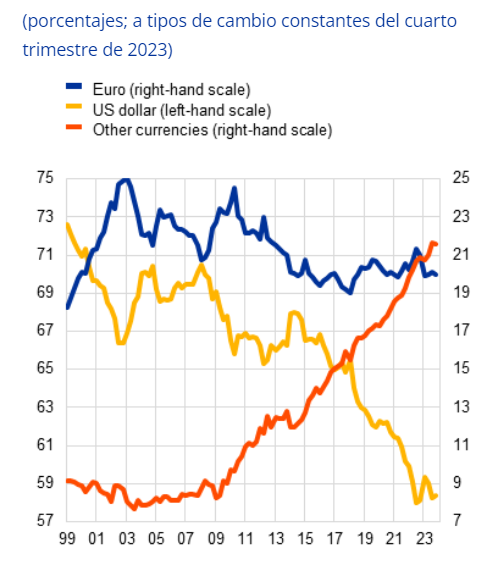
According to the report, the share of the euro in global foreign exchange reserves had a fall It is estimated at about 20%since 2020, falling by more than one percentage point during 2023.
ECB staff estimates suggest that, after accounting for valuation effects, official reserve managers were net sellers of euro reserve assets, to the tune of around €100 billion.
ECB report.
According to the report, although the position of the European currency has remained practically stable in the last year (maintaining its second place behind the dollar), the most recent survey data reveal that the decline in reserves is due to a relative decline in the attractiveness of the euro.
This fact is related to an increase in the purchase of gold and other currencies considered non-traditional, which now have more space in world reserves. A race where the Chinese yuan is the one that has won preference, leaving behind the Japanese yen, the Australian dollar and the Canadian dollar that are now integrated into the group of reserve currencies.

In that sense, the ECB data coincides with the statistics managed by the International Monetary Fund (IMF) in its most recent report. The international organization also recognizes that the inclusion of new currencies, as part of the reserves, has been causing a “slow erosion” of the role of the dollar internationally. This, despite the fact that the US currency retains its dominance.
As CriptoNoticias has reported, this entire de-dollarization process (and now deeurization) has been the result of a reconfiguration of the world economic order. It is largely influenced by the policy of imposing sanctions implemented by the US and its allies since 2022, after the outbreak of the war between Russia and Ukraine.
In the particular case of the euro, the ECB also attributes the loss of interest in the European currency as a reserve, to the application of higher interest rates in the EU.
This is a policy that, as happened in the United States, was implemented as a “solution” to the inflationary crisis that broke out as a result of the printing of inorganic money. Practice incurred in the midst of the Covid pandemic.
“Higher interest rates in the euro area did not translate into a stronger role for the euro as a reserve currency,” the report notes. This shows how economic risks have become an increasingly important consideration. for official reserve management decisions around the world.
However, it is geopolitical reconfigurationwhich emerged as a reaction to the sanctions imposed by the West on Russia, the one that has had a more predominant role in the loss of interest in the euro and the dollar.
According to the latest HSBC survey of 91 central banks in April 2024, representing 65% of global foreign exchange reserves, “geopolitical escalation” is the most important risk affecting the management of reserve portfolios, in particular decisions on investment location, counterparties and currencies.
ECB Report.
China’s yuan is gaining the most strength
According to the data managed by the ECB, the role that China is playing in the new geopolitical dynamics It is fundamental in the actions implemented worldwide to move away from the two dominant fiat currencies.
The Asian country stands out as the main promoter of global de-dollarization. Together with Russia and the rest of the BRICS countries, China is making more and more efforts because their local currency is used in international trade.
The work is giving good results, and this is recognized by the ECB. He cites as an argument a study by the Official Monetary and Financial Institutions Forum (OMFIF).
The research estimated that 40% of central banks plan to increase their renminbi holdings in the next ten years. They pointed to “diversification” and “China’s growing role in the global economy” as the main reasons for increasing their exposure to the yuan.
“The renminbi is now the third most important currency in global trade financing, with a share of 5%, after the US dollar and the euro,” notes the ECB.
Consequently, a gradual increase in the role of the yuan in international trade turnover is expected will lead to more diversified monetary patternsat least in some regions.
In addition to China, the ECB mentions the role of Russia and its multiple initiatives to dedollarize and deeurize your foreign trade. A measure that has allowed it to increase the use of national currencies in trade with other economies, mainly China.
And although they comment that the Eurasian country’s efforts to impose the ruble have not been as successful as those of China, they recognize that they have made progress in their goal of moving away from the dollar, even preparing the ground for the integration of central bank digital currencies (CBDC) into the international trade payment system.