

Bitcoin ETF reborn from ashes
Bitcoin (ETF) quoted funds (BTC) in cash in the United States, after weeks of weak capital flows, have registered a significant rebound.
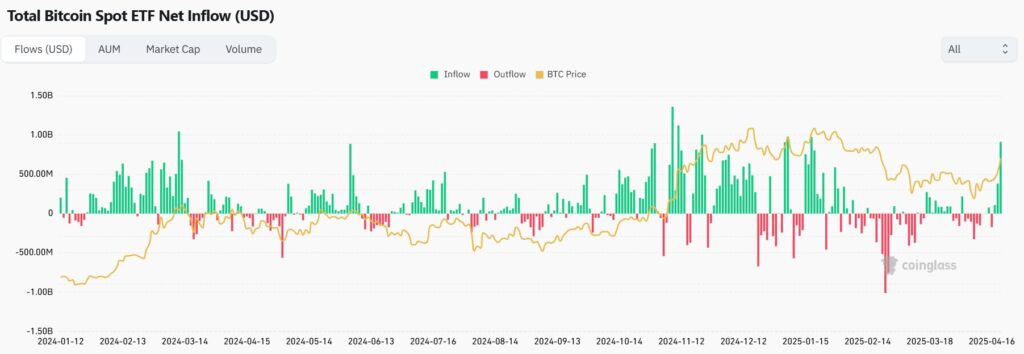
So far this week, These financial instruments have captured 1.2 billion dollars, marking the largest capital entrance since January.
This movement not only revitalizes interest in ETFs, but also promotes the price of the underlying asset, Bitcoin, in a context of global economic uncertainty.
A rebound led by investment giants
Yesterday, The Bitcoin ETF in cash attracted 912 million dollars, the third largest capital entry so far from 2025 and the highest since January 21, as shown by Coinglass.
The ETF Ark 21shares Bitcoin ETF (ARKB), managed by Ark Invest, led the tickets with 267 million dollars. He was followed by Fidelity Wise Origin Bitcoin Fund (FBTC), with 253 million dollars, and the Bitcoin Trust (ibit) Ishares of Blackrock, which captured 193 million dollars.
These figures reflect the renewed confidence of investors in funds supported by Bitcoin.
On Monday of this week, The ETFs had already shown recovery signs, with tickets of 381 million dollars. In total, the 1.2 billion dollars recorded this week consolidate a change in trend after a period of capital exits.
The direct impact of the ETF on the price of Bitcoin
The performance of the ETFs in cash has an immediate effect on Bitcoin’s price.
These funds, being backed by the underlying asset, They require that managers acquire and maintain Bitcoin in their treasury to support the actions issued. This process generates a direct demand in the market, reducing the available Bitcoin offer and, consequently, pressing its price.
In the last 24 hours, Bitcoin has registered a 5%increase, reaching $ 94,000. In the last seven days, its value has grown by 12%, consolidating an upward trend.
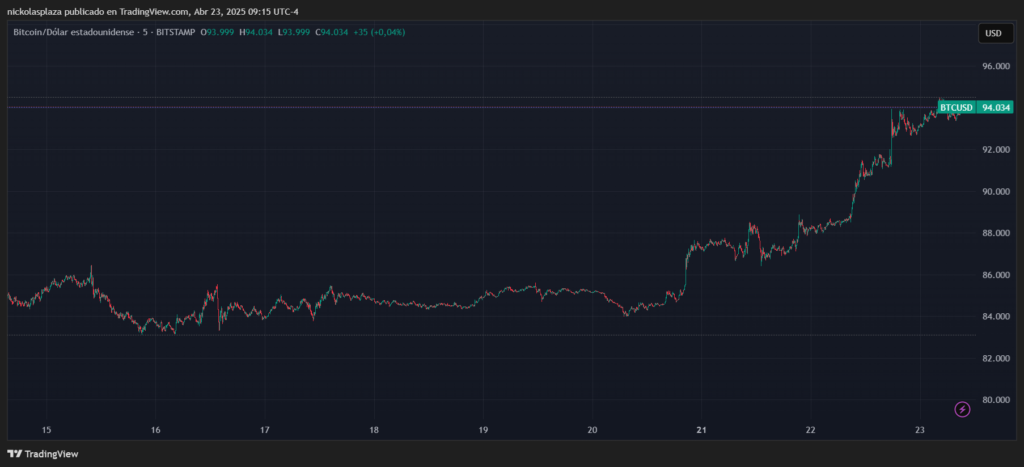
This impulse has been linked to the renewed interest in ETFs and external factors that have influenced the perception of investors.
Political and economic influences
The rebound in the ETFs and the price of Bitcoin occurs in a context of commercial tensions.
United States president Donald Trump announced that Tariffs to Chinese products “will be reduced substantially, but they will not be zero”.
This comment follows the implementation, on April 2, of a regime of reciprocal tariffs to imports from almost 60 countries, which was later suspended for 90 days, except China. American tariffs reached up to 145% on Chinese exports, while Beijing responded with 125% leviesas reported by cryptootics.
Although the initial announcement of the tariffs pressed Bitcoin, which came to quote at $ 74,000, The currency has demonstrated resilience.
In an environment where traditional markets face uncertainty, Bitcoin emerges as an asset of interest, breaking its historical correlation with Nasdaq, an index composed of technology companies such as Apple, Microsoft and Tesla.
Bitcoin, a shelter against volatility
Investors, tired of the volatility of traditional assets and monetary policies of the Federal Reserve, are exploring less dependent options for corporate or macroeconomic dynamics.
Bitcoin, with its limited supply and its decentralized mining, shares characteristics with gold, What positions it as a possible refuge asset.
In addition, the possibility of a more favorable regulatory environment and political support for cryptocurrencies in the United States have fueled expectations.
A key factor is the inclusion of Bitcoin in the United States Strategic Reserve, a movement that gives greater legitimacy to the asset. This context promotes the narrative that Bitcoin could be consolidated as an alternative to financial uncertainty and global political uncertainty.


