Bitcoin suffered an hour stagnation between block and block
-
It was an unusual event, because in Bitcoin the blocks are processed, on average every 10 minutes.
-
Mining is a probabilistic process, and processing times can vary.
The Bitcoin network experienced a rare “interruption”: on July 15, for about an hour, No new blocks were processed with new transactions.
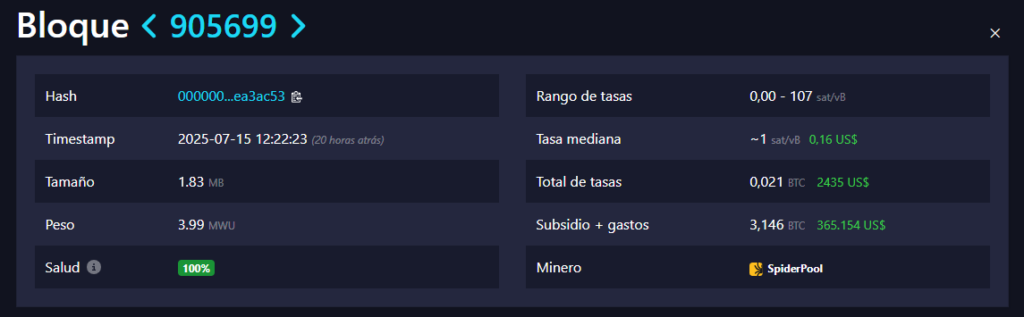
Block explorer data indicate that at 12:22 (Mempool.Space) of that day, Spiderpool Minó the 905699 block, as seen in the following image:

The following block, the 905700, found by F2pool, another mining pool, It was not processed until 13:16 (schedule reflected by Mempool.space), leaving an interval of 54 minutes Among the blocks.
The reason behind care for almost an hour is not clear. However, these delays usually obey adjustments in the difficulty of mining. This difficulty suffered an adjustment recently, on July 12, as Cryptonoths reported.
Bitcoin mining is a probabilistic process that follows a distribution of Poisson, a mathematical model that describes the occurrence of random events in time intervals, such as the creation of blocks.
Although the bitcoin protocol is designed to generate a block every 10 minutes on average, Times between blocks varyoscillating commonly between 1 and 20 minutes. A 54 -minute delay, such as the one observed, is statistically rare, but possible due to the random inherent in the process, where to solve the mathematical problem of a block can take more time.
Another factor that could have influenced this prolonged pause was The remarkable increase in Bitcoin’s hash.which went from 900 eh/s (exahasos per second) to more than 1 zh/s (Zettahash per second), while the difficulty of mining remained fixed in 126 billion since July 12.
This abrupt increase, due to the incorporation of new equipment or the reinstatement of miners, could generate a Temporary destabilization on the networkdelaying the propagation of the spiderpool mining block.
Although the difficulty adjusts every 2016 blocks to stabilize the times, its lack of immediate update against the increase of the hashrate could contribute to the anomaly. These prolonged pauses are not common, but they are part of the probabilistic nature of Bitcoin mining and They do not represent structural failures in the protocol.