Bolivia faces challenges and barriers to Bitcoin legalization
The historic decision of the Central Bank of Bolivia (BCB) to legalize the bitcoin (BTC) ecosystem and the rest of the cryptocurrencies will face a challenge that will be difficult to overcome: the lack of financial inclusion of the population.
This was made clear by the macroeconomist of the Institute of International Finance (IIF), Jonathan Fortunwho stressed that the measure is “innovative” and “potentially beneficial in the long term”, although he warned of its limits in a society with deficiencies such as Bolivia’s.
“In a country where a large part of the population does not have access to traditional financial services, expecting cryptocurrencies to solve complex macroeconomic problems is unrealistic.”
Jonathan Fortun, macroeconomist at the Institute of International Finance (IIF).
The macroeconomist told Bloomberg that the adoption of these technologies “requires time and a significant cultural change,” but that this task becomes more difficult when there is a low penetration of financial services in society.
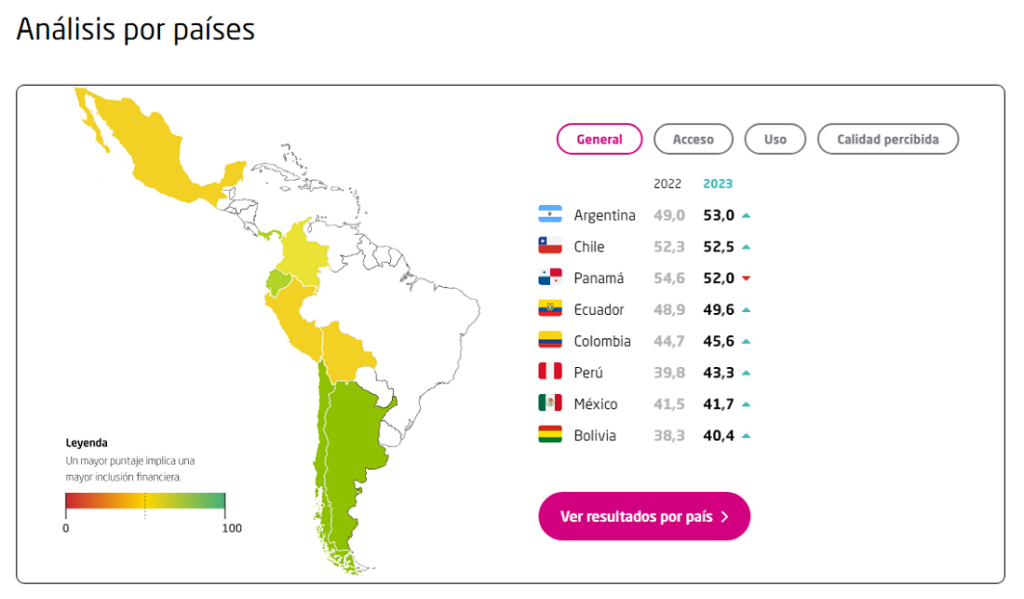
He Credicorp Financial Inclusion Index 2023prepared in conjunction with the consulting firm Ipsos, found that two out of five citizens in Bolivia have a low level of financial inclusion. According to this analysis, Bolivia is ranked the last place on the payrollwith a score of 40.4, compared to seven other countries in the region.
More striking is the use of financial services. In this dimension, the regional study by Credicorp showed that Bolivia reaches 20.5 points in this indicator, which reflects that 73% of the people surveyed “do not use”Formal means of making transfers«This point is a clear impediment to operating with digital assets.
However, one aspect derived from financial inclusion that deepens the problem is the technological deficit that society is experiencing.
“The technological infrastructure necessary to operate with cryptocurrencies, such as access to the internet and advanced mobile devices, not widely available. This significantly reduces the ability of cryptocurrencies to influence the local economy in the short term,” said the analyst from the Institute of International Finance (IIF).

Bolivia has significant infrastructure deficiencies in large areas of the country, including rural areas. Hundreds of communities depend on agrarian and subsistence peasant economies, which lack these types of resources.
According to data from the Telecommunications and Transport Regulation and Oversight Authority (ATT)91% of the population had access to the Internet via a cell phone as of December 2023, while only 56% had fixed Internet at home.
This reality of wide “digital gaps” is shared with other countries in the region with a peasant matrix.
“This urban/rural gap is greatest in Peru and Bolivia, two countries with huge variations in topography, underscoring the fact that adverse geography significantly increases the cost of connectivity,” explains a World Bank report.
Furthermore, another fact about the reality of Bolivia is that the low incomeswhich raises a barrier to access to the use of cryptocurrencies. According to Statista, in 2022, Bolivia was ranked 29th out of 33 countries analyzed, with a GDP per capita of $3,600.12.

As CriptoNoticias reported, the Bolivian central bank announced on June 26 the lifting of restrictions on the free trading of crypto assets in the country. This was resolved in a context of social protests against restrictions on access to dollars.
In this way, the use of Electronic Payment Channels and Instruments for the purchase and sale of BTC and other digital assets was enabled. Previously, Bolivians could only acquire cryptocurrencies in exchanges and global platforms.
The measure responded to the recommendations of the Financial Action Task Force of Latin America (GAFILAT)which requested that the Bolivian authorities proceed with the regulation of the activity.
For analysts, the only thing left to do is to move forward with new regulatory standards that clarify how the ecosystem works.
“Without a solid and clear legal framework, it is difficult for cryptocurrencies to be adopted massively in a safe and efficient manner. The lack of regulations on consumer protection, fraud prevention and transaction security limits their potential impact,” said Jonathan Fortun.