Cervical insufficiency or cervix, what is it?
Cervical insufficiency is the inability of the cervix to stay closed during pregnancy, which can cause premature birth. Its treatment includes cerclage or progesterone to prevent complications.

Doctor specialized in gynecology and obstetrics. With more than two decades of experience in the profession, she is an expert in 20-week ultrasound, prenatal diagnosis, childbirth, surgical hysteroscopy and laparoscopy, among others. He combines his work in different centers with teaching and writing articles.
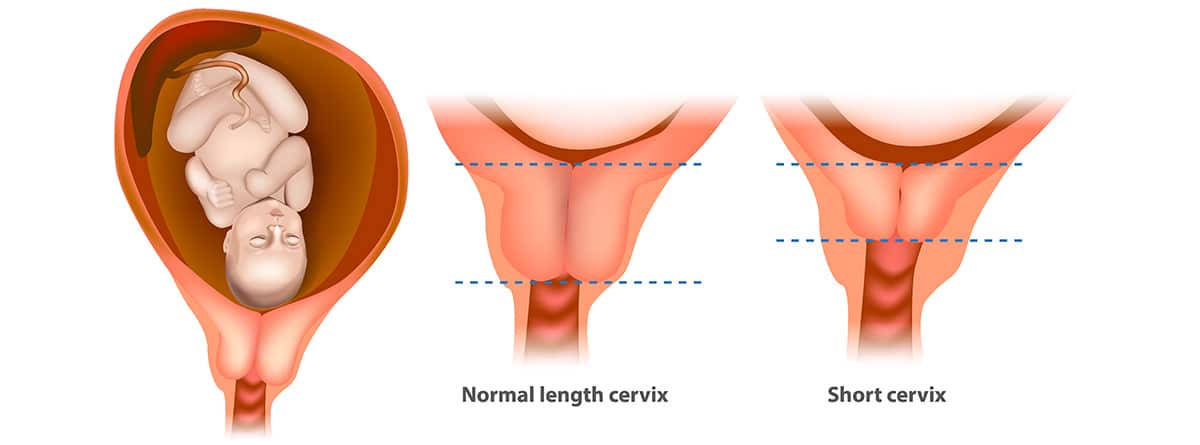
We apply this term to cervix unable to remain closed until pregnancy reaches termdilating prematurely in the absence of uterine contractions. Currently, it is preferred to use the term “insufficiency” over “incompetence” due to the negative connotations that the latter implies.
It can affect approximately 1% of pregnancies.but if there is a previous history it can repeat in subsequent pregnancies in 25%. It is the cause of 8% of premature births and 10-25% of pregnancy losses. second trimester.
What is the cervix?
The cervix is an anatomical structure in the lower part of the uterine body, whose function is retain the fetus inside until deliveryduring which it undergoes a series of modifications in its length and dilation, allowing the fetus to emerge outside, and recover its initial characteristics later. Under normal conditions it measures between 30 and 50 mm during pregnancy. The measurement of uterine length is used as a predictor of the risk of premature birth, and is considered short below 25mm before week 28, less than 20 between 28 and 32, and less than 15 after 32. In any case, neck length is simply a risk factor, but it is not considered diagnostic, since only a low percentage of pregnant women with a short cervix will give birth prematurely.
Its composition is mostly fibrous tissue, only 10% are muscle fibers.
This tissue may have alterations in its structure:
- Intrinsicthat is, due to its own constitution, due to congenital anomalies or genetic mutations that cause alterations in the collagen or elastic fibers of the individual.
- Acquiredthat is, it was originally normally constituted, but due to surgical processes or trauma in previous births it has been definitively damaged.
Symptoms and prognosis
Pregnant women who have cervical insufficiency have shortening and dilation of the cervix without contractionsin some cases they describe the sensation of pelvic or suprapubic pressure or changes in the characteristics of vaginal discharge or an increase in its amount, but most cases are asymptomatic and they are diagnosed ultrasonographically, confirming their shortening or narrowing, or by vaginal examination, confirming their dilation.
If you have recognized some of these symptoms, remember that at MAPFRE Health Insurance you will find great specialists who will help you find the most appropriate treatment.
CALCULATE YOUR PRICE
How is it treated?
Once diagnosed, in a pregnant between 12 and 24 weekss you can perform a procedure called cervical cerclagewhich consists of suturing the entire contour of the cervix, with a permanent material, so that the cervix remains ringed, which will be removed when the pregnancy has reached term or when the pregnant woman goes into labor. It’s a effective procedure, but invasive and with a certain rate of complicationsso each case must be individualized.
Cerclage can be indicated in three contexts:
- Preventively: in women who have a history of second trimester pregnancy losses, premature births or a history of complex surgeries on the cervix that have had consequences in previous pregnancies (we are not talking about cervical conizations, which are the most common surgeries in this area, as they usually do not substantially damage its structure).
- therapeutically: in patients with a history of premature birth or second trimester fetal loss who have undergone neck length monitoring and have been found to have shortened ultrasound.
- urgently: in a pregnant woman who is already dilated.
Pregnant women with suspected cervical insufficiency but who do not meet the requirements for uterine cerclage may benefit from treatment with progesterone, which is administered in daily vaginal beads. to prevent preterm birth and is also effective.
There is also a silicone device, called pessarywhich is shaped like a ring and would be placed around the cervix to perform the same function as a cerclage, but greatly simplifying the placement procedure and minimizing complications, but according to the results published to date there is not enough evidence to indicate it as an alternative to a conventional cerclage.
Prevention
Despite everything, there is consensus in Scientific Societies that there is not enough scientific evidence to support systematic screening of the entire population, so Routine cervical length measurement is not recommended. to asymptomatic pregnant women without risk factors.
In conclusion, cervical insufficiency represents a relevant clinical challenge due to its association with premature birth and its perinatal consequences. Although its incidence is relatively low, its impact is significant, especially in women with an adverse obstetric history. Identification of at-risk patients and their control allows for better selection of patients likely to benefit from interventions such as cervical cerclage or vaginal progesterone.
What you should know…
- Cervical insufficiency is the inability of the cervix to remain closed, which can cause premature births or losses of the second trimester, and its diagnosis is usually ultrasound or vaginal examination.
- The main treatment is cervical cerclage, applied preventively, therapeutically or urgently, complemented in some cases with progesterone or a pessary according to the needs of the pregnant woman.
- Systematic screening is not recommended for all pregnant women; The identification and monitoring of at-risk patients is key to preventing perinatal complications.