
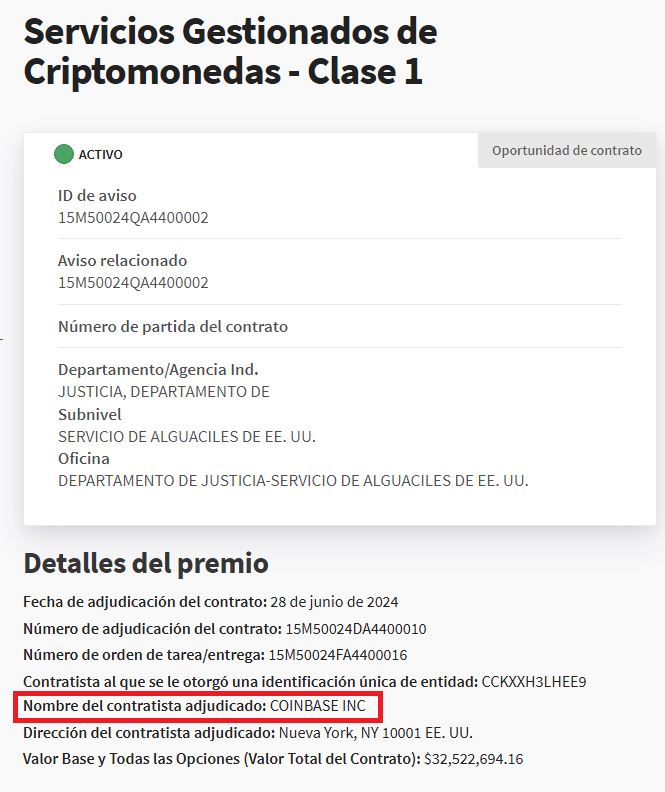
Coinbase is now the custodian of bitcoins confiscated by the United States
The largest bitcoin (BTC) and cryptocurrency exchange in the United States, Coinbase, officially became the entity in charge of safeguarding the BTC that is confiscated by that country.
The U.S. Marshals Service (USMS) reported that, after a period of evaluations, they chose this exchange house as the company in charge of “safeguarding and marketing” the digital asset portfolio that are in the “large cap” range.
The Marshals are a division of the United States Department of Justice tasked with asset forfeiture. They are also federal agents known for pursuing fugitives, protecting federal courts, and guarding federal prisoners.
This entity is known for having under guard Several thousand bitcoins that have been confiscated over the yearsIn fact, the agency has been responsible for putting thousands of units of this digital asset up for sale, seized in various federal, criminal, civil and administrative cases.
The USMS selected the Coinbase Prime service to “provide custody and advanced trading services for the agency’s ‘Class 1’ digital assets,” which centrally manages seized funds, assets and property “in support of federal law enforcement.”
“The USMS conducted a competitive due diligence process that evaluated a range of solutions, ultimately choosing Coinbase due to our strong track record and ability to securely provide institutional-grade cryptocurrency services at scale,” the largest U.S. exchange argues.
It is not the first time that renowned institutions choose Coinbase to safeguard their BTC and cryptocurrenciesSpecifically, its Prime service, launched almost three years ago, has served as a priority platform for institutions and large cryptoasset holders.
This service is, in fact, responsible for safeguarding most of the BTC acquired by approved exchange-traded funds and currently trading on the US stock market.
According to Coinbase’s own count, as of March 31, 2024, the exchange Custody over USD 330 billion in digital assetsAdditionally, they recorded USD 256 billion in institutional trading volume during the first quarter of 2024.
The choice of this exchange by this state agency is contrary to the position that other federal offices in the United States have maintained, such as the Securities and Exchange Commission (SEC), which has been trying to take this exchange to court for several years.
However, since 2014, that exchange launched a law enforcement program and, today, the company “works with all major U.S. federal, state and local law enforcement agencies, as well as international agencies on all continents,” according to them.

