Debt will rise in next 10 years, US warns
The United States will not be able to escape debt, not at least for the next 10 years, as it is expected to increase to almost $57 billion by 2034, according to estimates from the Congressional Budget Office (CBO). of the North American country.
In a report published this week, the US Legislative Branch indicates that the debt will increase steadily from this year and for the next decade, to the extent that increases in interest rates and mandatory spending exceed the reductions in discretionary spending and income.
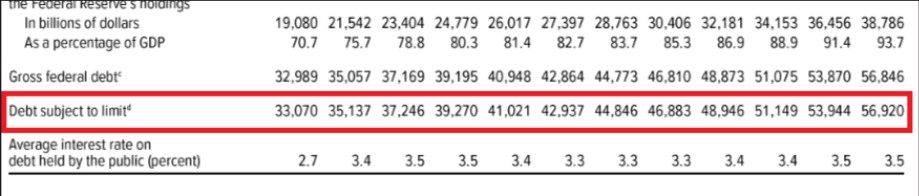
Speaking in figures, the amount of federal debt subject to the global limit established by law will increase from the current USD 35,137 million to USD 56,920 million, according to CBO projections.
The agency points out that currently the legal limit for the issuance of new federal debt is suspended until January 1, 2025. Therefore, if Congress does not determine a new limit before the suspension ends, the amount of debt accumulated during the suspension will be added to the previous debt limit of $31.4 trillion.
The projections of the growth of the US debt coincide with the alarms raised by the former president of the Lower House of Congress, Paul Ryan. For this politician, A debt crisis is foreseeable in the US in the short term.
As reported by CriptoNoticias, Ryan noted that there is a growing risk that the government will experience a failed debt auction before long. Something that “would agitate the markets and seriously undermine the credibility of the United States” on the international level.
Ryan, however, spoke of a possible solution to this coming crisis. Stable cryptocurrencies with 1:1 parity to the US dollar. Among them, USD Tether (USDT) and USD Coin (USDC) stand out.
For the former congressman, these cryptoassets can guarantee continued and significant demand for US debt. At the same time, they can stop the de-dollarization that is brewing in the world’s economies. And, in turn, be a promotional tool for the greenback.
American economy in crisis
On the other hand, the CBO predicted that the federal budget deficit in the current fiscal year is 1.9 trillion dollars. And it is expected that in 2034, the amount will rise to USD 2.8 trillion.
In that sense, the organization warns, “deficits are equivalent to 7% of GDP in 2024 and 6.5% of GDP in 2025.” And if that were not enough, they project that the adjusted deficit will be equivalent to 6.9% of GDP. “Significantly more than the 3.7% that deficits have averaged over the last 50 years,” warns the CBO.
The legislative body also indicated in its report that They project a 2% slowdown in economic growth of the country for this year. All in the midst of “a higher unemployment rate and slightly lower inflation.”
According to CBO projections, inflation, as measured by the personal consumption expenditures (PCE) price index, will be less than 2.7% in 2024meeting the Federal Reserve (Fed) goals of 2% by 2026.
For this reason, the CBO expects the Fed to respond to low inflation “by reducing interest rates starting in early 2025.” What will allow meet projections of stable economic growth of 2% for next year, “before settling at approximately 1.8 percent in 2026 and subsequent years.”
What the CBO estimates for the US economy has already been noted. The Nobel Prize winner in economics, Paul Krugman, assured a few weeks ago that the US government should stop focusing on keeping inflation low and start worrying about a plausible economic recession, as a result of high interest rates.
As CriptoNoticias reported, Krugman asserted that inflation in the US is at controlled levels and close to the Federal Reserve’s objectives. But the cost of that stability is interest rates, which have not changed in more than a year. and which currently remain above 5% annually.
Krugman indicates that, if interest rates do not fall or remain the same, US economy could begin to erode. “So I think the Fed should cut interest rates, and soon,” said the award-winning economist.