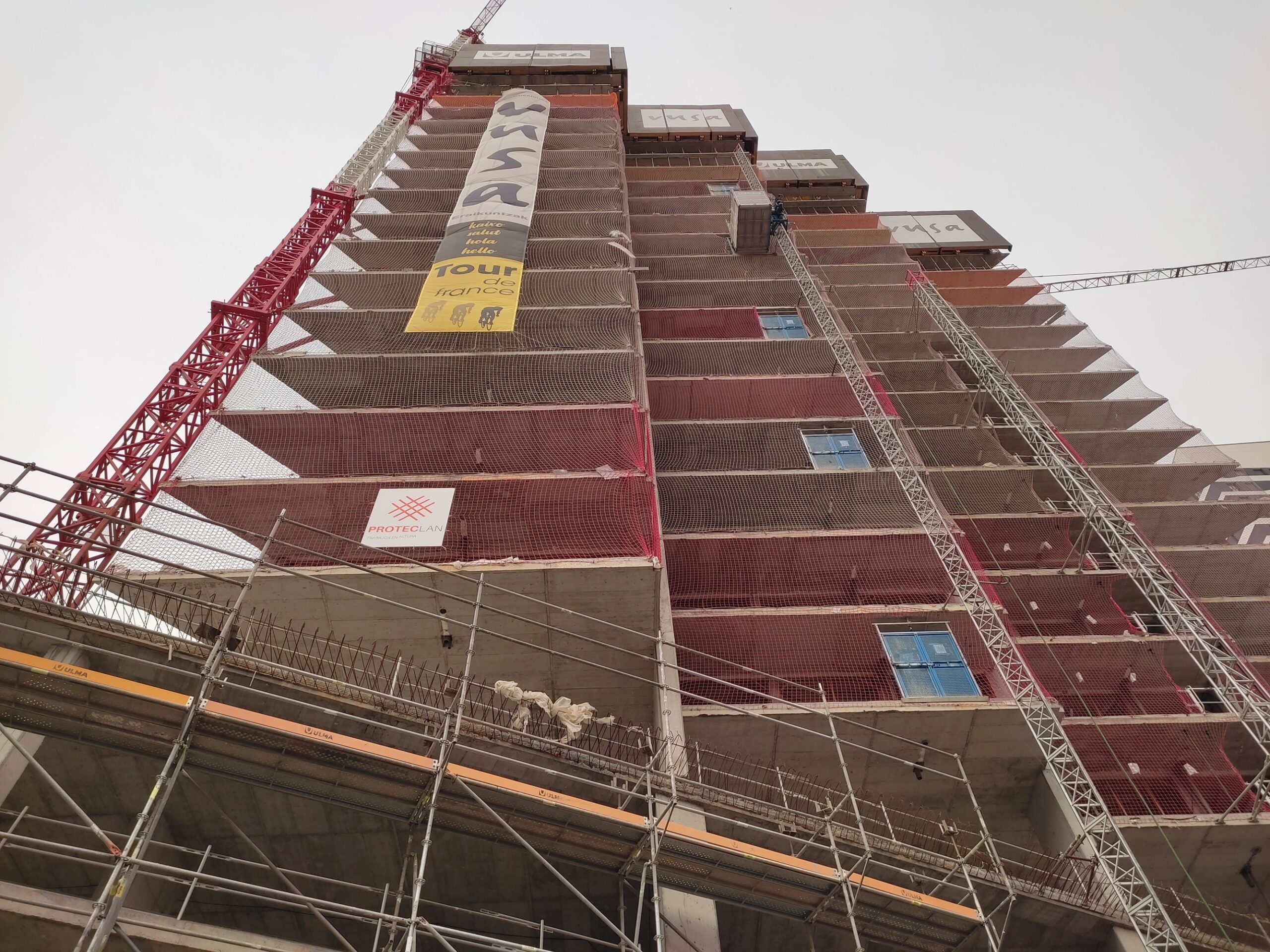
Developers and banks point out that the “poor regulation” of land hinders housing construction and ask to reform the law
The solution to the housing problem is to build more apartments and, for this, the raw material is land. That is the conclusion reached by different representatives of the banking and real estate sector in a conference organized this Monday by Funcas to analyze the situation of the real estate market and housing policies. As a first step to tackle the problem, they demand to resume the reform of the land law, which ran aground again a few weeks ago in Congress when the PSOE withdrew the bill presented by the Government just a few hours before the text was to be voted on. , by not having sufficient support assured.
The Bank of Spain estimates that by 2025 a deficit of 600,000 homes will accumulate in order to accommodate new households. The supply and demand for apartments have grown at different speeds in recent years, giving rise to an imbalance that has pushed prices up. “Why has supply reacted more slowly than demand? One of the elements may be the lack of land”pointed out the general director of Economy and Statistics of the Bank of Spain, Ángel Gavilán, who was in charge of presenting the event, together with the general director of Funcas, Carlos Ocaña.
“The main bottleneck is insufficient supply, any solution involves building more”, stated Ocaña, while acknowledging that the creation of new properties “takes time” and that there are no “magic solutions.” The general director of Funcas has called for “realistic” solutions and has given the modification of the land law as an example. “Poor land regulation can be fixed without spending a lot of money. It is almost free, it only requires the will of the legislator,” he said.

This boost to supply through the expansion of the land available for construction has focused much of the debate in the subsequent round table, in which the director of Strategic Planning and Studies and Economics of Caixabank, Enric Fernández, participated; the general secretary of the Association of Construction Developers of Spain (APCE), Beatriz Toribio; the general director of the Group of Cement Manufacturers of Spain (Oficemen), Aniceto Zaragoza, and the economic situation director of Funcas, Raymond Torres.
Toribio recalled that in Spain around 90,000 homes are built every year, a figure that is insufficient to cover demand and very far from the more than 600,000 that were built before the burst of the real estate bubble. “The main problem is the lack of land,” he explained, urging this bottleneck to be solved. “It makes no sense that it takes 20 years to develop urban projects,” he reproached the different administrations, adding that legal uncertainty deters investors. For all this, Toribio has stated that Land law reform is “crucial.”
“We need a legal framework that will lead us to have more land to build on,” Fernández agreed. The head of Caixabank has stated that the text withdrawn by the Government was “in the right direction” and has said he trusts that the regulatory change will be implemented “as soon as possible”, at the same time that he has demanded to address housing as “a policy of State”. “It is a topic that requires broad consensus among the main political parties and between all levels of Administration. “That will offer a sufficiently stable framework to attract the investment we need,” she said.

“There really is an abundance of land. Spain is one of the least dense countries in Europe and the price of urban land has stagnated for ten years even in cities like Madrid or Barcelona,” said the director of economic situation at Funcas, who has clarified that “The problem is not in the availability of land, but in the fact that it is not developed” due to the lack of legal certainty. Zaragoza has also agreed on the need to reform the land law, although it has warned that “we have a problem for a while.” “This is not going to end with a law,” he said, asking to go further.
More labor and rent
The lack of land suitable for starting construction is not the only problem that threatens the real estate market, also hampered by the lack of labor and the concentration of supply in sales, according to experts. “The new construction that is developed is mostly free housing ownedwhen the problem is above all on the rental side,” Torres pointed out. “We have to develop the rental market but without forgetting the sale, because property is a source of savings and has protected many families,” Toribio clarified.
Regarding the need for manpower, the general secretary of APCE has warned that The difficulty in filling vacancies is a “pressing problem” due to the lack of generational change, given that those under 25 years of age represent less than 10% of the total workers in the construction sector. Given this imbalance, Torres has stressed the need to bring the existing workforce closer to the profiles demanded by the market, pointing out that Spain has 129,000 unemployed people from the ‘brick’ sector and 250,000 unemployed young people with secondary or professional training who could turn towards this type of activities.
Finally, the director of the financial and digitalization area of Funcas, Santiago Carbó, has concluded that, despite there being a consensus on the magnitude of the housing problem, its resolution presents considerable “difficulty.” “There are many legs that must be touched,” he summarized, calling for caution when adopting short-term solutions. “We need housing. If not, we can strangle the very growth process of the Spanish economy”he has warned.