Does the world move away from the dollar or do you cling more to it?
-
China drives Yuan and explores BTC to avoid sanctions.
-
For the US Treasury, the stablecoins backed in bonds strengthen the dollar.
From the Bretton Woods agreements, signed in 1944 with the aim of establishing a new financial order that would avoid recurring crises, the US dollar assumed a dominant role. The other coins began to link to him, and the green ticket, backed by his direct convertibility into gold, became the world reference. However, almost 81 years later, that panorama seems to be changing: clear signs of a global tendency towards defolarization are already perceived.
The expansive use of Yuan in international trade is a sign that should not be underestimated. In March 2024, more than half of China’s cross -border payments were settled in yuan, a figure that contrasts strongly with the low 1% registered in 2010. This growth reflects the effort of the Asian giant for internationalizing its currency, driven by bilateral agreements with countries such as Brazil and Argentina, and the decision of key commercial partners, such as Russia, to settle transactions in yuan They limited access to the dollar.
Yuan’s advance suggests that several countries are looking to reduce their dollar dependencewhich reflects a growing distrust in the green ticket as the only pillar of the international monetary system, especially in a context marked by the worrying level of indebtedness of the United States, which in 2024 exceeded the USD 34 billion.
The United States has benefited for decades of the role of the dollar as a world reserve currency, which has allowed him to borrow at low cost thanks to the high demand for treasure dollars and bonds. However, this advantage could weaken if such debt level continues to ascend and begins to undermine international confidence. In this scenario, investors could demand higher interest rates to compensate for the risk, which would make the financing of the fiscal deficit. In turn, A lower demand of the dollar would reduce the country’s capacity governed by Donald Trump to impose sanctions or apply monetary policies With a great impact worldwide.
One of the most influential voices that has warned about the risks of American indebtedness is Ray Dalio, who pointed out that the current level of systemic debt, combined with the recent geopolitical tensions, could be brewing A collapse of the global monetary order. This, according to him, would lead to the unilateral domain of the United States to come to an end.
In a similar line but from another perspective, Jack Mallers, CEO of Strike, argues that Donald Trump’s policies would deliberately weaken the dollar as a strategy to rebuild the country’s economy, although it warns that this approach could accelerate the adoption of alternatives with greater long -term potential. This is where Bitcoin and cryptoactives begin to collect relevance.
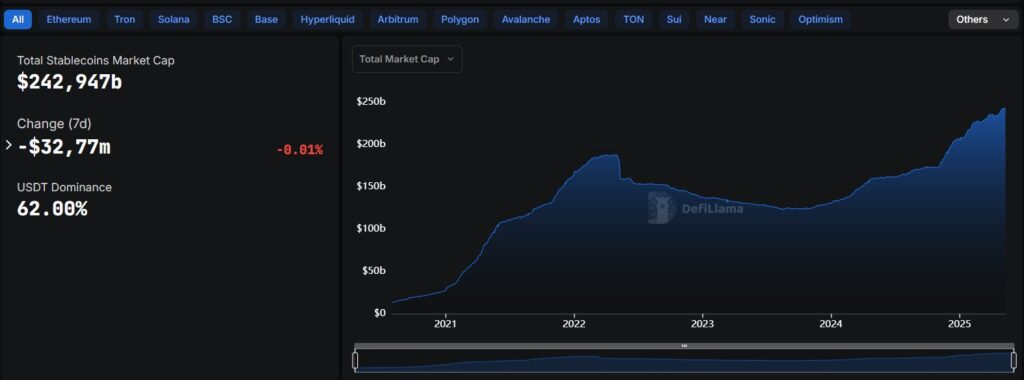
However, despite the signs of de -drainage, right now The dollar remains the centerpiece of the international financial system; That is, we talk about an asset that participates in around 88% of international transactions and maintains their status as the main reserve currency, representing more than 50% of global reserves. Even within the cryptocurrency ecosystem, the stablecoins backed by the dollar, such as Tether (USDT), continue to dominate the market, with a quota close to 62%, according to defillion data.
Trump’s tariffs and stablecoins
Although the dollar maintains its dominant role as a reserve currency and remains widely used in international transactions, The progress of dredolarization has generated a defensive response by the Donald Trump administration. In January, the president threatened to apply 100% tariffs to the BRICS block countries that drive alternative currencies to the dollar, in an attempt to stop the growth of proposals led by China and Russia.
An example that is worth highlighting is that of India, which, Despite its belonging to the BRICS block, it has adopted a more prudent position in the face of the defolarization process. In April, after a 90 -day pause in American tariffs, New Delhi and Washington resumed trade negotiations, in order to reach a new understanding and not establish additional rates to the Asian country. Vice President JD Vance and Prime Minister Narendra Modi presented the initial guidelines for a bilateral commercial agreement.
Although India’s pragmatic posture reflects the complexities of the defolarization process, the truth is that the American currency has found a new support in the digital ecosystem: the stablecoins. Paolo Ardoino, CEO of Tether, said that USDT is a great ally for the hegemony of the US dollar, and that The project has benefited millions of users in markets that lack access to banking services. Along the same lines, Jeremy Allaire, CEO of Circle, stressed that stable currencies backed by the dollar, such as USDC, are strengthening the domain of the dollar by integrating it into the global economy.
The integration of the dollar into the digital economy is not only rhetorical: Stablcoins are generating an impact to which attention must be paid. Today, Tether and Circle together have more than USD 130 billion invested in United States Treasury bonds. This strong demand helps that the US can finance its deficit with lower interest rates, so, instead of disdaining, This reflects a form of redolarization, especially in countries with unstable coinswhere millions of people use stablcoins like USDT to protect their savings.
For example, in Argentina, where inflation exceeded 200% in 2024, the stablecoins have become a solid alternative to weight, occupying a volume of transactions that exceeds 60% and that is well above the world average (44.7%). Far from giving in to the de -dearization driven by Yuan or the sanctions, The dollar is expanding its influence through cryptoactives.
At first glance, the world seems to be taking distance from the green ticket: the advance of the yuan, the diversification of reserves and doubts about the sustainability of US debt point in that direction. However, a more careful analysis reveals a complex dynamic. Although alternatives arise, many do not replace the US currency, but they incorporate it or reinforce it. The growth of stablcoins and their extended use in unstable economies reflect a digital redolarization that, far from weakening the hegemony of the American currency, actually renews it. More than getting away from the dollar, the world economy continues to revolve around it. We will have to see what happens in the next two decades, since the US financial strength is not at all the same as in the period after World War II.