
EigenLayer becomes the second most valuable DeFi on the market
Key facts:
-
An airdrop of the EIGEN token has boosted usage of the protocol.
-
David Duong, head of research at Coinbase, sees “hidden risks” in re-staking.
EigenLayer is a re-staking protocol for the Ethereum network. With accelerated growth so far this year, it has become the second most valuable platform in the world of decentralized finance (DeFi) worldwide.
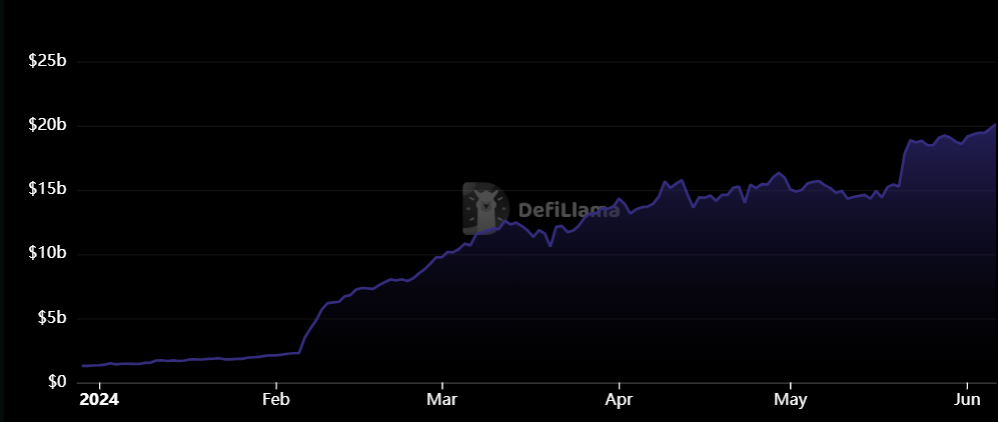
The total value locked (TVL) of the protocol at the beginning of May was $15 billion and currently it has reached 20,125 million dollars. This represents an increase of 33% in that period, according to data from DeFiLlama.
As you can see in the graph below, There was a spike in funds blocked in the protocol since May 20.
In this way, the protocol is placed behind the liquid staking pool, Lido, which has a TVL of $36 billion.
This is an example of the popularity that EigenLayer and its re-staking proposal have achieved, a modality that has become a growing trend in the Ethereum ecosystem and other cryptocurrencies.
Re-staking consists of give additional utility to the tokens delivered by liquid staking platforms (Lido, for example) as proof of deposit of ether (ETH), Ethereum cryptocurrency (or other cryptocurrencies).
In the case of EigenLayer, it allows users to maintain full control over the assets while participating in staking, using derived tokens such as stETH (Lido). This model offers investors the opportunity to maximize their profits and diversify their participation in the cryptocurrency ecosystem.
One way to obtain greater profits can be putting those tokens as collateral on a decentralized lending platform and use the money earned to re-stake Ethereum or other networks. EigenLayer facilitates the automatic execution of these types of strategies.
Among the advances that have increased the use of the protocol founded by Sreeram Kannan, former professor at the University of Washington, there are updates and even a airdrop.
Since last April, re-stakers (person or entities re-staking cryptocurrencies) who use EigenLayer can delegate their entire participation to an operator of their choice.
Operators can register with EigenLayer and choose to run Actively Validated Services (AVS). AVS are various types of decentralized services and applications that require additional security and active validation.
These AVS can register on the protocol, starting with EigenDA, a secure, high-performance and decentralized data availability service built on Ethereum, which is currently in beta, as reported by CriptoNoticias.
There is an active airdrop for early EigenLayer users
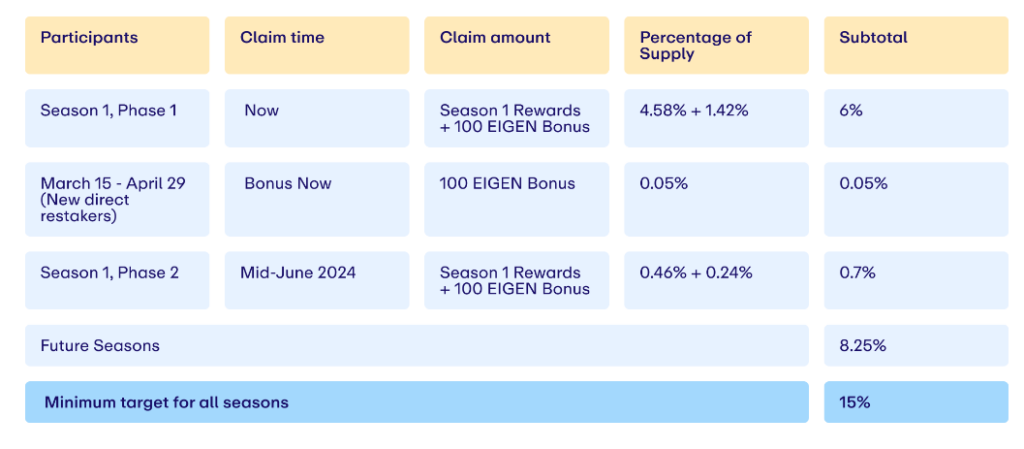
Most recently, the protocol airdropped its new native token EIGEN. Season 1, as they called the first stage of the airdrop, began with 6.05% of the initial supply (113 million EIGEN).
Access to the airdrop has been available since May 10. For its part, Phase 2 of Season 1 will increase that supply figure to 6.75% in mid-June. Total, 15% of the initial token supply has been reserved for the community throughout all seasonsas you can see in the following image.
The period established by EigenLayer to claim the airdrop is until September 7, 2024, the protocol said in a statement.
Among the users who can access the free token delivery are those who re-staked ether and liquid staking tokens (LST) before March 15. Your EIGEN allocation includes 100 bonus tokens.
EIGEN tokens are non-transferable and They can be unlocked for use once greater decentralization is achieved. Until transfer restrictions are lifted, there will be no EIGEN staking rewards for major contributors or investors, EigenLayer clarifies.
As pointed out by cryptopedia, the educational section of CriptoNoticias, airdrops are common in the cryptocurrency industry, since it is a way to promote projects, increase the activity and users of their networks, promote commerce and expand the monetary supply of their networks. digital economies.
Re-staking is also seen as a risk
Despite this growth, not everything is positive in Ethereum re-staking. David Duong, head of research at the American exchange Coinbase, recently referred to platforms that provide services like EigenLayer.
In his statements to the Reuters agency, he said that re-staking could carry “hidden risks”, if tokens are used again in staking related to cryptocurrency loans, because there could be forced liquidations and more volatility during market declines.
This is what the executive says, because if the value of the tokens suddenly falls below the loan maintenance threshold, the platform could liquidate the position, selling the tokens at a potentially low market price to recover its loan. This could result in significant losses for the investor, especially during drastic market declines..
A similar perspective has Adam Morgan McCarthy, research analyst at Kaiko. “When you have something that has warranty upon warranty it’s not ideal, it adds a new element of risk that wasn’t there.”


