“European cryptocurrency companies are not prepared to comply with MiCA”
The surveys are still underway, but the majority of the companies that have been interviewed so far say they have difficulties in adapting to the requirements established by the Regulation for the Cryptoasset Market (MiCA), which will come into force next December.
This is stated in a report published by the consulting firm Acuiti within the framework of an investigation into the impact of MiCA on the European cryptocurrency market. The information was obtained after the survey of executives from 68 companiesincluding exchanges, hedge funds and trading companies in the cryptocurrency market.
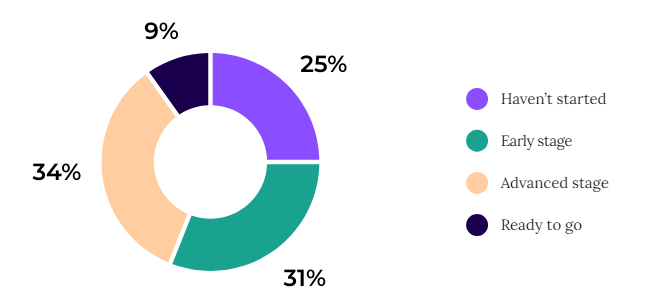
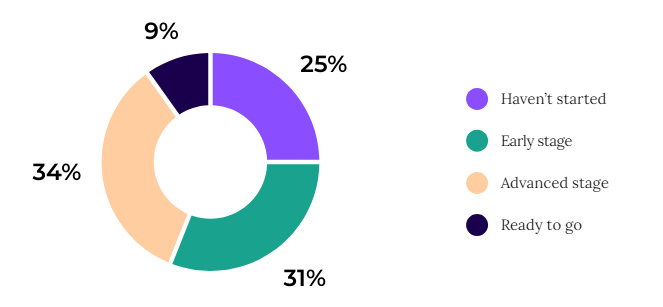
The data collected so far indicates that Only 9% of cryptocurrency platforms are ready to comply with regulations. A quarter of them say they are just in the preparation phase, a third believe they are advanced and more than 25% have done nothing.
This indicates the presence of a series of doubts in relation to compliance, specifically regarding the license that must be requested before the authorities.
It also cited a significant level of uncertainty among many companies trading in cryptocurrencies, which do not know whether or not they are subject to MiCA.
Many think that They do not have to comply with this law. These include: hedge funds, proprietary trading firms, and asset managers.
The definition of what financial instruments are is another difficulty, taking into account that these assets will not be regulated under MiCA and are subject to MiFID (Markets in Financial Instruments Directive).
What is clear at this point is that assets such as bitcoin (BTC) are regulated by MiFID II and fall outside the scope of MiCA. In that sense, it is expected – although not confirmed – that Cryptocurrency derivatives, such as ETFs, fall under this exemption.
Additionally, cryptocurrency companies face a number of concerns, as the competent authorities of the 27 countries that make up the eurozone are just beginning to move forward in the transposition of MiCA standards to their respective regulations.
Although the framework largely follows the same guidelines as MiFID II, there are still points of ambiguity and operational difficulties that firms are trying to resolve. Complications arise in the process as authorities adapt MiCA to local legislation.
Acuiti report on MiCA.
At this point, analysts draw attention to the fact that the products in the cryptoasset market are very different from those handled in the traditional financial market. Hence, dilemmas arise when applying the law.
There are problems in implementing surveillance systems
According to the results of the survey, for the majority of cryptocurrency companies it is the first time that they face a regulation of the dimensions of MiCA, especially due to the existing obligations of comply with strict KYC (know your customer) and market surveillance standards.
“A high percentage of respondents expect difficulties in adapting to the specific nuances of crypto surveillance,” the report notes, adding that this has become another obstacle for companies.
According to the executives interviewed, compliance with these requirements implies for many a strong investment in infrastructure and human resources. That is why the data collected indicates that 70% of companies still do not have systems for the market and user surveillance required by MiCA.
A group of companies admitted to having made security investments in the last three years and around 21% of respondents said they needed to invest in these systems to comply with MiCA. 58% said they would invest in systems in the next 12-18 months due to the mandatory nature of the law.
Acuti report on MiCA.
All this is happening at a time when EU supervisory bodies are constantly urging companies to define its regulatory status promptly and follow compliance measures. The calls increase as The deadline for implementing the regulations is approaching at the end of this year.
As CriptoNoticias has reported, the first part of the regulation came into force yesterday, establishing new rules for stablecoins. There are many expectations about how this regulation will affect the market.