fiat is a hallucination from which we can wake up with bitcoin
Yuval Noah Harari, author of at least two of the best-known popular books of the 21st century, is considered one of the most important intellectuals of our time. Thanks to the experience of selling forty-five million books in sixty-five languages, he knows how to participate in current public debates to stay relevant. And as he could not be otherwise, he recently dedicated a few words to bitcoin.
The first thing Harari does is take one of Bitcoin’s nuclear slogans to sharpen it and use it as a throwing weapon.
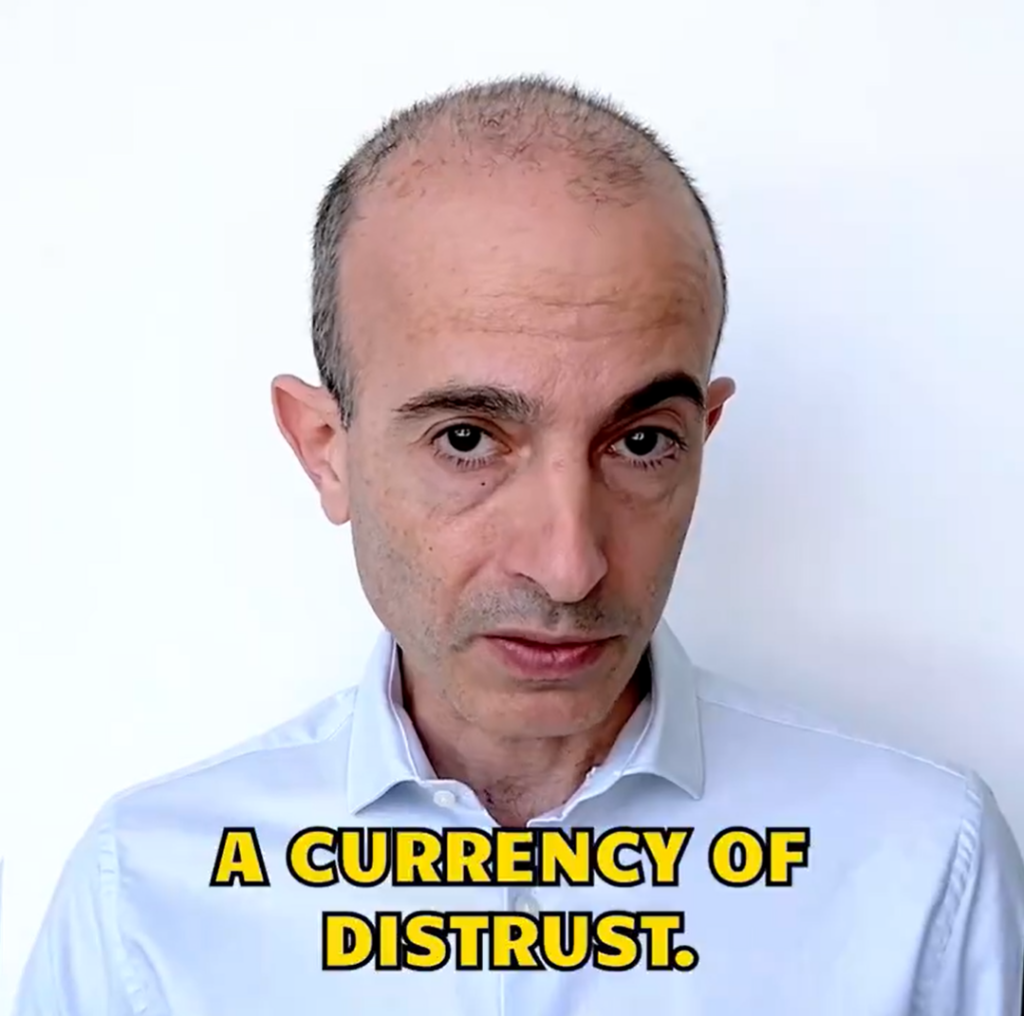
When I say that Bitcoin is a currency of distrust, I am just repeating what Bitcoin fans themselves say.
Yuval Noah Harari, Israeli historian and popularizer.
Let’s leave aside the fact that he uses the word “fans” to designate bitcoin users, linking them to religious believers and sports fans. Harari only states a half-truth when he says that bitcoin is a “currency of distrust.” I say half because reading about bitcoin I have never heard such a phrase.
In fact, in the literature on cryptocurrency there is an abundance of the expression “Bitcoin is Trustless”, whose more accurate translation would be that bitcoin is “trustless”. Adding up, Bitcoin is a currency without trust, not distrust.
The difference in terms is small, but important: Harari’s version portrays bitcoin as a reactive monetary system, forged with social reactivity and the moods of a skeptical teenager.
When we regenerate the phrase to its original state (Bitcoin is Trustless)what we say is that does not have or requires confidence to use it. Let’s go to something Harari hasn’t read: the bitcoin whitepaper.
What is needed is an electronic payment system based on cryptographic proof rather than trust, allowing two interested parties to transact directly with each other without the need for a trusted third party.
Satoshi Nakamoto, creator of Bitcoin.
Concept regenerated through, the cryptocurrency and its monetary system appear rather propositional, more like an alternative and valid paradigm to the establishment. And why not say it, better.
Bitcoin distrusts human institutions, and rightly so
Harari continues:
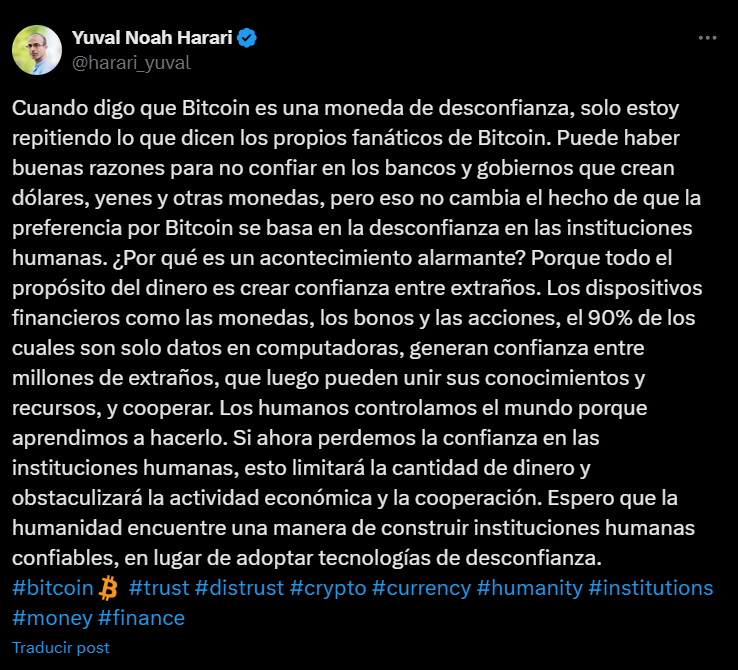
There may be good reasons not to trust the banks and governments that create dollars, yen, and other currencies, but that doesn’t change the fact that the preference for Bitcoin is based on distrust of human institutions.
Yuval Noah Harari, Israeli historian.
It seems that Harari believes that proclaiming the origin of bitcoin in human suspicion towards institutions should produce secret shame for bitcoin users. On the contrary, he seems not to believe that such an idea can be proclaimed with pride, and that The usefulness and necessity of an ethical technology do not depend on whether it has its origin in a positive or negative value, in fear or in hope. Less when it is a protocol that performs a specific function; of a technology that, even though human values participated in its invention, does not stop to evaluate issues outside of its closed programming logic.
Surely the usefulness and universal necessity of the watch would not depend on whether its creator designed it to defend the military camp against enemies by measuring the time of the night guards, or as an alarm clock and calculator to arrive early to work at the favorite traditional institution. . The watch is a precision instrument and performs without being aware of what it was created for. Like Bitcoin.
In his defense of tradition, the intellectual is even less correct when “human institutions”, in general, means “traditional institutions”, in particular. Is Bitcoin not a human system, or an institution? How can bitcoin not be human if it functions as a payment network that includes millions of real people?
In other words, is every proposition other than traditional institutions inhumane or “uninstituted,” and cannot offer something of public interest using a methodology other than the traditional one? Bitcoin was born as an alternative electronic payment system to fiat money, banks and its fractional reserve:
After each transaction, the coin must be returned to the mint to issue a new coin, and only coins issued directly from the mint are trusted not to be spent twice. The problem with this solution is that the fate of the entire monetary system depends on the company that runs the mint, and every transaction has to go through it, like a bank.
Satoshi Nakamoto, creator of Bitcoin.
Likewise, fiat was born, in the form of portable promises of payment in gold, against immovable tons of the metal. It was born a second time as centralized money, against Kublai Khan’s handfuls of rice, mulberry tree leaves and against barter.
All these money technologies were born at the very heart of civilization. Bitcoin is not a alien that comes from out of this world to break the institutions. In any case, he represents an evolution of them and comes to help them and improve the institutions, but demanding the sacrifice of his unlimited power.
Good money, like Bitcoin, is not based on trust
If we read between the lines, we will understand what Yuval Harari really wants to tell us:
Why is this an alarming development? [la preferencia por Bitcoin]. Because the purpose of money is to create trust between strangers. Financial devices like currencies, bonds, and stocks (90% of which are just data stored on computers) build trust among millions of strangers, who can then pool their knowledge and resources and cooperate.
Yuval Noah Harari, Israeli historian.
He wants to tell us, on the one hand, that he doesn’t understand what the money is about. The purpose of money is not to create trust, because trustworthy money is not trustworthy only by virtue of the human consensus that legitimizes it. The purpose of money is to exchange goods and services without the need for a coincidence of desires regarding the class or type of goods.
The trust that a form of money grants is consequence of the validity and strength of its properties. At least three of these independent properties of trust are: its ability to serve as a medium of exchange, to keep accounts, and to reserve value for the future.
Yuval Harari knows it: money is a concept and a human fiction. But here’s what’s really important and what you don’t know: it’s a concept and a fiction. trapped in a physical object that may (or may not) be subject to deterioration, disappearance, instability, error and death, like the genie when they destroy the lamp where he lives.
If the properties of money didn’t matter, what would stop us all at the same time from using cups and lemons as a unit of account and store of value? A more plausible theory of the purpose of money is that it depended on trust because no one had invented a technology trustless, or the means to do so did not exist. In this way, fiat money would not be due to human credibility, but rather to the natural slowness of the technological development of civilization.
Better the gentle lie of fiat than the thunderous truth of Bitcoin?
Harari wants to tell us, on the other hand, that cooperation based on the false creed of fiat and fantasies is worth more than producing new forms of organization, simply because that everyone already believes the fantasy. He thinks we would be better off believing falsehoods and not waking the sleeper, just so as not to fracture the passive (and obligatory) cooperation that exists between banks, the government and the people. Here the evidence:
If we now lose trust in human institutions, this will limit the amount of money and harm economic activity and cooperation. I hope humanity finds a way to build trustworthy human institutions, rather than adopting untrustworthy technologies.
Yuval Noah Harari, Israeli historian.
But the truth is that money is better off this way, without trust. Bitcoin frees people from having to invent and intervene in a monetary system every day to correct it if it goes astray.
At the same time, Bitcoin frees people from the moral burden of error; it relieves them ethically when it exempts them from making wrong decisions that will harm millions of people. Bitcoin is better money.
Disclaimer: The views and opinions expressed in this article belong to its author and do not necessarily reflect those of CriptoNoticias. The author’s opinion is for informational purposes and under no circumstances constitutes an investment recommendation or financial advice.