Fidelity launches interest-paying token
Key facts:
-
Tokenization is done on the Ethereum-based network developed by JP Morgan, Onyx.
-
Fidelity has experience tokenizing assets with Swiss bank Sygnum.
Fidelity International, an investment management company, has announced a new step in its foray into the tokenization of real-world assets (RWA) on cryptocurrency networks.
The company has tokenized shares of its money market fund (MMF). This is a type of instrument that invests in short-term assets of high credit quality, such as Treasury bills, government securities, time deposits in banks, commercial paper and repurchase agreements.
For this project, Fidelity has used the Ethereum-based network developed by JPMorgan, known as Onyx Digital Assetssaid company spokespersons.
Through this network, interest is paid to the fund’s investors, improving the efficiency and transparency of the process.
Investment bank JP Morgan acts as transfer agent, being responsible for recording the fund’s share transactions.
The tokenization process uses the Tokenized Collateral Network (TCN), a JPMorgan application that operates on the Onyx network. TCN acts as an intermediary between the investors who purchase the tokens and Fidelity Internationalwhich issues them.
The connection between the transfer agent and TCN allows token transactions to be recorded on both the fund’s traditional ledger and the Onyx blockchain.
When an investor purchases tokens from the fund, the transaction is instantly recorded in the TCN system, meaning the investor receives the tokens immediately, without needing to wait for the traditional transaction to be processed.
RWA refers to the tokenization or representation of real physical or financial assets in the form of tokens. The idea is to improve liquidity, transparency and efficiency in the transfer and management of these assets.
Real world assets may include real estate, works of art, vehicles, intellectual property rightsinvestments in private companies, commodities, financial contracts, among others, as CriptoNoticias has explained in several articles related to this growing industry.
“Tokenizing our money market fund shares for use as collateral is an important and natural first step in expanding our adoption of this technology,” said Stephen Whyman, head of debt capital markets at Fidelity International.
Whyman points out that the intention of tokenizing the fund is to reduce transaction costs and operational risk.
It is worth clarifying that, in order to operate with this token, you must be an accredited investor and meet the requirements established by Fidelity and stock market regulators, including going through a KYC (know your customer) process. It is not a token that anyone can acquire from a decentralized exchange or on the main cryptocurrency exchanges.
Fidelity delved into asset tokenization in March
Fidelity International, which manages investments for clients in Europe, Canada and Asia, is not new to the world of RWAs.
Last March, the company partnered with Sygnum, a global digital asset banking group, to tokenize $50 million of the treasury reserves of Matter Labs, the company behind the development of Ethereum layer 2 zkSync.
The security tokens issued by Sygnum represent units of Fidelity International’s $6.9 billion Institutional Liquidity Fund (ILF), according to a statement.
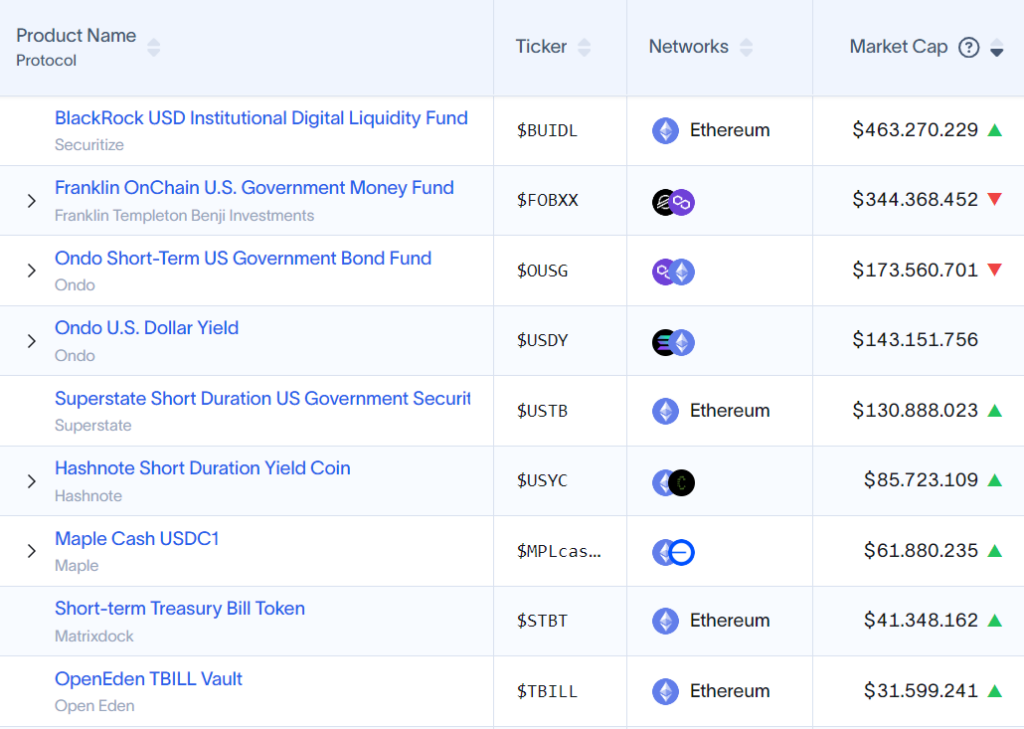
With this move, Fidelity International follows in the footsteps of asset managers such as BlackRock and Franklin Templeton, which lead the tokenized investment fund category, as seen in the following chart from RWA.xyz.

BlackRock launched the BUIDL fund last March, which in just two months climbed to first place in this type of fund, attracting $463 million, surpassing Franklin Templeton, which occupies second place with $344 million.