Having better returns than Warren Buffet in trading is possible, says specialist
Key facts:
-
Warren Buffet, considered the best investor in the world, earns returns of 20% annually.
-
Retail investors can afford higher risk exposure.
Warren Buffet is almost a mythical figure in the investment world. His ability to generate returns of 20% per year, on average, has crowned him the king of Wall Street. He is often called “the best investor in the world” and it is said that no one can beat him.
But, Is it really impossible to surpass his achievements? This is a cliché that many traders take for granted, a kind of mantra that is repeated ad nauseam in every corner of the financial market. However, Victor Urrutia, a psychologist turned trader, is willing to dismantle this belief.
The point of Urrutia, host of the YouTube channel “El psicológico del trading,” is not to discredit Buffet, but to open traders’ eyes to new possibilities. While Buffet has perfected his strategy over decades, Small investors can take advantage of their size and ability to move quickly in the market.
The psychologist says in one of his videos that “there are some conditions that must be understood in order to explain why a trader can earn more (percentage-wise) than Warren Buffet.”
«The reality is that the conditions that Warren Buffet has when operating are not the same conditions that you or I have. Although it may not seem like it, being a retailer is not always a bad thing.
Obviously, if you are a professional manager and you have many millions of dollars, it is better because you have a lot of money and with little profitability you can earn a lot. But being a retail manager has other advantages that a manager like Warren Buffet, who has billions of dollars, does not have. And that is that, unlike them, you as a retail manager can operate low-cap assets that move much more than the market.
Victor Urrutia, psychologist and trader
Urrutia mentions that these Small-cap assets “move much more than anything Warren Buffett can currently hold in his portfolio”.
Although Urrutia does not mention any asset in particular and he is not specifically a cryptocurrency trader, but rather focuses more on the traditional stock market, The concepts he pours out are also applicable to the bitcoin (BTC) and altcoins niche..
CryptoNews has shown that this year, low-cap cryptocurrencies (e.g. memecoins) have had large price movements. Traders who know how to take advantage of these ups and downs have been able to make profits. Furthermore, this high volatility increases the risk of losses.
The “trading psychologist” says that Buffet invests in stocks such as Apple (AAPL), Bank of America (BAC), Chevron (CHV), Coca-Cola (KO) and American Express (AXP). These are all multinational companies with a market capitalization large enough that Warren Buffet can inject his liquidity into them and not move the market.
On the contrary, Retail traders can afford to put their money (which is much less than Buffet’s) in smaller assets and therefore more volatile:
«Unlike this blessed problem, which is ‘Holy crap! I have so much money, I have to watch where to put it so that I don’t manipulate the market myself!’ We, the retail traders, don’t have that condition, so we can put our thousands of dollars wherever we want.
We have more options to find ‘edge’ [ventaja competitiva] In the market, we have more opportunities to find inefficiencies to exploit, because we are not involved in them. We will be part of them, but we will not generate them. We will not move the market. In other words, we have absolute freedom to make decisions that give us profitability.
As you can see, Warren Buffet cannot get involved in these assets. Because if he were to invest part of his capital, enough for the profitability he would obtain from them to make sense, he would move the market. They would be the market themselves. Inefficiency would disappear.
Victor Urrutia, psychologist and trader
The higher the risk, the higher the profits (and losses)
Another factor why retail traders can make higher profits than Warren Buffet or other professional asset managers is that they can afford to have greater exposure to risk when opening trading operations. Professional managers, on the other hand, because they manage their clients’ money, must remain within a moderate risk range (which, although it limits losses, also puts a limit on profits).
Urrutia says: “The fact that most retail traders lose is because they operate in much more aggressive and volatile environments than those in which Warren Buffet operates. So 95% of people lose means that the 5% of people who do win, when they win, win a lot.”
That said, the psychologist clarifies the importance of proper capital management, which is “what will make the difference between a recreational retail trader, who is just there because he wants to make a killing, and someone who really wants to dedicate himself to this professionally.”
Now, if any reader is already thinking about getting into trading to have 100% or 200% annual returns for life, it is necessary to remain calm. “The fact that you can have incredible returns, absurd in many cases, does not mean that this growth can be exponential,” says Urrutia and adds: “your growth will have a ceiling no matter what.”
This ceiling can be reached for two reasons. The first is at a mental level. The psychologist explains that “It is not the same to take a risk of 2% of your capital when you have 1,000, 10,000 or even 50,000 dollars, than when you have 1 million dollars”.
“Your mental capacity to take certain risks has a limit, so it is not scalable to infinity.”
Victor Urrutia, psychologist and trader
The second reason has to do with the market. Assuming that someone achieves absurd returns with trading and can maintain them over time (which is, statistically, very unlikely), There would come a point where the market in which it operates stops giving it liquidity..
The trader explains that “normally, environments that offer such aggressive, high returns are low-liquidity environments. They are environments in which the counterparty is limited, so you will be able to increase your risk exposure and your capital until a point in time when you yourself are the market.” When that happens, there will be no liquidity to exit and it makes no sense to continue trading.
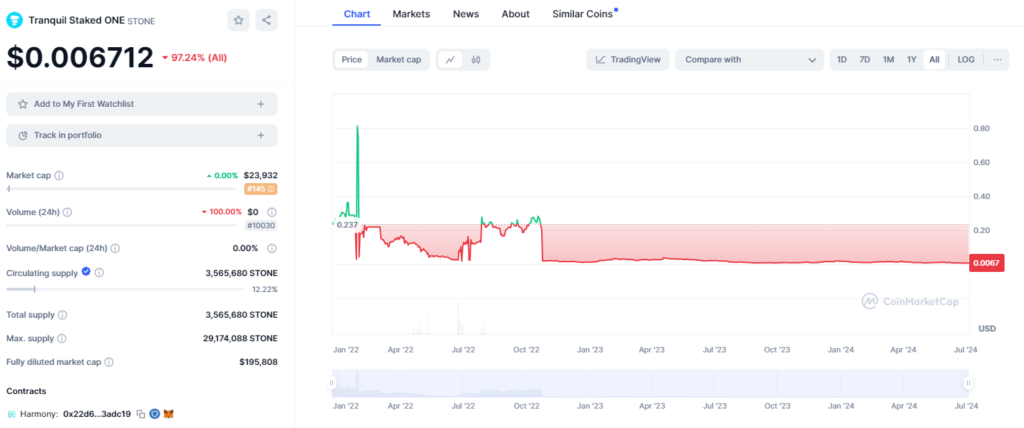
What Urrutia says is something that is seen daily with low-cap cryptocurrencies. For example, if we go to the bottom of pages like CoinMarketCap we see that there are cryptocurrencies like Tranquil Staked ONE (STONE). Its market capitalization is only $23,000. This means that if someone were to buy just $230 of this cryptocurrency, they would already have 1% of its circulation. It would cause a huge market movement and it would probably be very difficult for them to get rid of their holdings (unless they want to sell them at a much lower price than the purchase price).
Urrutia says about low-cap financial assets:
«Just so you understand, it makes no sense at all to put $500,000 into a trade if there is no one who can pay you $500,000. So when you have this discussion with someone about whether or not you can outperform Warren Buffet in terms of profitability, the answer is yes, you can. You can generate a return on capital used that is much higher than Warren Buffet. However, on your total capital, that is no longer the case.»
Victor Urrutia, psychologist and trader.
“It is important that you take care of your financial health”
In conclusion, Urrutia points out that it is necessary to follow Warren Buffet’s “mantra” and seek moderate returns (for example, by indexing in the S&P500) with part of the capital and, at the same time, seek high returns with riskier investments with another part of the capital.
«You, as a trader, must try to generate the maximum possible profitability. As much as you can, always assuming a coherent risk that will not burn your account, that has a controlled risk of ruin, that is, you must be the best trader possible in terms of a return-risk ratio,» says Urrutia. But he again emphasizes the importance of Knowing the “scalability limit”.
Also, according to this specialist, It is useful to move profits into safer investments “to try to participate in the market in a much more passive way” such as “indexing in places where capital grows month by month.” The goal of this is not to obtain large profits in a short time but to wait, over the years, for that investment to increase in value.
Although, as already mentioned, Urrutia does not make any reference to cryptocurrencies, one could find a certain analogy with what many cryptoasset traders do. They look for big profits through low-cap shitcoins and, when they get them, They are moving their money to bitcoin, which has proven to be a good store of value in the medium and long term.
Clarification: This text is written for informational purposes only. It does not constitute financial advice or investment advice. Each investor is responsible for conducting his or her own research.