

Historical Impact: GPT-5-Pro Test New Theorem
 By Canuto
A user in X states that GPT-5-Pro, an advanced AI, solved an open problem in convex optimization, improving a theoretical limit. ***
-
A user reported that GPT-5-PRO demonstrated a better limit in a convex optimization problem.
-
The test was manually verified and is based on an existing academic article.
-
The details include an increase in the “guaranteed convexity window” from 1/l to 3/(2l).
For those who just explore the crossing between artificial intelligence (AI) and mathematics, this field combines advanced algorithms with complex theories.
Convex optimization, a key area, seeks to find the best result in mathematical problems under certain conditions.
Recently, the IAS have begun to attend the resolution of problems that challenge human experts.
A bold statement on platform X
An identified user as Sebastien Bubeck published on August 20, 2025 a surprising statement.
He maintains that GPT-5-Pro, an advanced version of AI, managed to test a new mathematical limit in an open convex optimization problem.
Claim: GPT-5-Pro Can Prov New Interesting Mathematics.
Proof: I took A convex optimization Paper with a Clean Open Problem in It and Asked GPT-5-Pro To Work On It. It provides Better Bound Than What is in the Paper, and I Checked The Proof It’s Correct.
Details Below. pic.twitter.com/enegqyzg0l
– Sebastien Bubeck (@sebastienbubeck) August 20, 2025
The source indicates that it took an academic article with an unsolved problem and asked the AI to address it.
Details of the proposed improvement
According to the post, GPT-5-Pro improved an existing limit after analyzing the document.
The AI extended the “guaranteed convexity window” of η ≤ 1/l a η ≤ 3/(2l) under the same assumptions of theorem 1.
Bubeck manually verified the correction of the test, highlighting that this result exceeds the original limit.
Verification and documentation
The user shared a screenshot that shows the interaction with GPT-5-Pro.
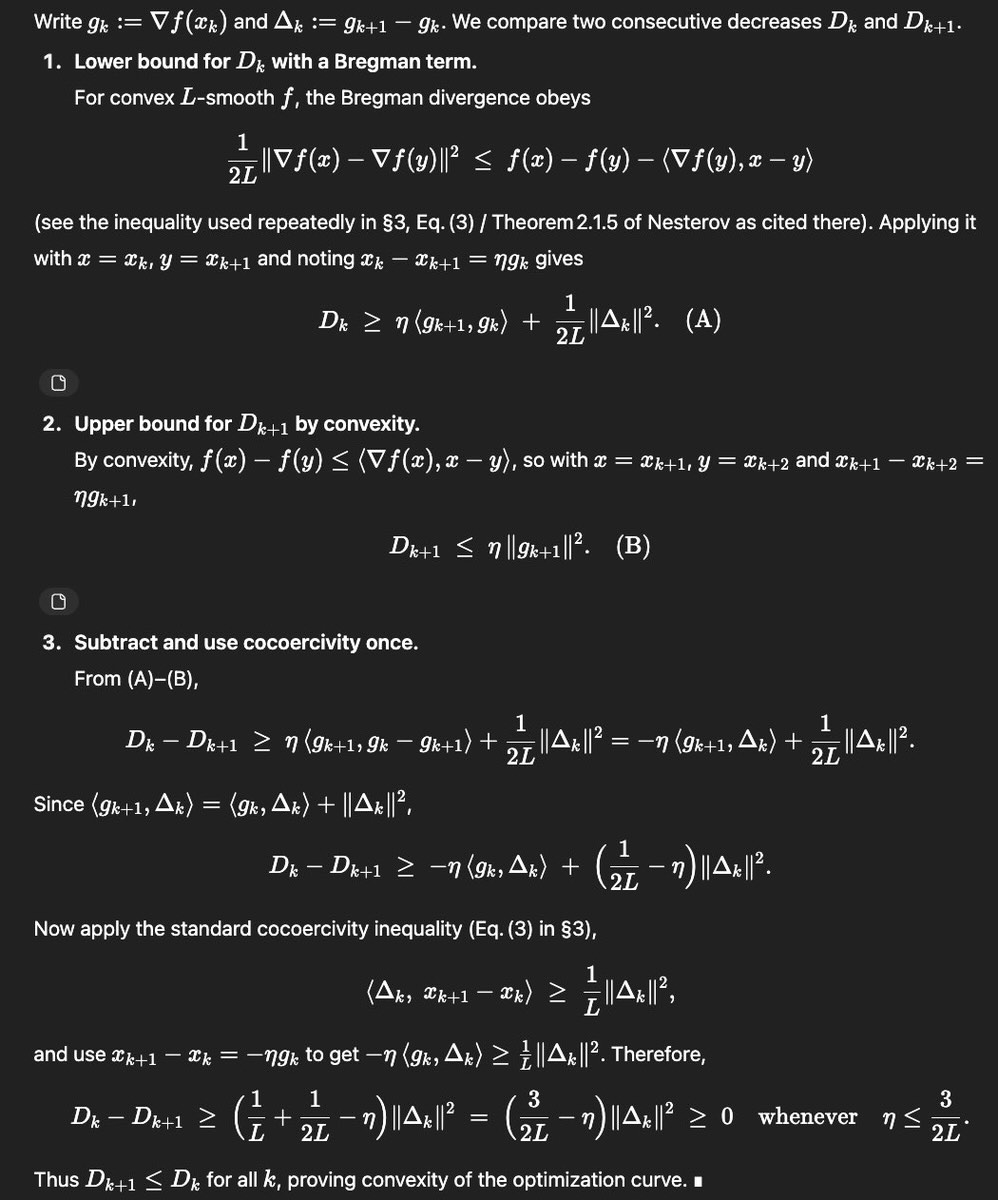
In the image, the AI responds in 35 seconds to a request to improve the condition of the passage size.
The original document, a PDF labeled as “2503.10138v1.pdf”, serves as the basis for statements.
Implications for the academic community
This news could generate interest between AI and Mathematics researchers.
If confirmed, it suggests that the IAS can contribute to theoretical advances beyond human assistance.
However, the scientific community must rigorously review the details before accepting it as a valid achievement.
Reflection on the future of AI
The case raises questions about the role of AI in pure research.
Some experts could see this as a step towards more autonomous tools in science.
Even so, the source warns that the test must undergo additional scrutiny to validate its impact.
Source and next steps
The information comes from a post in X of Sebastien Bubeck, accompanied by an image and a link to a PDF.
Official comments from the academic community have not been published so far.
Those interested can follow the development by reviewing the references cited in the original document.
Original image of Diariobitcoin, created with artificial intelligence, for free use, licensed under public domain.
This article was written by an AI content editor and reviewed by a human editor to guarantee quality and precision.
WARNING: Diariobitcoin offers informative and educational content on various topics, including cryptocurrencies, AI, technology and regulations. We do not provide financial advice. Cryptactive investments are high risk and may not be adequate for all. Investigate, consult an expert and verify the applicable legislation before investing. I could lose all its capital.
Subscribe to our newsletter


