Is it true that Bitcoin miners steal electricity in Venezuela?
Starting the Venezuelan government’s crusade against the Bitcoin mining industry, the governor of Carabobo state, Rafael Lacava, assured, after dismantling one of these data centers, that the miners “steal” electricity for their activities.
Lacava argues that the Bitcoin miners authorized by Sunacrip were connected to the National Electrical System (SEN), which suffers frequent interruptions, especially in the South American country.
Given this, the governor of Carabobo took the measure of closing the Bitcoin mining farms “because of the need we have for those megawatts that are being stolen,” as he pointed out in a video published on his social networks.
The measure responds to the ordinance of the Ministry of Electric Energy, which announced last week the disconnection of all Bitcoin mining farms from the National Electric System.
Now, is it true that the electrical energy used by Bitcoin miners was “stolen”? Were the miners in Venezuela illegal? Let’s see:
Bitcoin miners pay for the electricity they consume
Bitcoin mining, which has been a legal activity in Venezuela for almost four years, is also an industry that is obliged to pay the National Electric Corporation (Corpoelec) for the energy it consumes.
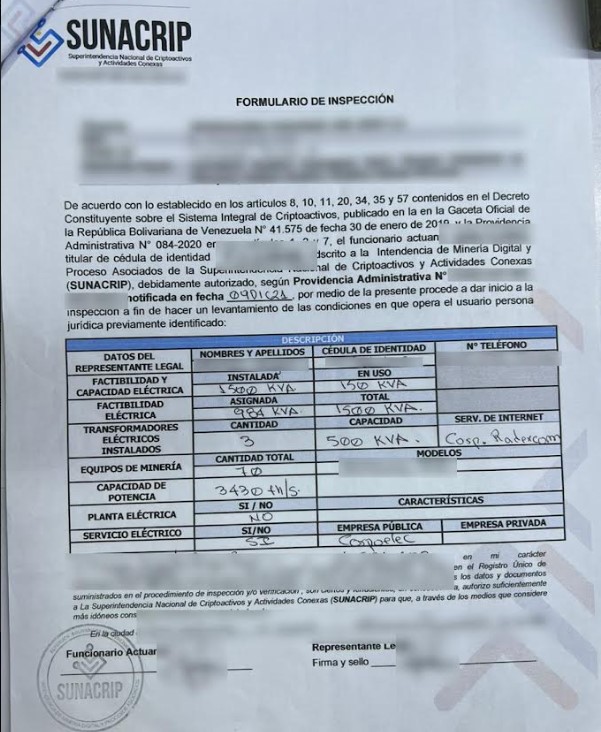
CriptoNoticias had access to official documentation of Bitcoin miners, which indicates that their operations had electrical load assignments by Corpoelec. Likewise, they shared documents showing inspections carried out by delegates from the state electricity company to duly regulated and supervised Bitcoin mining farms.
As a Bitcoin miner who spoke anonymously with CriptoNoticias said, there is no free electricity for your operations. Nor is it stolen. This is because they must pay the State for everything they consume.
The miner and bitcoin enthusiast in Venezuela, Leonardo Perruolo, explained that, to mine in Venezuela, operators must pay electricity to the State by the number of kilowatts declared and not those consumed. That is, if someone obtains a 3,000 kVA license and has only 100 pieces of equipment, he must pay the same for the declared amount of energy.
Something similar was explained by lawyer Samuel Nunez, who detailed, during a conference, that Bitcoin miners in Venezuela must pay a kind of fee of entry, as well as a monthly payment for its operations. During the meeting, held in 2022, Núñez pointed out that the costs depend on the scheduled consumption and that, to collect the electricity service bill, formulas are used that “must be evaluated to see if it is profitable or not” to mine Bitcoin.
Until 2022, Bitcoin miners had to pay an average fee of USD 0.010 for each kilowatt/hour consumed to Corpoelec. A fairly low cost compared to other countries in the region and the world.
Cheap electricity in Venezuela responds, in part, to the fact that in that country electric energy is generated renewablythrough the Simón Bolívar Hydroelectric Power Plant, known as El Guri, which has an installed power of 10,000 MW.
That became an incentive for mining operators in Venezuela, who took advantage of the benefits of renewable energy for the environment. and, of course, for their own pockets.

Venezuela’s electrical failures have other origins
According to Governor Lacava, Bitcoin miners, by “stealing” electricity, cause recurring electrical failures. However, This scourge has other origins, in the opinion of specialists in the field.
According to figures from the Venezuelan Observatory of Public Services (OVSP), The SEN has an energy deficit of at least 3,000 megawatts. This independent entity assures that in Venezuela there are only 10,000 MW available of the 13,000 MW demanded by the population.
Juan Carlos Rodríguez, a member of the OVSP team of experts, says that the lack of investment and maintenance of the SEN is what has generated a deterioration in the Venezuelan electricity industry. A situation exacerbated by the shortage of fuel and gas, which makes the operations of the Guri hydraulic turbines difficult.
Due to this situation, the frequency of blackouts in Venezuela increased, which went from weekly to daily, with durations of between 2 and 6 hours in some cases, and others between 6 and 9 hours, according to the OVSP.

Bitcoin miners in Venezuela, in addition to being legal and paying for the electricity they consume, can help rebuild the SEN. An operator told CriptoNoticias last week that it is possible to reach “win-win” agreements with the government, since they can provide resources for the electrical system “by integrating mining into industrial processes.”
“We are aware that the SEN has problems in its transmission and distribution process to bring the energy to its end user and in this we miners can help,” said the hash producer who spoke anonymously.