

Kyrguistan debuts with a golden stablecoin. Want the Bitcoin of El Salvador?
-
USDKG seeks stability with gold and audits, but its centralization is a risk.
-
El Salvador wins with each Bitcoin revaluation, but its keys are held by the Government.
There is no small country if its currency is large, a phrase that resonates with the audacity of El Salvador by adopting Bitcoin (BTC) as a legal tender in 2021. Now, Kyrguistan, a small country nestled in the high mountains of Central Asia, follows an equally ambitious path when launching the Gold Dollar (Usdkg), a stablecoin backed by gold, a proposal that could redefine the paper of Emerging economies in the future of money.
For the third quarter of 2025, Kyrgyzstan plans to launch his stablcoin, positioning himself as a new actor in the digital financial stage. To achieve this, it will use an initial support of 500 million dollars in gold reserves of the Ministry of Finance and plans to expand them to 2 billion in the near future.
His plan is to revolutionize cross -border transactions and international trade, starting with Central Asia and with a view to the Southeast Asia and the Middle East. But is this digital gold A wink to the past of the gold pattern or a play to create a new version of money in the hands of the states in a career for the financial future?
The USDKG, linked 1: 1 to the US dollar, is presented as an option compared to other alternatives, including Bitcoin, to facilitate remittances – which represent 30% of Kirguistan’s GDP – and international payments.
Allows users redeem it for physical gold, other digital currencies or fiat money, with independent audits to guarantee transparency. Gabriel Guerra, project advisor, said at the Token2049 conference in Dubai that “we do not seek to replicate gold prices like other tokens, but to offer stability supported by real reserves.”
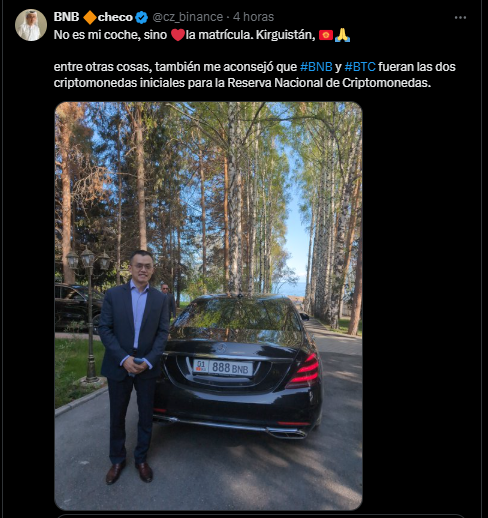
The Kyrguistan initiative has also captured the attention of prominent figures of the cryptocurrency ecosystem. Changpeng Zhao, former CEO of Binance, expressed his enthusiasm in a recent comment at X: “It is not my car, but the registration. Kyrgyzist.” With this, Zhao revealed that He advised the country to include BNB and Bitcoin Like the two initial digital currencies for a possible national cryptocurrency reserve, suggesting that Kyrguistan could diversify its strategy beyond the USDKG.
Bitcoin is digital gold that captivates the world
The launch of a gold -based stablecoin in Kyrguistan and the possibility of creating a cryptocurrency reserve attracts attention, especially since countries are currently talking about creating Bitcoin strategic reserves, following the steps given by El Salvador. In Japan there is a movement that is urgently evaluating the adoption of a national strategy focused on digital currency, as Cryptonotics reported. The same happens in Australia, where they even consider overcoming El Salvador.
The reason why individuals, companies and nations are resorting to Bitcoin is because the invention of Satoshi Nakamoto is increasingly seen as a value reserve. With a fixed supply of 21 million units, some promote it as “digital gold” resistant to inflation, unlike Fíat currencies susceptible to uncontrolled and devaluation emission.
Bukele defended this strategy as a protection against the erosion of value, especially after the revaluation of Bitcoin, which reached $ 100,000 in December 2024, doubling the value of the Salvadoran reserve to more than 600 million dollars, with unrealized profits of 344 million.
This financial success shows that the strategy of accumulate bitcoin as a national reserve, it can work, Validating Bukele’s vision of positioning El Salvador as a pioneer in digital assets. Despite initial criticisms and challenges such as low adoption, the increase in BTC’s value has generated a significant return, strengthening the narrative that Bitcoin reserves can be a viable bet for emerging economies that seek to diversify their assets and protect themselves against inflation from traditional currencies.
A gold stable emitted by the State
A stablecoin backed in gold and issued by the State, allows greater flexibility in the issuance, provided that additional reserves to support new units. This model, managed by the Kirguistan Ministry of Finance, It is not limited by a fixed supply as Bitcoinbut because of the government’s ability to accumulate gold.
This centralization introduces the risk of excessive issuance if the authorities succumb to political or economic pressures, eroding confidence in the support of the USDKG. Although audits promise transparency, the history of coins backed by physical assets, such as the gold pattern, shows that governments can suspend convertibility in times of crisis, A risk that Bitcoin, due to its decentralized nature, avoids.
However, a Bitcoin reserve also carries significant risks, particularly because the private keys to these reserves are in the hands of a government that can have the funds to their discretion.
In short, no initiative is inherently “better” in regard to money issued by the State. The choice depends on risk tolerance, institutional strength and strategic objectives of each nation.
The stablecoin backed by gold seems more appropriate for economies that prioritize stability and confidence in the short term, especially for remittances and trade in a world in disdain. Its conservative design and tangible support makes it attractive to cautious emerging economies, but the risks of centralization and dependence on physical reserves require impeccable management.
On the other hand, the Bitcoin reserve is a bold and risky bet, ideal for countries willing to tolerate volatility in exchange for overall autonomy and positioning, as evidenced by the financial success of El Salvador in 2024. However, the state control of private keys remains power to citizens.


