New Visa card allows you to pay with USDT in Latin America stores
-
For Visa, the agreement with Bridge is key to promoting the stablecoins.
-
The new cards can be used in more than 150 million businesses in the region.
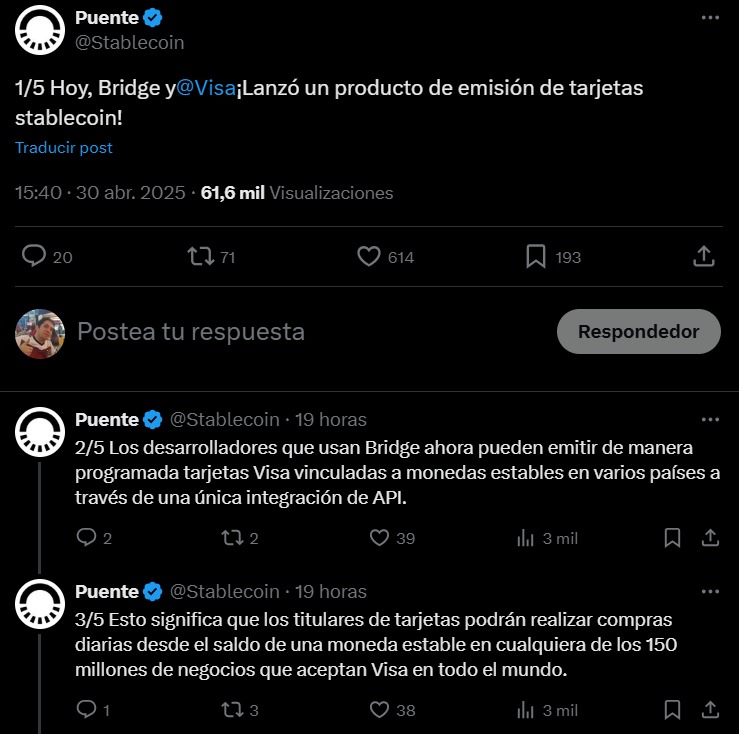
Visa, the global giant of digital payments, has been associated with Bridge, a company specialized in Stablecoins that was acquired by Stripe, to allow customers to use cards related to projects such as USDT in several Latin American countries. This functionality will be possible thanks to a single integration through an API, which means that card emitters will be able to connect to the Stablecoins network quickly and easily, without the need to develop complex infrastructure.
According to the official statement, thanks to this integration, the headlines of the new cards will be able to use their balance in Stablecoins to make daily purchases in any trade that Visa accepts. It is known that The program will arrive simultaneously to Argentina, Colombia, Ecuador, Mexico, Peru and Chileand that Visa plans to expand this initiative to Europe, Asia and Africa in the coming months.
The announcement offers a brief explanation about the operation of the product: basically, Bridge will automatically convert the funds into stablcoins to money Fíatallowing businesses to receive each payment as if it were a traditional transaction.
For example, when a client in Colombia understands locally and pays a trade with its Visa Card compatible with Bridge, Bridge will deduce the necessary funds of its stablecoins and make them a FÍAT currency, which will allow the establishment to receive the payment in its local currency like any other transaction. In this way, customers can add these cards to compatible digital wallets and pay in the more than 150 million businesses that accept visa.
Visa -issued statement.
Jack Forell, Product Director and Visa strategy, stressed the company’s commitment to innovation: «We are integrating Stablecoins into the network and visa products safely and easily. Our alliance with Bridge is a key step to make Stablecoins part of daily life, providing users with more options to manage and use their money.
The demand of Stablcoins continues to grow in Latin America, promoted by economic instability in several countries and difficulties in making cross -border payments through traditional methods.
Even Paolo Ardoino, in an interview in mid -April, acknowledged that “the Stablecoins are not for the United States” and that they emerged as Response to economic crises in countries such as Argentina, Türkiye and Venezuela. Visa seems to be clear about this panorama and this is reflected in its statement: “The focus in Latin America seeks to respond to the growing demand for consumers and companies that use Stablecoins to preserve value and finance their daily purchases.”
The truth is that more and more key actors in the traditional financial system believe that Stablcoins fulfill a fundamental role in the global financial system. A recent example comes from Brazil, where Itaú – the largest bank in the country – declared just a few days ago in launching its own stable currency. This technology is no longer an experiment, but is emerging as a specific tool to modernize finance.
In parallel to visa advances with Bridge in Latin America, proposals centered on privacy and global access without bank intermediaries also arise. As part of this, recently, Cryptonoticias reported the case of Dolphin Card, a new visa card announced by Aqua and Jan3, which will allow users to spend Bitcoin and other cryptocurrencies without the need to go through identity verification processes (KYC).