“Now we are going to zero emissions”
Key facts:
-
Whether knowing it or not, Milei is following the example of bitcoin, which has a limited supply.
-
The approval of the Ley Bases expands the Argentine government’s room for manoeuvre.
The president of Argentina, Javier Milei, indicated this morning that his next objective is to end the issuance of the peso to prevent it from generating inflation.
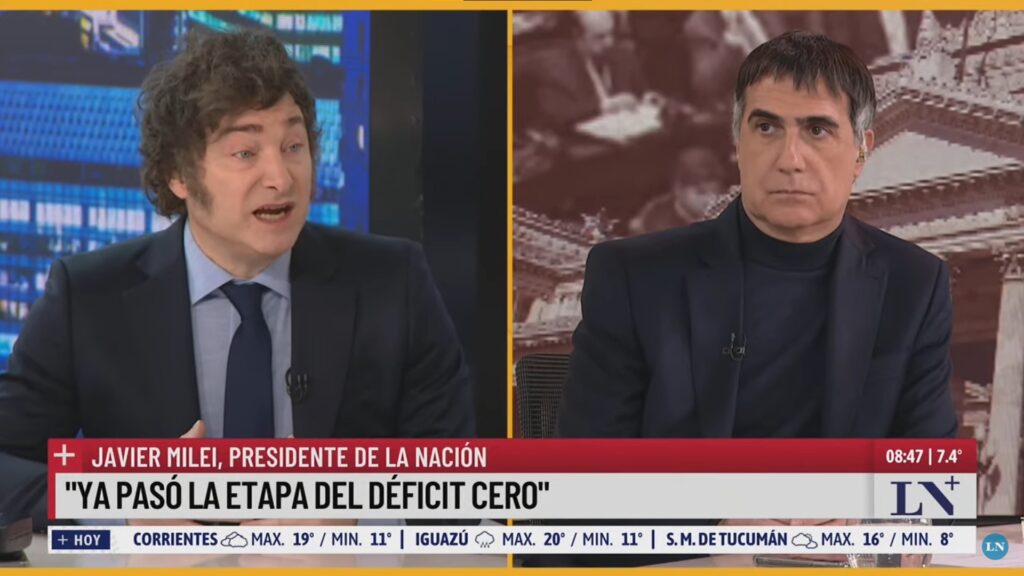
“We have managed to consolidate one of our main policies, which was zero deficit. (…) Therefore, what comes from now on is: The zero deficit stage has passed; now we are going to the zero emission stage,” Milei emphasized. With this initiative, he maintains that “the change of monetary regime is coming.”
This was indicated in a television interview this morning with journalist Antonio Laje, where he was optimistic about his management and the future of the economy. This takes place just over six months after he began his mandate.
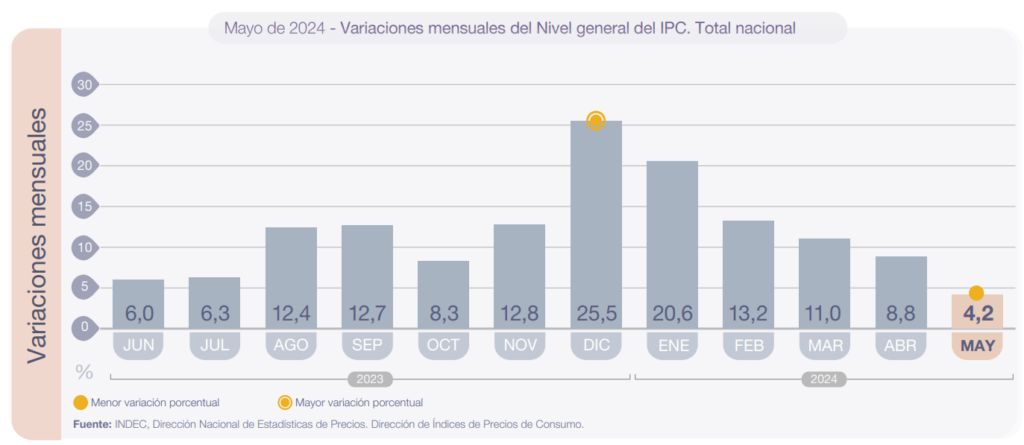
Since Milei’s presidential inauguration, Monthly inflation has been falling consecutively, as the following graph shows. This is due in part to the achievement of zero fiscal deficit since the first month of the government’s administration, which prevents greater monetary issuance.
The explanation behind this is that money, like other financial assets, works because of supply and demand. Therefore, as the issuance of a currency increases, its price devalues if it does not attract greater demand.
“We are aiming to ensure that what is called ‘the broad monetary base’ does not vary further,” Milei explained. This term refers to the total amount of money in circulation. In this way, it seeks to prevent the currency from devaluing and inflation from rising.
The president explained: “the economy, as it found a floor and is rebounding, the demand for money is growing.” In other words, this means that Argentines are using more pesosinstead of moving their capital to other assets such as the dollar (USD), which is why its price has not risen as much compared to December.
“Given the fall in the inflation rate and nominal interest rates, this makes people want to have more money in their pockets,” Milei said. He then clarified that this leads to a recomposition of the currency in circulation.
With a constant broad monetary base, the Argentine president warns: “there is a virtuous balance to the extent that you continue to increase the demand for money and the economic situation is restored.”
Although the president does not mention bitcoin (BTC), his actions are in line with the characteristics of that asset. This digital currency, which reached a record price this year of more than $73,000, was born fifteen years ago under a monetary policy different from fiat money.
Unlike national currencies, which They can be issued in an unlimited manner at the request of the government in power enabling inflation, bitcoin has a limited supply. The issuance of the digital currency is automatically halved every around four years through an event called a halving, which will occur until 21 million BTC are mined.
Once this happens, there will be no further issuance, as its code cannot be changed without majority consensus on the network. This limited supply reflects the scarcity of the asset, which attracts demand and drives up its price. Currently, 19.7 million BTC have already been mined.
Although Milei does not identify as a bitcoiner, as CriptoNoticias reported, shows connection to the community by being a fervent opponent of the issuance of money by the State. In fact, the government is preparing to present a bill that defines this activity as a crime with a prison sentence for the officials who carry it out.
Milei projects economic growth and poverty reduction for Argentina
With the measures of zero fiscal deficit and zero emission, Milei indicated that they are moving to lift the exchange rate restrictions, that is, the restrictions on the purchase of foreign currencies. In this way, different quotes for the purchase and sale of the official dollar and others such as the mep used in investments and the blue in the informal market would cease to exist.
The president also considered that the sanction of the Bases Law in Congress “is a historical and monumental milestone for Argentine history.” “If we add to that that the DNU is in force, that means that Argentina has just implemented 80 structural reforms,” he added.
According to Milei, with this scenario, Argentina will climb 90 positions in the ranking of countries with the most financial freedom. “It puts us on a path of growth to levels of being able to quadruple the GDP per capita, which implies a reduction in the number of poor and indigent people and substantial increases in the standard of living,” he concluded.