One piece of data reveals Argentina’s distrust of its financial system
Key facts:
-
Faced with inflation and uncertainty, Argentines prefer to avoid the national peso.
-
This figure is in line with the growth of Bitcoiners in the country.
Argentina’s financial system has been damaged for years. After recurring crises and devaluations that have damaged the national currency, the population has decided to keep a real fortune away from the control of local institutions.
While thousands of Argentines have rushed to acquire Bitcoin (BTC) and other stablecoins in recent years to protect themselves from economic turbulence, others prefer to go the more traditional way: save in cash and “under the mattress” your assets in dollars.
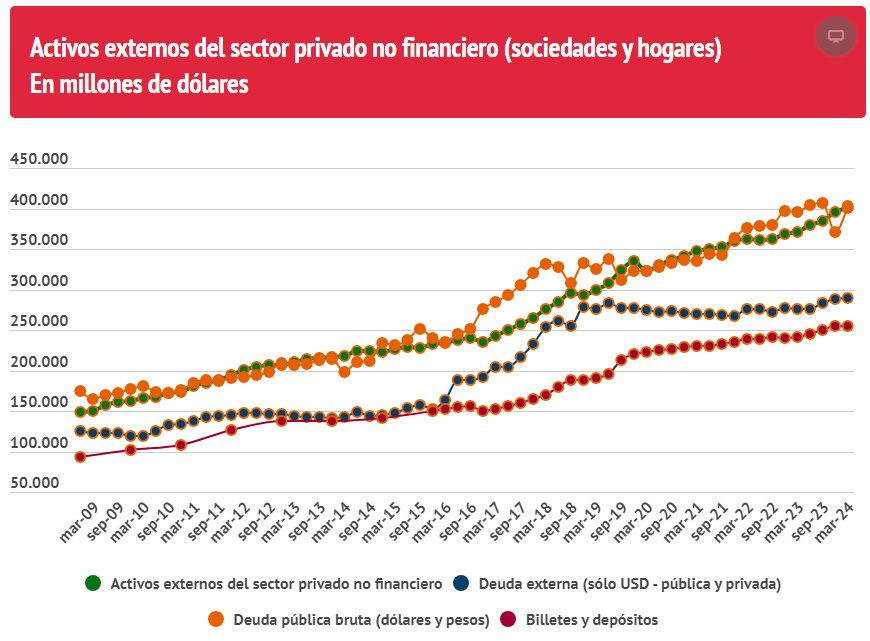
Specifically, the holding of cash and deposits in foreign currency in the hands of Argentines reached, at the close of the year, first quarter of 2024the USD 255,148 million. If the USD 16,915 million that are deposited in the bank accounts registered by the Central Bank of the Republic (BCRA) are discounted, The total amount of money that is off the official radar is USD 238.233 billion.
The data comes from the latest report of the National Institute of Statistics and Census (INDEC) on “Balance of payments, international investment position and external debt”. This significant amount practically quintuples the amount owed by the country to the International Monetary Fund (IMF).
These so-called “external assets” are savings that are usually deposited in checking accounts abroad, banknotes kept in the security boxes from financial institutions or physically hidden in some property.
The distrust towards the national fiat currency is greater, if another indicator is taken into account. In total, if the accredited stock assets, properties and other traditional investments accredited abroad are included, the amount of money in the foreign assets of the non-financial private sector reached USD 400.925 billion at the end of March.

This structural resentment towards financial institutions, to the point of assuming the cost of not investing money in assets that generate returns, is a long-term trend that deepened after the 2001-2002 crisis in the country, which had the effect of collapsing the currency convertibility model.a weight, one dollar” .
In those years, the government of the then president Fernando de la Rua fell due to massive social protests. Political and citizen tension worsened after that administration ordered a “playpen“of deposits, which meant a ban on withdrawing money from banks, with a minimum amount.
In parallel, the situation worsened stock of external debt in the country. According to the same report, this indicator increased in the first months of Milei’s government and reached almost USD 290 billion.
As a result of this increase, and the current recession that Argentina is going through, its weight on the Gross Domestic Product (GDP) also grew in the first quarter of 2024 to almost 60 percent. According to the INDEC report, External debt rose by USD 2.16 billion (+0.8%) compared to the last quarter of last year.
This is a pressure that the population is currently bearing with measures to adjust public spending, which impact income levels and public services. And it is a point that restricts economic freedoms. For years, savers have had to resort to alternative and informal markets when it comes to acquiring dollars.
The escape to cryptocurrencies
While most insist on taking refuge in traditional dollars, which are becoming more and more expensive due to local demand, the number of Argentines who own cryptocurrencies is estimated at 5 million. In the region, it is already the second largest market for these digital assets, ranking 15th in Chainalysis’ 2023 Global Cryptocurrency Adoption Index. Other studies already place the country in first place, as reported by CriptoNoticias.
“Argentina is the country with the highest volume of all the countries in the region, even more than Brazil and Mexico. Consider that they represent 240 million or 150 million, and we are 45. In other words, if you do the math in terms of volume per capita, we are by far the country with the highest adoption in the entire region,” he said in an interview. Marcelo CavazzoliCEO of exchange Lemon.
One of the hypotheses behind this trend is that Argentines tried to find other ways out of uncontrolled inflation over the last eight years, whose rate exceeded 200% in 2023. In addition, restrictions on the purchase of dollars closed one of the traditional “taps” to protect personal assets.
“I think that, due to the context we had, people were able to open up to new things. I think that in that search they found Bitcoin, they found “stablecoin” they saw that there was something more and they began to see everything that comes next,” Cavazzoli said.

“We have public adoption, talent, a lot of talent and knowledge among citizens. I travel to different countries and connect with many people and sometimes I ask them, ‘Do you know Bitcoin?’ And they answer, ‘No, no, what is that?’ Here in Argentina that doesn’t happen to you,” he added.
The general director of Bitso in Argentina, Julian Colomboagreed that “Argentina is, in general, one of the countries with the highest adoption of cryptocurrencies in the world.” “But there are still 9 out of 10 people who have never operated with cryptocurrencies. And there we have a lot to conquer,” he pointed out in statements to a local media outlet.
The persistence of instability
The arrival of the government of Javier Milei generated certain expectations in a sector of the population due to the promises to eliminate some of the restrictions. Among them, the lifting of the obstacles to operating with digital assets, based on the implementation of a “free currency competition regime.”
The truth is that these political signals had a minimal effect on the stock of dollars in cash outside the local financial system. Between January and March, there was only a marginal reduction of USD 560 million (-0.2%) of this capital under the mattress, from USD 238,793 million at the end of 2023 to USD 238,233 million.
In other words, few people believed in “laundering” and re-entering their assets into the domestic economy. And in recent days, the alternative dollar exchange rate began to skyrocket to over 1,400 pesos in the “blue” or informal market.
In this context of instability and distrust towards official measures, the ecosystem of digital assets becomes a favorable field for continued growth. “In countries like ours or like Colombia in recent times, with many macroeconomic problems, People find that crypto helps. In Argentina, it was easy access to the dollar to mitigate triple-digit inflation, to move money between one country and another very easily. I think that makes it a very attractive product for societies like ours,” Colombo summarized.