Only two sectors have enough young people to cover retirements for the next 15 years
In Spain there are 7.6 million workers who will retire practically entirely within fifteen years. Their weight in the country’s workforce is such that they occupy one in every three jobs that currently exist. Finding a replacement for the vacancies they will leave is one of the biggest challenges facing the Spanish economy. And it won’t be easy at all. The ‘great relief’ seems highly problematic. There are barely 3.2 million young workers to pick up the baton.
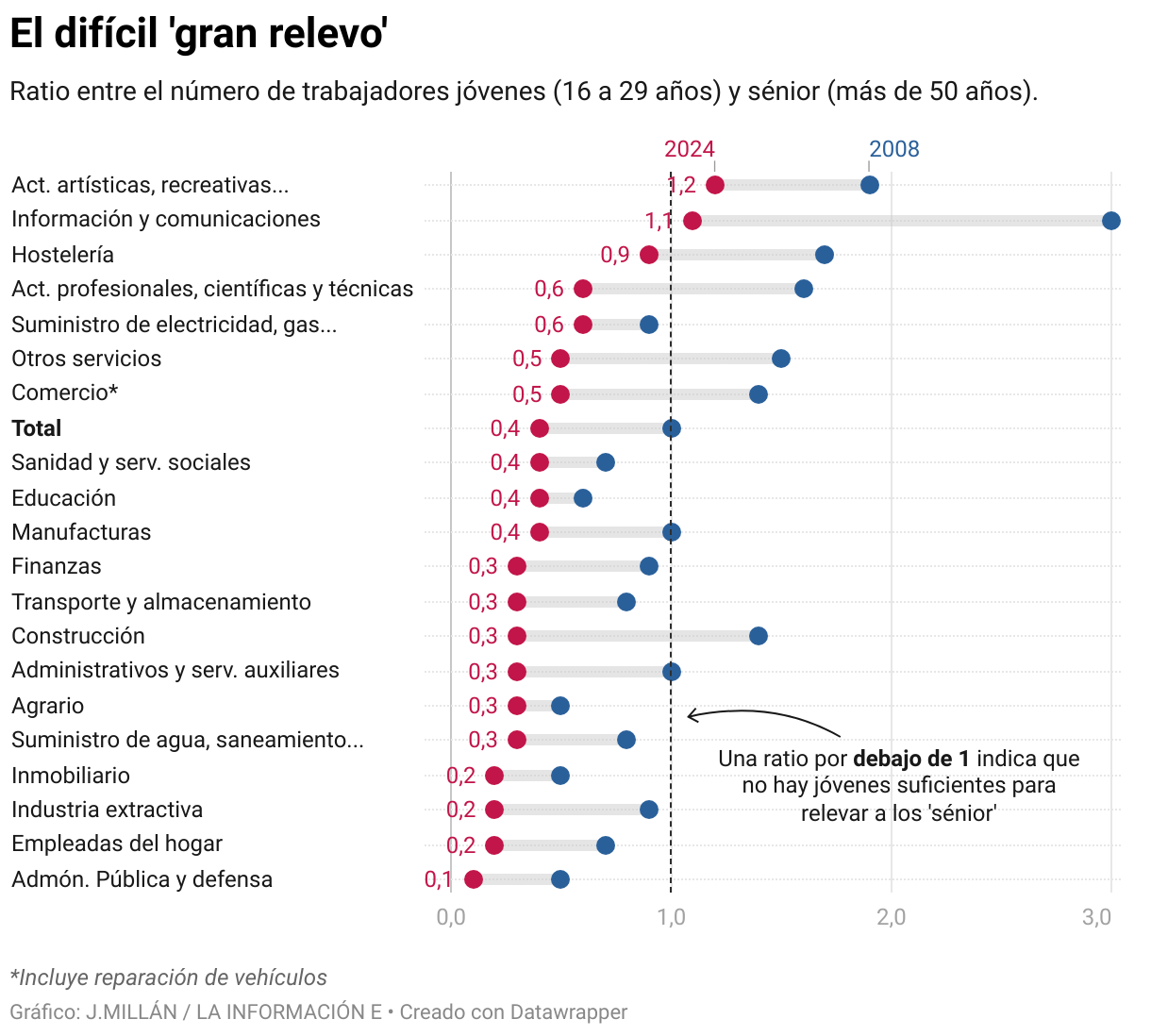
Of the 20 sectors of activity that make up the national economy according to the National Classification of Economic Activities (CNAE), There are only two trades in which the number of young workers (between 16 and 29 years old) exceeds that of ‘senior’ employees (over 50 years old). These are artistic, recreational and entertainment activities and information and communications (one of the professions that has grown the most in recent years).
In the hospitalitythis ratio between young and ‘senior’ employees is close to one (0.9), but it is already below the threshold that determines that the generation that is starting in the labor market is less numerous than the one that is closer to leaving it. The photography seen in the rest of the sectors paints a gloomy picture, with young labor completely insufficient to take over from the older ones.
The sector that has it most difficult is the public administrationwhere for every ‘senior’ worker who will have retired within 15 years there are only 0.1 young people. However, in this case it must be taken into account that it is common for workers to join the public service after the age of thirty.
The outlook is not much more promising in other activities. In sectors such as agrarian, administrative activities and auxiliary servicesconstruction, transportation and storage or finance; For every person over 50 years old, there are barely 0.3 employees between 16 and 29 years old.
A ratio that barely rises to 0.4 in the manufacturing industrythe education wave health and social services. The ratio rises to 0.5 in commerce and rises to 0.6 in professional, scientific and technical activities, but it is far from that reference of one that indicates that there are the same number of ‘senior’ as ‘junior’ employees.
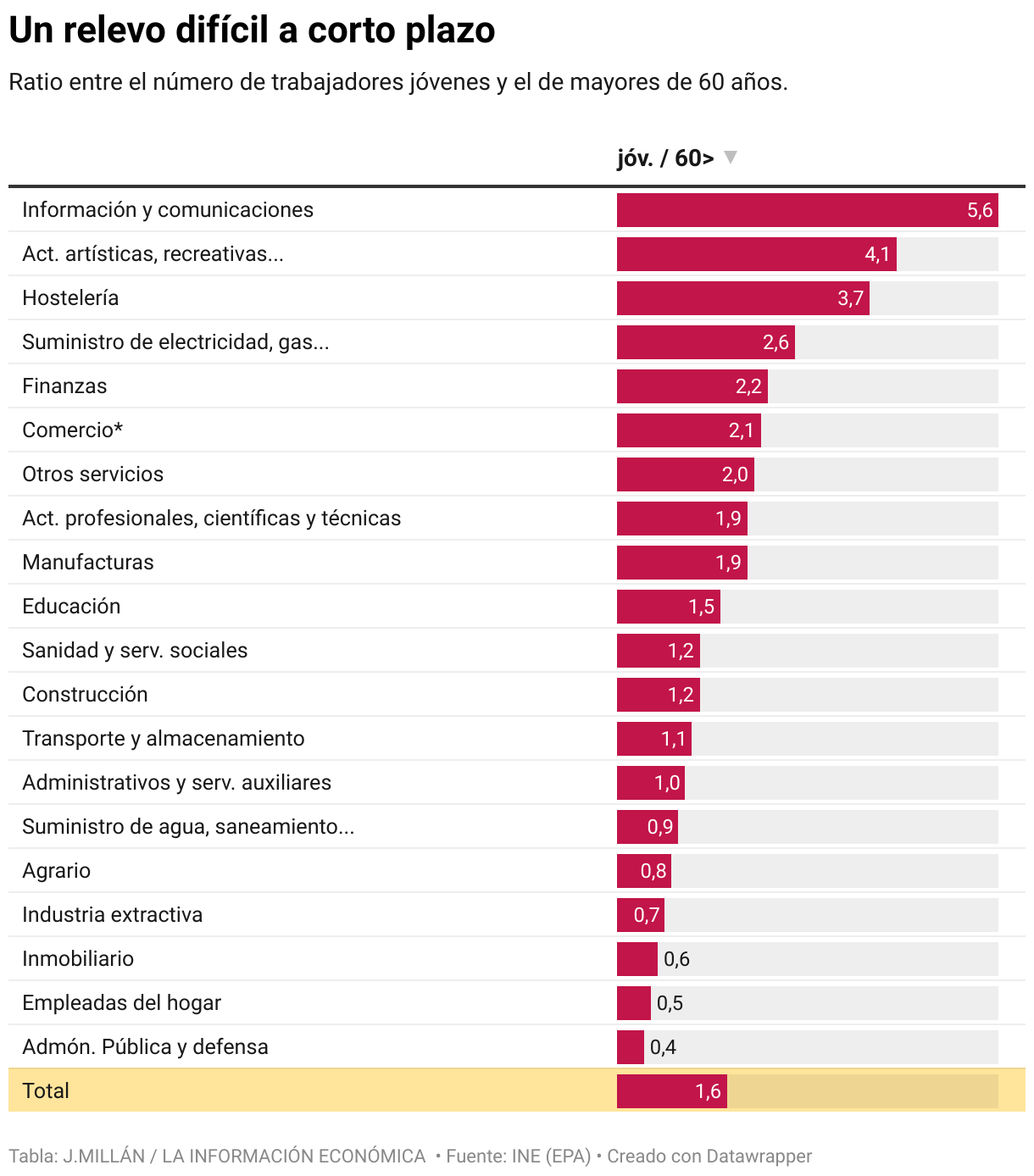
In fact, There are some jobs where the relief is already starting to be a real complication. In the agricultural sector or in public administration there are fewer young people than workers over 60 years of age. A generation that is just five years away from leaving its position vacant to embark on retirement.
The aging of the workforce has accelerated considerably in recent years. When the great recession broke out in 2008, there were more young people than older people in the labor market in Spain. The number of workers between 16 and 29 years old was 4.55 million, compared to 4.3 million people over 50 years old. However, it must be taken into account that during the bubble times, many young people went to work in construction and left their studies early. A situation that has now been reversed and is reflected in the figures.
The mystery of immigration
With the ratios between ‘senior’ workers and young people that are currently seen, it is difficult to think that it will be possible to fill all the vacancies that will become available in the next 15 years. However, other factors must be taken into account.
For example, The jobs that young people have today do not have to be the ones they will occupy in the future. At an early age it is normal for workers to work in sectors that require few qualifications such as hospitality or commerce while they finish completing their studies and look for jobs in line with their training.
We must also take into account the role of migration, which has become a fundamental driver of the labor market in the years following the pandemic. The arrival of foreign workers can partially offset retirements may occur in the future, but it is far from being a magic bullet.
According to recent research by Fedea and BBVA Research, in Spain there are four autonomous communities where the arrival of migrants has not been enough to cover the retirements that have occurred in the last seven years. Furthermore, it must be taken into account that The foreign workers who arrive are not dedicated to the same occupations as those who leave. The dissimilarity index—which reflects the extent to which the sectors where each work are similar—between migrants and retirees is around 50%. In the case of young natives, the difference with respect to retirees exceeds 70%.
To all this, another additional factor must be added. And it is that The generation that will replace what are now young workers in 15 years is even smaller. According to official figures from the INE, there are currently 7.7 million people between 15 and 29 years old, while the population between one and 15 years old now totals 6.4 million people.