
Probabilities point to a dollar drop
-
“An abrupt movement is just around the corner,” says analyst.
-
Gold could be favored in this context and Bitcoin?
“The calm before the storm.” That is the phrase that Jesse Colombo, investor and financial analyst, to describe the moment that the markets are going through, after several weeks of volatility caused by the “tariff war” initiated by the president of the United States, Donald Trump.
As Cryptonoticias has reported, the president announced on April 2 reciprocal tariffs for several countries, among which were China, Canada, the European Union (EU) and all of Latin America.
A few days later, Trump himself decided to postpone the application of the measure by 90 days to negotiate new commercial agreements. However, this kind of truce left China out, to which 145%tariffs applied.
The authorities of the Asian giant did not stay with a crossed arms and also raised taxes for imports from the United States.
When the conflict between the two main commercial powers seemed to intensify, the authorities of both countries issued signs of dialogue, which provided a respite to the markets.
In this regard, Colombo says: “After a couple of volatile months full of incessant and countercurrent news of the tariff plans and other policies of the Trump administration, financial markets have calmed down in recent weeks, which has provided a very necessary respite for all.”
But, and taking up the phrase with which this article begins, this calm could be temporary. It is that Colombo himself argues that “another abrupt movement is just around the corner.”
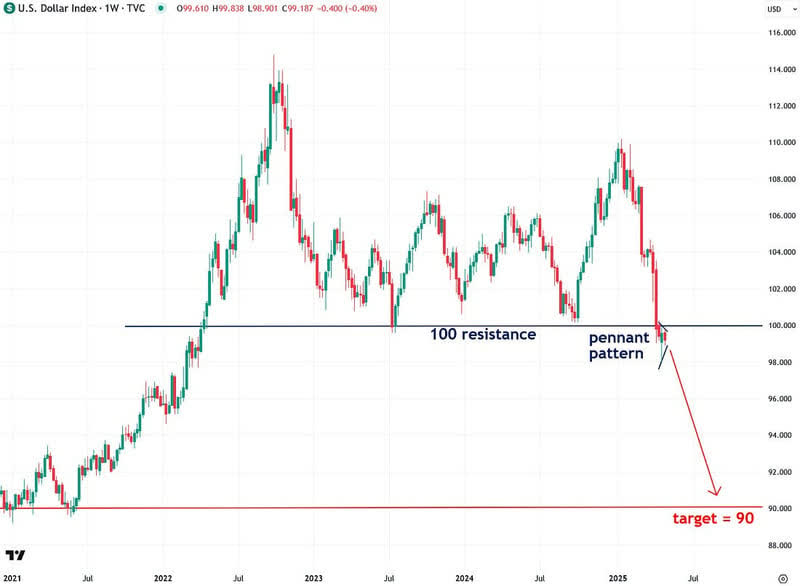
Colombo’s thesis focuses on the DXY index, which measures the value of the US dollar in front of a basket of Fíat currencies. Such index Recently it fell below 100 points, its minimum in three years.
“Historically, rebounds from the level of 100 have caused strong mass sales in raw materials such as gold and silver, due to the inverse relationship well established between the dollar and the prices of raw materials,” explains Colombo.
According to its analysis, the DXY is consolidating a pattern of flag, a technical analysis figure that is formed after a strong initial movement (ASTA), followed by a consolidation period, before the price continues in the same direction.
That is, after falling below 100, the DXY began to move laterally, which resulted in the formation of a flag. This type of figure, usually It tends to be resolved in the same direction of the previous movement, which in this case was bassist.
Likewise, Colombo warns: “If the index continues to fall, the next key support level to consider is 90, a movement that would mark a 10% drop with respect to current levels. It is a very realistic objective, especially as we approach a recession and a bearish market.”
As explained in cryptopedia, cryptootic educational section, in technical analysis, the term support is used to identify a kind of soil or level where the price of an asset tends to bounce.
According to Financial Bulletin analysts The Kobeissi Letterthis fall of the DXY occurs because in April foreign investors got rid of $ 22,000 million in US shares.
Although it is a significant figure, it represents a decrease compared to March, When a record output of 41,000 million dollars was recorded, the largest in at least one year.
“As the money leaves the United States, the euro is strengthened against the dollar,” said financial newsletter specialists.
The other face of the currency is that a fall of the DXY is usually interpreted as a bearish signal for the dollar, but bullish for assets such as gold and other raw materials, since they become more attractive in times of economic uncertainty. In this regard, Colombo explains:
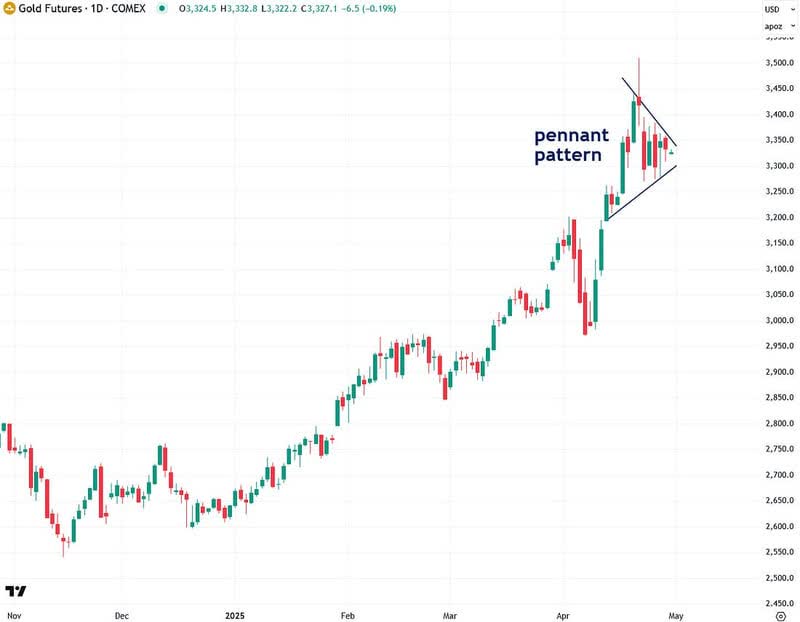
“Last week, gold was technically overcaped in the short term, which justifies a certain caution. However, it is important to remember that the most explosive bullish movements usually occur when an asset is already overcapted and has a strong impulse. If gold can confirm its strength breaking its flag upwards, I would not be surprised to see it upload it to the $ 4,000. Banderín established ”.
Jesse Colombo, financial market analyst.
The specialist argues that the publication of macroeconomic data from the United States or novelties in the “tariff war” could act as a catalyst for the price of gold.
In times of economic uncertainty and weakness of the US dollar, gold is the reserve assets most chosen by investors.
Is that, for thousands of years, gold has maintained its role as a means of exchange and reserve of valuestrengthening its importance throughout history.
And Bitcoin?
Although Colombo does not mention Bitcoin (BTC) in his thesis, it must also be included in the list of assets that could be benefited by the weakness of the US dollar.
This is because many investors define the currency created by Satoshi Nakamoto as “Digital Gold” for its similarities with precious metal.
What happens with BTC is that it has a limited supply in 21 million units, whose broadcast is reduced every 4 years in an event known as halving.
Likewise, it should be noted that, unlike Fíat money, Bitcoin is not devalued by the monetary issuance or decisions of a central bank. In addition, it is a decentralized currency and resistant to censorship and confiscation.
Even Blackrock, the world’s largest financial asset manager, has focused on these characteristics and in one of its reports recognizes its potential as “unique diversifying active.”
For the firm that leads Larry Fink, the digital currency can act as “coverage against risks that traditional assets cannot address, particularly in times of greater geopolitical and economic uncertainty.”
Although it is still in its early stages of adoption, The fact that in 16 years of history is compared to gold It reflects the exponential growth of its relevance in financial markets.
This comparison not only highlights its potential as a value reserve, but also its ability to capture the attention of institutional investors in search of alternatives to the traditional financial system.


