Solana will be the home of Stablecoins as USDC, no Ethereum, says analyst
In a recent publication, the analyst Fred Krueger said that, in his opinion, the massive adoption of Stablecoins, such as USDC (issued by Circle), will not occur on Ethereum, but on Solana.
«I can’t imagine people using MetamSk and jumping between Ethereum secondary layers to buy coffee in Starbucks. Yes I see them using USDC in Solana, ”he said.
His argument suggests that Ethereum user experience can be too complex for everyday useslike payments in shops.
For example, Metamask wallet usually requires users to interact with different second -layer (L2) chains, which are solutions designed to reduce the congestion of the main network and lower costs. However, this may involve additional steps, such as changing network manually or paying several commissions.
In contrast, Krueger’s position is oriented towards a more fluid use experience, in which Solana gains prominence – the commissions are very low and there is no need to change network. In your vision, it is a more appropriate option for the daily use of Stablcoins such as USDC.
A debate on
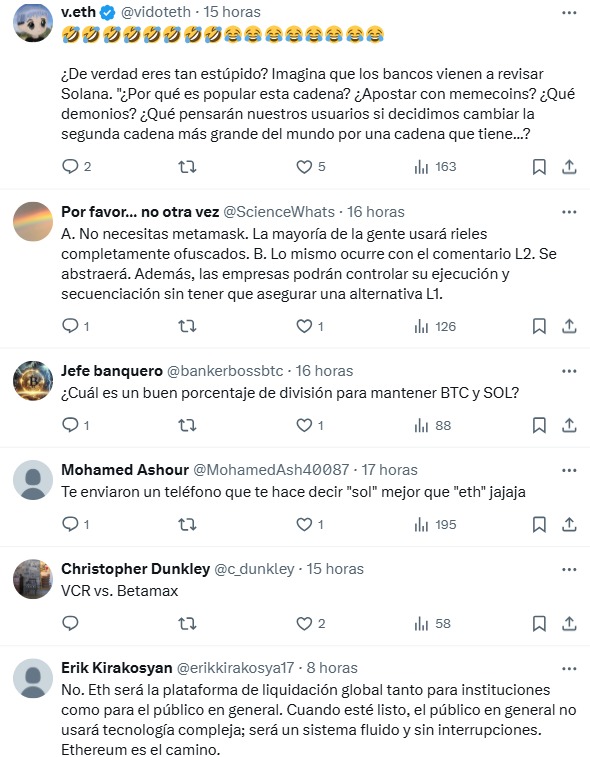
The analyst’s position unleashed a series of comments. Some people pointed out that neither Bitcoin (BTC) nor Ether (eth) are used today for retail paymentsand that does not determine which network will prevail in the long term. «People also use BTC to buy at Starbucks. That will not be the reason why Ethereum reaches mass adoption, ”said a user.
Others pointed out that Stablecoins compete with debit cards for their ability to make instant payments, but in developed countries, credit cards are more popular due to benefits such as rewards or payment facilities. According to this perspective, stable currencies will not reach mass adoption in developed countries, and their growth will be more linked to emerging economies.
Hard criticisms of Solana also emerged. Some warned that their reputation against banks and large institutions could be affected by its history of technical interruptions, failed projects and the speculative activity with Memecoins. “What will users think if banks opt for a chain associated with bets, crimes and can go out at any time?”
Memecoins, such as Shiba Inu (Shib) or Dogecoin (Doge), are usually more created tokens by trend or fun than by real or solid use of technological support. Therefore, they are often associated with risks of scams or RUG PULLS (scams in which the creators of a project disappear with investor funds). This reputation generates distrust, especially between institutional investors and regulators.
It should be noted that this adds to a technical questioning that has accompanied Solana over time: the project has been indicated by having a structure of validators – the ones in charge of processing and verifying the transactions – more concentrated and expensive to operate, which makes it difficult to participate in small actors and raise the risk that the control is concentrated in a few nodes – the devices that store and communicate the information within the network.
For some critics, this can compromise decentralization, a key principle in cryptocurrency networks.
On the other hand, Ethereum maintains a more solid reputation as a platform for the development of more sustainable projects, with a community of mature programmers and an infrastructure designed for interoperability with traditional systems.
Others defended Ethereum’s strength as the most reliable platform For financial applications. «Tokenization will occur in a reliable network. Ethereum has not suffered falls, is more decentralized and better meets legal requirements. That is why it is the preferred option by Wall Street, ”said an Internet user.
The truth is that the numbers support Solana’s growth and popularity. As reported CryptooticsDuring the second quarter of 2025 the network generated $ 271 million in commissions revenue, surpassing Ethereum (129 million), Tron (165 million) already Bitcoin (50 million), and consolidating itself as leader for the third consecutive quarter.
Although Solana currently leads in commissions, the debate on the massive adoption of Stablecoins remains open, with Ethereum maintaining its strength in financial applications and decentralization.