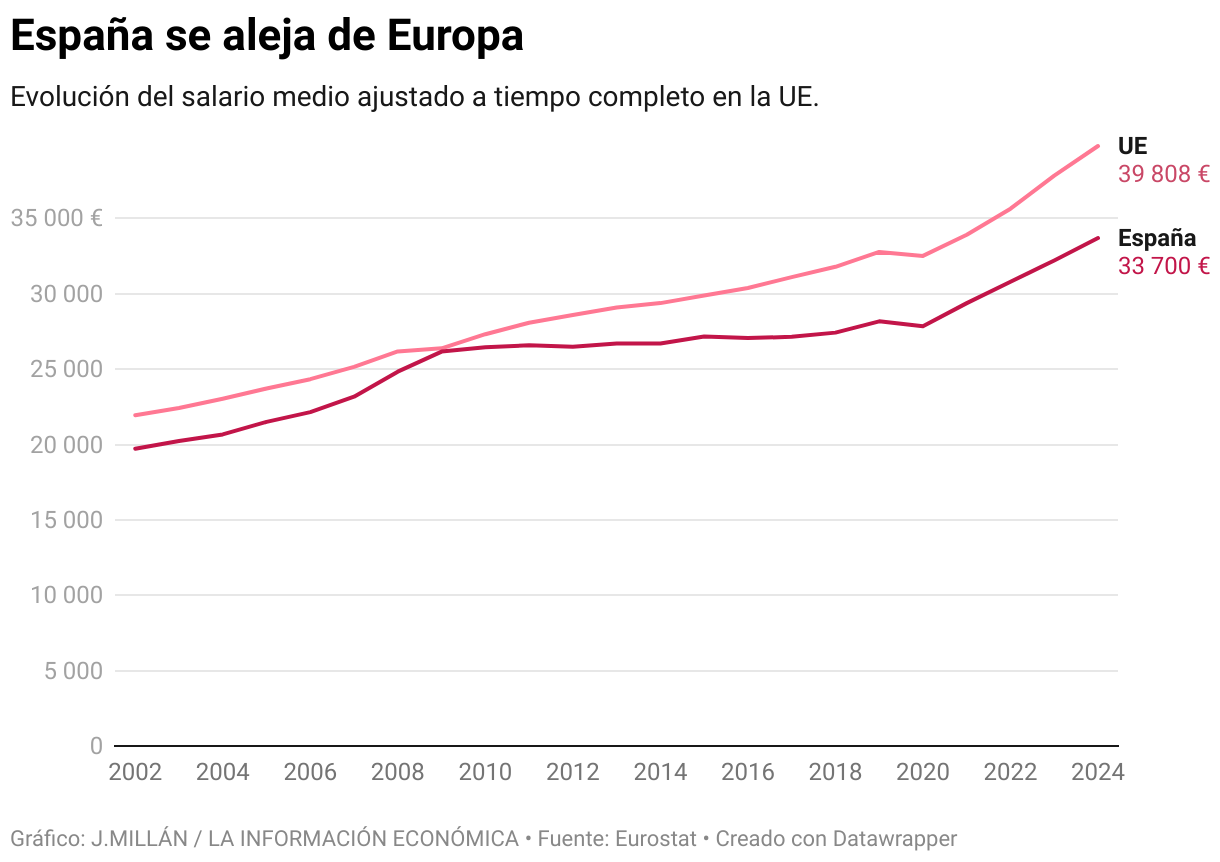
The average Spanish salary is already 6,100 euros lower than that of the EU
Spain is moving further and further away from Europe in terms of salaries. Spanish salaries are not capable of keeping up with the pace set by an EU where average remuneration grows driven by the pull of the Baltic countries, Hungary, Poland or Romania. The adjusted average full-time salary in Spain reached 33,700 gross euros in 2024according to the data published this Wednesday by Eurostat, the European statistical office.
The country’s remuneration remains 6,100 euros below the European averagewhich stood at 39,808 euros last year. Thus, the average salary in Spain is 15.3% below that of the European club as a whole, a gap that, far from reducing, has not stopped increasing in recent years.
The evolution of salaries in Spain so far this century It has two clear phases. With the entry into the euro and encouraged by the boom economic situation in the 2000s, Spanish salaries grew above the European average until reaching convergence in 2009. The average salary in Spain in 2002 (19,720 euros per year adjusted to full-time) was 10% of the EU reference, but the year after the great financial crisis broke out they were practically on par (26,169 euros in Spain and 26,384 in the EU as a whole).
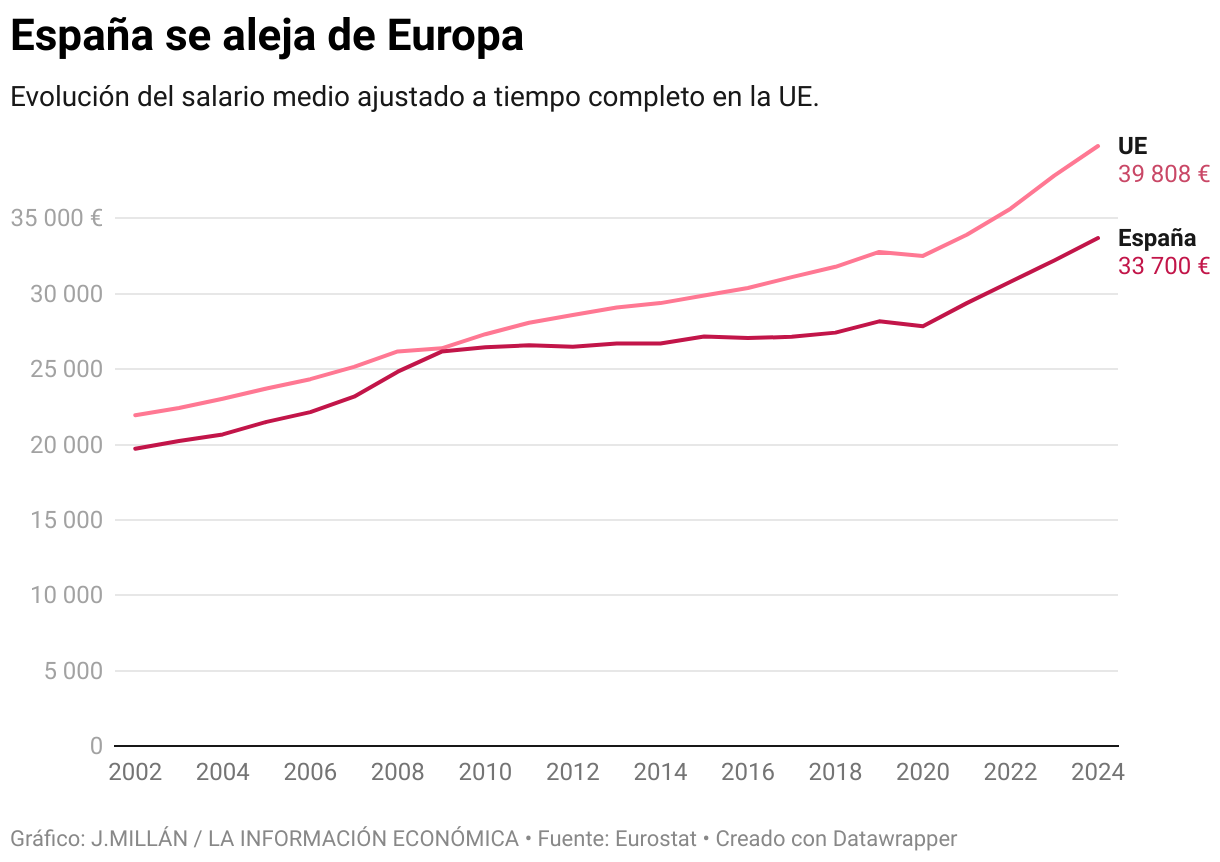
However, hehe shock of the great financial crisis of 2008 caused a salary devaluation that opened the gap again which had closed after the boom years. At the same time, the strong pull of economies such as Poland, Hungary, Romania or the Baltic countries (Estonia, Latvia and Lithuania) has contributed to the growth of the European average salary. In the last ten years, the average remuneration in these countries has doubled or even tripled in some cases.
In just ten years, the average salary of Romania It has gone from 6,812 euros per year to 21,108; the one of Lithuania has jumped from 10,214 to 29,104 euros; the one of Bulgaria has gone from 6,025 to 15,387 euros, that of Estonia has been revalued from 13,112 to 26,546 euros and that of Latvia has grown from 11,212 to 22,262 euros. Other countries like Czech Republic (from 11,916 to 23,998), Poland (10,827 to 21,246) or Hungary (9,621 to 18,461) have also recorded significant salary increases.
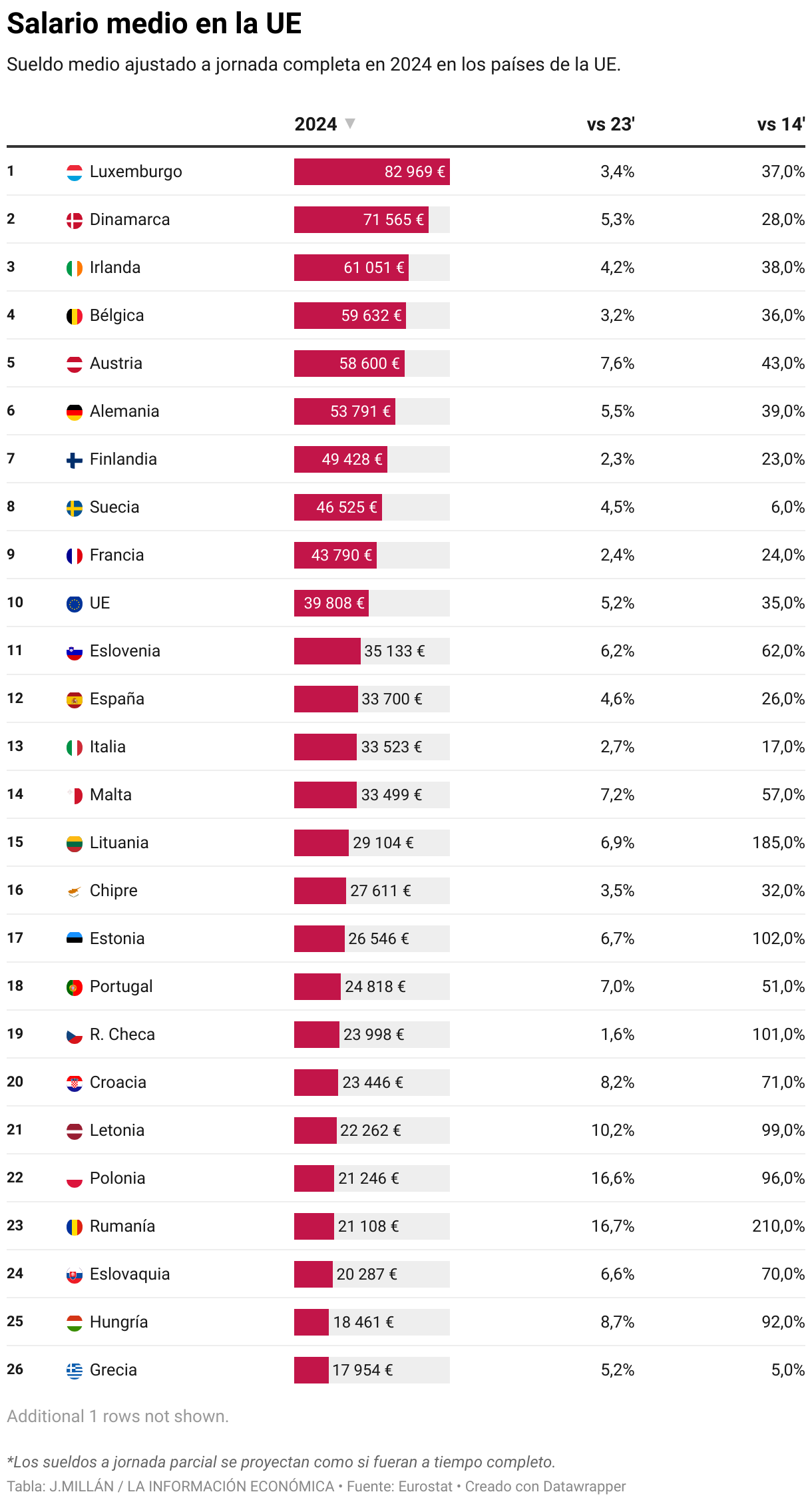
Spain is the tenth country in the EU where salaries increased the least in 2024. They did so by 4.6% compared to 2023, an increase slightly lower than that registered by the community bloc (5.2%). On the other hand, if we look back 10 years, Spanish salaries are the sixth ones that have increased the least. The accumulated increase since then is 26.2%, compared to 35.5% in the EU as a whole.
Spain is the 11th country for average salary
Despite everything, Spain is still in the upper half of the table of countries with the highest salaries. Specifically, it occupies eleventh place on a list headed by Luxembourg (82,969 gross annual euros), followed by Denmark (71,565) and Ireland (61,051). Behind them, appear Belgium (59,632); Austria (58,600); Germany (53,791); Finland (49,428); Sweden (46,525) and France (43,790).
In the block whose remuneration is below the European average there are Slovenia (35,133 euros), Spain (33,700 euros); Italy (33,523); Malta (33,499); Lithuania (29.104); Cyprus (27,611); Estonia (26,546); Portugal (24,818); Czech Republic (23,998); Croatia (23,446); Latvia (22.262); Poland (21.246); Romania (21.108) and Slovakia (20.287). They close the list Hungary (18,461), Greece (17,954) and Bulgaria (15,387).