
the b side of the furor over Worldcoin in Argentina
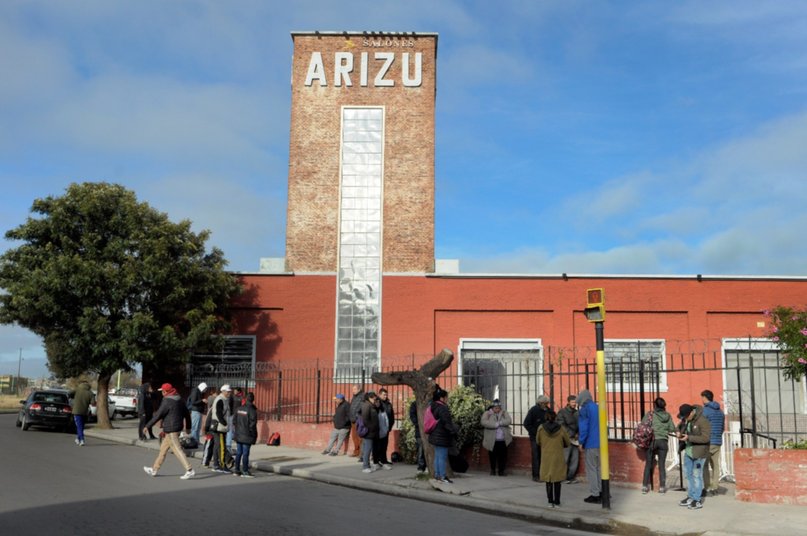
In recent weeks, Julián and many other residents of the city of Bahía Blanca, located in the interior of Argentina, approached the old building of the extinct Bodega Arizu. In this environment of the last century, the Worldcoin company offers the payment of an important reward for the depressed local pockets, in exchange for scanning the eyes of the volunteers.
After spending a few seconds in front of a silver sphere with a built-in camera, Julián receives the equivalent of approximately $50 in tokens. “I do it because I don’t have a penny. And this is easy money. There is no other reason”, he expressed after completing the process.
Another young man, Franco, 20, also participated in iris scanning in exchange for the WLD digital asset. However, he confessed that he had doubts when proceeding:
“It scares me a bit. The truth is that I don’t have much idea what they will do with this, but it is also true that for several years I have been giving my personal data to different virtual platforms without them giving me a peso.
Franco is 20 years old and had his iris scanned for Worldcoin
This avalanche of interested parties is not an isolated case. Worldcoin installed nearly 250 positions throughout Argentina. But it is also symptomatic of how the vision of these users, whose testimonies were reproduced by the newspaper The new onereflects the thoughts of many who They do not give true value to your private data.
The absence of regulation is one of the great concerns regarding this type of technology.
“Today I would define it as a sociological problem. “Since there is no regulation in this regard, it cannot be said that a crime is being committed,” he says. Carlos Chesñevardoctor in Computer Science and director of the Institute of Computer Science and Engineering (CONICET-UNS).
The specialist highlights the uniqueness of the iris as biometric data. “No two irises are the same, and this is an advantage to use it as an identification system in the not too distant future.” He also highlights the precision of this method, comparing it to the fingerprint, because it is something “unique and unrepeatable.”
“Due to its characteristics, there are 10 to 78 different combinations in the iris, this is equivalent to a 1 followed by 78 zeros. It is a gigantic number equivalent to the number of atoms in the known universe, while the possible combinations of fingerprints is a much smaller number, approaching 6 to the 13th (60 billion, equivalent to a 6 followed by 13 zeros)” , accurate.
From this point of view, the specialist added that it is practically impossible for the iris that one has to be repeated in another person on planet Earth, and that is why this type of biometrics can reduce the possibility of fraud.
“It is highly likely that organizations or institutions will move towards iris scanning as a more effective measure for registering a person, because it would be much more reliable than a fingerprint,” he noted.

The controversies behind Worldcoin
Worldcoin and its novel global project are the subject of controversy around the world. The company uses advanced biometric hardware to issue an ID, or digital passport, without requiring other personal information.
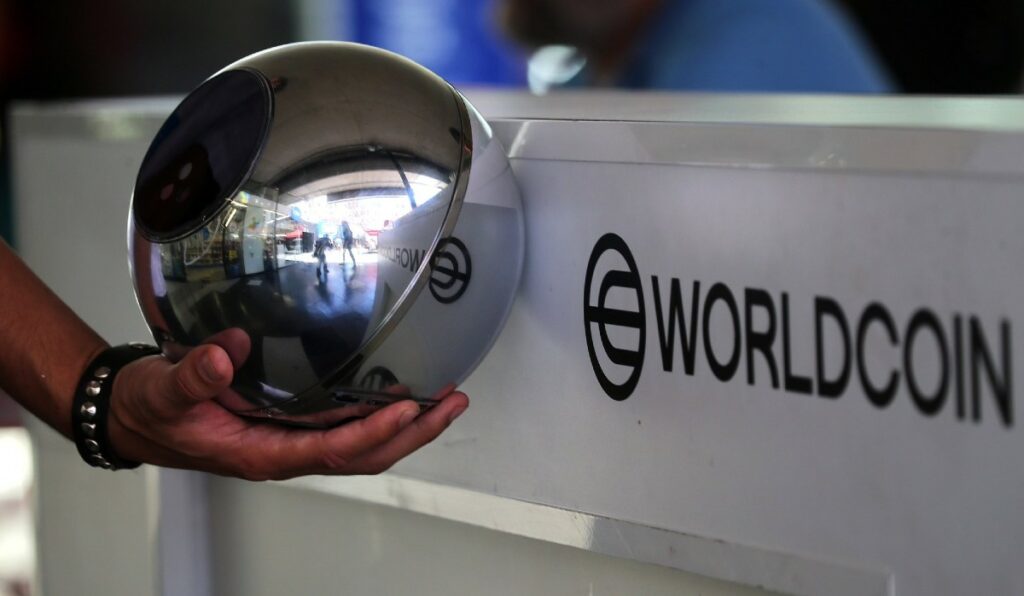
The device used to collect this sensitive information is the recognizable orbto which Julián and Franco lent themselves in Bahía Blanca, and the application World App.
As the company explained, its project “does not intend to collect or store biometric data, but rather uses the information to demonstrate the uniqueness and humanity of a person, creating a global identity document (World ID).”
The main controversy revolves around the suspicion that the company could be compromising the security of the data collected. This is due to the difficulty of replacing or unlinking this data from personal identity, even when attempting to anonymize it and use it for commercial and security purposes.
The alert was also detected in other countries in the region. Jaime DelgadoPeruvian lawyer and consumer advocate, emphasized the risk inherent in exchanging biometric identity for minimal monetary compensation, which he considered dangerous.
“Selling the iris of your eyes for a few cents or the biometric identity is as if you were selling your organs,” warned the specialist, who also questioned that there is no guarantee that this information can be used in the future for other purposes. , since it was “sold” to Worldcoin.
Another expert, systems engineer specialized in artificial intelligence Lennin Cenas, pointed out the security consequences of the use of biometric data and how cybercriminals can take advantage of them. “My recommendation is clear: do not transfer biometric data to any project,” he emphasized.
As reported by Criptonoticias, in countries such as Spain and Portugal, among others, the authorities ordered Worldcoin operations to be suspended due to the lack of clarity about the use of the data.
In the province of Buenos Aires, the technology company faces serious accusations. According to the local government’s Ministry of Production, the company has been accused of containing “unfair terms” in their adhesion contracts. In the latest inspections by the authorities, contradictions were detected in the information provided by the company.
After the summons, the company did not respond satisfactorily and incurred contradictions, such as regarding the scanning of minors’ biometric data,” stated one of the reports.
The Agency for Access to Public Information (AAIP)one of the organizations specialized in data regulation in Argentina, decided to open an independent investigation into how Worldcoin handles this personal information.
As for the possible consequences, the company could face a fine of up to 1,000 million Argentine pesos (approximately 1.1 million dollars to official listing) for alleged violations of the right to identity and privacy.


