The digital euro adds 70 allies, but does not dissipate the fears of the community
-
The ECB explores conditional payments, but the legislation for its launch is uncertain.
-
Critics fear that mafias and hackers explode an expensive system that does not solve real needs.
The Central Bank of Europe (ECB) presents the digital euro as the future of money. He ensures that his Central Bank digital currency (CBDC) is safe, modern and efficient. But in social networks, it is something else, since it is said to be a “multimillionaire waste”, a risk for privacy and a magnet for hackers and organized crime.
The debate on the digital euro takes a new impulse in social networks, just at the time when The ECB is being associated with 70 organizationsincluding startups, merchants, fintechs, banks and payment service providers that bind to the project.
The digital euro now has two groups: the “pioneers”, which explore conditional payments (for example, payments that are activated when fulfilling a condition, such as the delivery of a package), and the “visionaries”, who investigate cases of use with social impact, such as financial inclusion and tokenization.
Only four banks participate directly (from Austria, Cyprus, Germany and Spain, with CaixaBank as the largest), while entities such as ABI Lab of Italy and Iberpay of Spain collaborate in projects related to distributed registration technology (DLT).
The pioneers They will work with a digital euro simulated platformwhile the visionaries will participate in workshops this month. Both groups will submit reports to the ECB, which will publish a final report in October 2025, when it will also decide whether it launches the digital euro, subject to legislative approval.
However, legislative support has almost certainly decreased after last year’s European elections, adding uncertainty to the project. And addition to this, we must consider he Little level of acceptance that has the digital euro not only in the region, but in several parts of the world, fearing for the negative effects of the CBDC.
Part of these concerns is related to the level of control that allows, as warns, Gianluca Grossi, who describes the digital euro as “The dream of central banks with anxious control”with “zero privacy, maximum centralization and no possibility of opposition by citizens.”
The ECB insists that the digital euro will prioritize privacy, promising a level of anonymity similar to cash for offline payments and ensuring that it will not store individual transaction data. However, critics such as the Spanish analyst Marc Vidal doubt these promises, comparing the project with the Chinese Yuan Digital, which has experienced with restrictive functions such as geolocation and spending limits.
The security of the digital euro also worries the community, as reflected in the user of X, Deodato Ribeira, who questions that the ECB has the technical competences to protect European citizens from hackers and mass attacks. He ironic about how the digital euro will face mafias such as Italian or Dutch myocromafia, which could exploit vulnerabilities of the CBDC.
A millionaire cost Who pays the development of the digital euro?
These concerns are added to doubts about whether the digital euro really addresses payment needs not covered or if only seeks to counteract the influence of foreign suppliers such as Visa and Mastercardas Ledger Insights points out.
In his comments, Grossi also confirms that the digital euro is a technology that “nobody likes”, stating that European citizens will pay for a system that mainly benefits the ECB. While the aforementioned means of communication indicates that this cost is high, since there are private contracts for more than one billion euros that have already been awarded to develop the system, which feeds criticism about its economic viability.
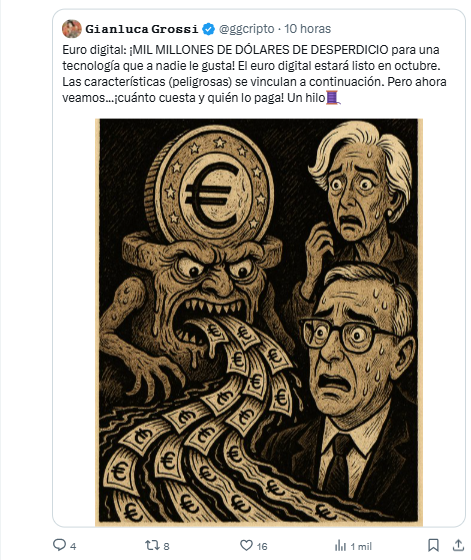
In addition, the urgency of the project has been questioned. This taking into account that He was considered a priority in 2020, forgotten until 2022, and presented as essential since 2024.
Criticisms in X and other social networks reflect deep skepticism about its benefits and a distrust of the ECB’s intentions on this project. Which shows that the European CBDC faces a path full of obstacles. And while this happens, the final decision on the viability or not of the project is approaching, something that only Bitcoin can stop, according to the words of the president of the European Central Bank, Christine Lagarde, as reported by cryptootics.
The monetary policies of the ECB and the measures that restrict freedoms have pushed many Europeans to leave the continent. Some, such as Charlie Stevens, find refuge in Ciudadlas de Bitcoin, such as Berlin in El Salvador, fleeing centralized control.
There is also the case of Quentin, a Frenchman who now lives in Isla La Pirraya, east of El Salvador, while Dusan Matuska directs the Bitcoin Educational Center located in the citadel of Honduras.
These cases reflect an exodus driven not only for the rejection of ECB policies, but also for distrust of the dollar and its global financial domain. When looking for shelter in cities such as El Salvador and Honduras, where Bitcoin is legal tender or a means of resistancethese Europeans demonstrate their commitment to decentralized systems that escape the control of central banks and the influence of traditional currencies such as the dollar, whose stability and policies also generate skepticism.