The ECB highlights that the Eurozone economy is performing better than expected and sees the rate level as appropriate

The European Central Bank (ECB) highlights that the Eurozone economy is advancing more than expected just a few months ago, when uncertainty around tariffs and the trade war clouded the region’s horizon. The behavior of activity and inflation prospects lead the entity to maintain that the current level of interest rates is “appropriate”.
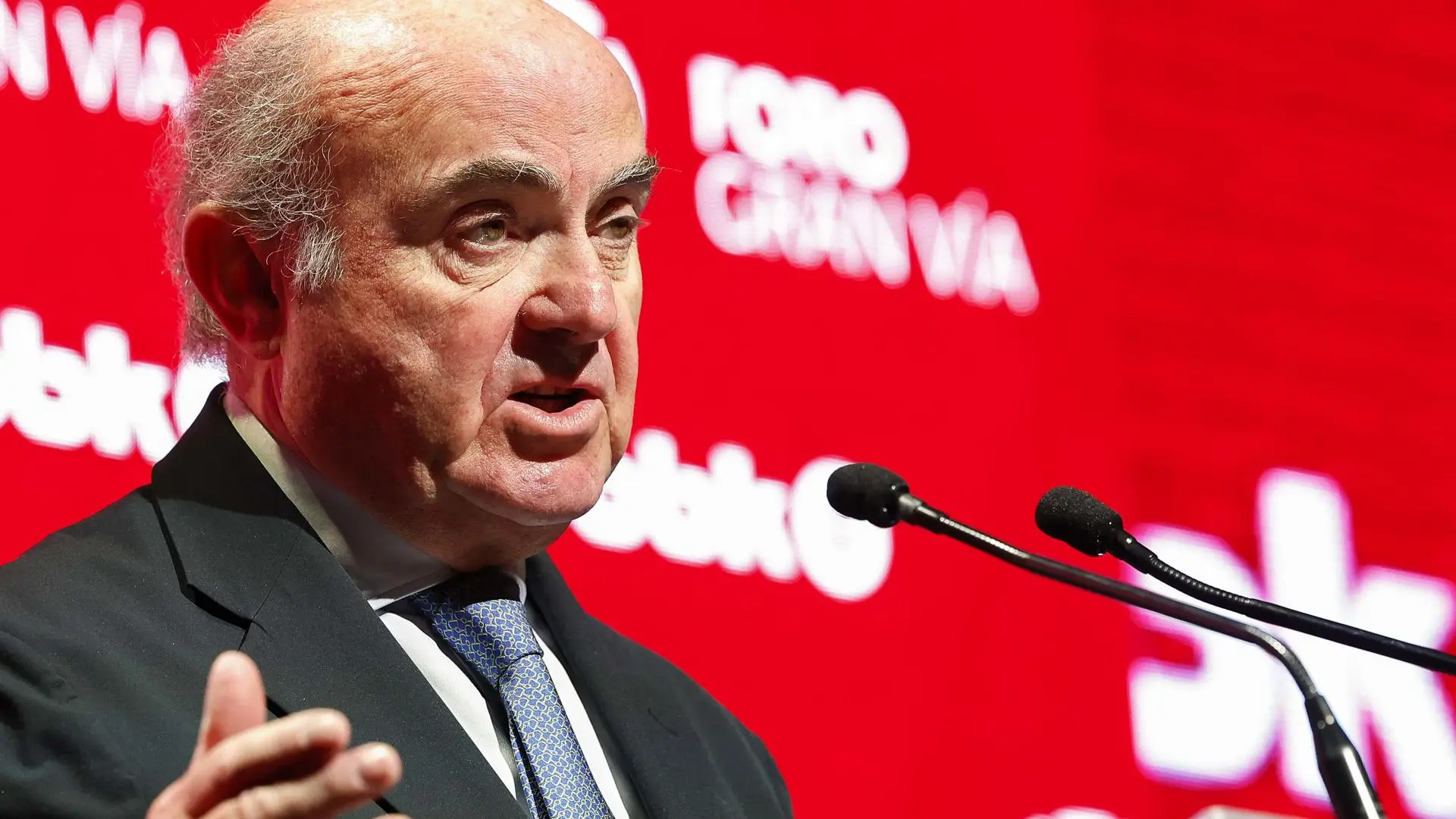
This was stated by the vice president of the entity, Luis de Guindos, within the framework of the Gran Vía Forum, which started this Friday in Bilbao with the help of the BBK Foundation. The ‘number two’ of the entity has stressed that the European economy is “behaving better” than they expected “three or four months ago”, in a time of “enormous uncertainty”. From his point of view, the tariff agreement between the European Union and the United States has prevented the trade war from escalating, which would have been “very negative for everyone.”
Eurostat, the community statistics office, confirmed last week that the GDP of the group of countries that share a currency increased by 0.2% between July and September, one tenth more than the previous quarter. Employment, however, stagnated, increasing at the same rate as in the immediately previous period, barely 0.1%.
Along the same lines, the Composite PMI index prepared by S&P Global and the Hamburg Commercial Bank, published this Friday, shows how activity in the euro zone remained on the rise in November for the eleventh consecutive month thanks to the boost of services, which have increased their activity at the fastest rate in a year and a half.
The analysts who prepared it believe that this trend could continue due to the optimism shown by businessmen. The indicator stood at 52.4 points in November, one tenth below October, but still above the 50 points that separate growth from contraction. De Guindos recalled that tariffs in the United States for European products are going to be “somewhat higher”, since they were around 3% and will be “slightly below 15%”. This will impact European exports, although it must beAlso wait to find out how the agreement with China is closed.
The former Economy Minister under Mariano Rajoy has emphasized that it is “essential” and “an unavoidable objective” for Europe to increase defense spending, although this must be “compatible with maintaining budgetary stability in the medium term.”
Internal barriers, worse than tariffs
However, there are more economic barriers apart from tariffs, as the president of the ECB, Christine Lagarde, has recalled. At the European Banking Congress held in Frankfurt, French policymakers warned about Europe’s loss of competitiveness and how exports have ceased to be the driving force of the community economy, in an environment of trade tensions and increased global competitiveness.
Lagarde has focused on one of the structural problems of the area’s economy since the creation of the euro, the internal barriers that persist in the European market. In his view, these should be “low enough” to stimulate future growth. “In the last 20 years, barriers to cross-border trade within Europe have not been reduced faster than those faced by international companies that want to operate here,” he highlighted.
Thus, although services now account for three quarters of Europe’s economy, trade in services within the Union represents only one sixth of GDP, the same as trade in services with the rest of the world.