The institutional fomo by Bitcoin was unleashed
Bitcoin investment funds (BTC) registered massive capital entries, driven by a phenomenon known as FOMO, or “fear of being left out.”
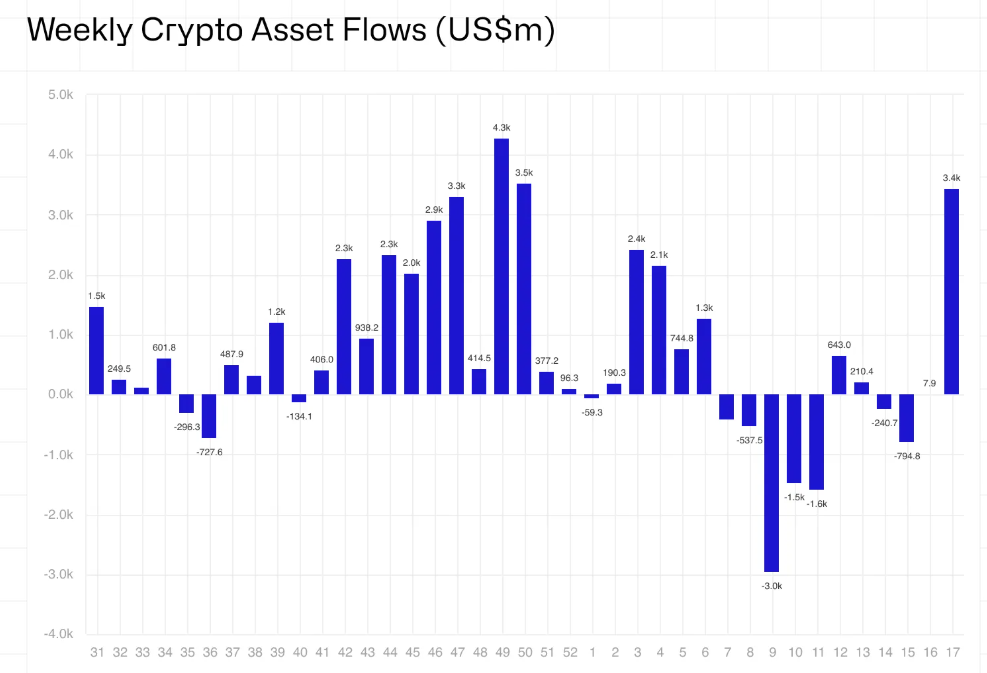
Last week, Investment products in digital assets captured $ 3.4 billionthe third largest weekly entry in history and the most significant since December 2024.
This massive flow, fed by commercial tensions and the weakness of the dollar, reflects a change in the perception of large investors, who fear the opportunity to capitalize on Bitcoin’s boom.
They also show a renewed interest in digital currency as a refuge against economic uncertainty.
What is FOMO and why does it drive investors?
The fomo, acronym for Fear of Missing Out (fear of being left out), describes the anxiety of investors to the possibility of not participating in an upward trend.
In the current context, the rapid rise of Bitcoin, combined with an uncertain economic environment, has unleashed this phenomenon among financial institutions. The perception that other actors are obtaining substantial profits drives more funds to join, creating a domino effect that amplifies capital entries.
A shelter in front of the economic storm
Institutional investors lead this trend. James Butterfill, Chief of Research of Coinshares, attributes the phenomenon to two key factors: the concern for the impact of tariffs on corporate profits and depreciation of the US dollar.
Since January 2025, the DXY index, which measures the value of the dollar against other Fíat currencies, until you fall to 97 points last week, its lowest level in three years.
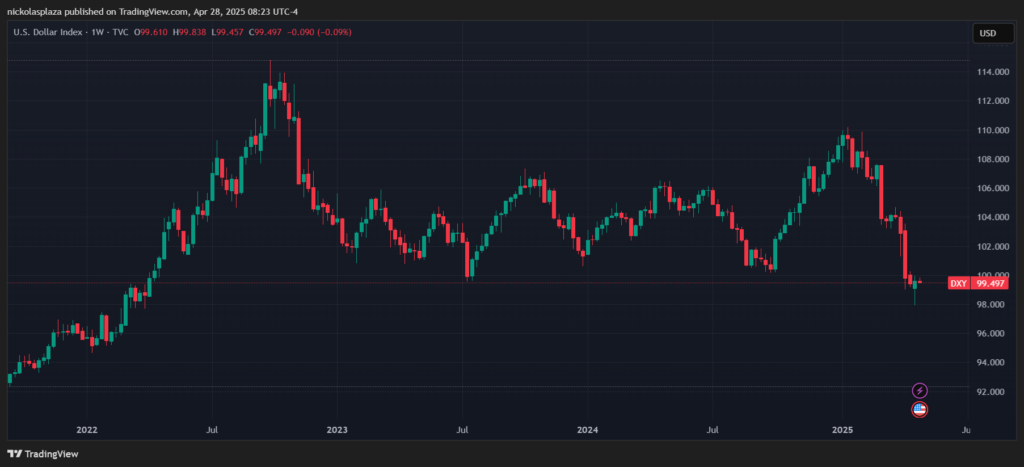
This context, aggravated by the commercial confrontation initiated by the president of the United States against more than 60 countries, with China as the main objective, reinforces Bitcoin’s narrative as an active refuge.
For those reasons, Bitcoin investment products attracted $ 3,180 million in the last weekcarrying the total assets under management to 132,000 million dollars, a level not seen since February 2025.
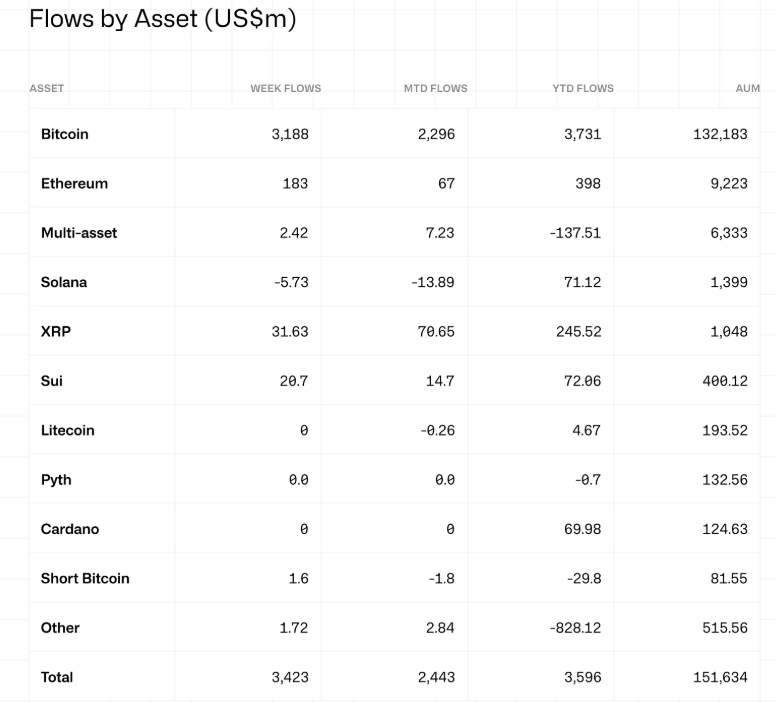
US funds dominated the flow, with $ 3.3 billion ticketsalthough Germany and Switzerland also stood out, contributing 51.5 and 41.4 million dollars, respectively.
The Bitcoin ETF, boom engine
Bitcoin’s listed funds (ETF) in cash in the United States emerge as protagonists. Last week, These instruments recorded tickets for 3,000 million dollarswith a daily peak of 1,540 million, according to Glassnode data.
This volume, one of the highest since the creation of the ETF, coincides with the Bitcoin escalation to $ 94,000. Today, The currency remains above $ 95,00021% more than $ 75,000 three weeks ago.
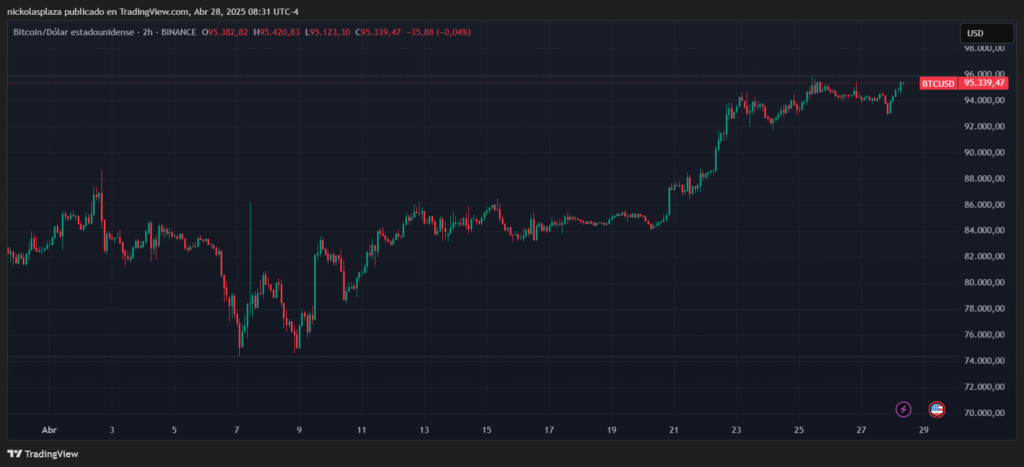
Besides, ETF flows are consolidated as a key indicator of institutional trust. Glassnode emphasizes that, in the last two weeks, the ETF experienced two waves of inputs that exceeded 10% of the Bitcoin cash volume, reflecting a solid demand.
The managers of these funds, forced to buy Bitcoin to support their actions, contribute directly to the price increase, an effect promoted by the supply and demand law.
The term “institutional” refers to large financial actors, such as investment funds, banks, assets and corporations, which handle significant capital volumes. Bitcoin investment products, such as cash ETFs, are mainly used by these institutional investors due to their regulated structure, which allows exposure to bitcoin without the relative complexity of managing digital assets directly.
It should be clarified that operating actions in a stock exchange can also be intricate, since it requires licenses, understanding regulations and assimilating concepts and dynamics typical of those markets. For those who are not initiated or simply feel more comfortable in a known environment, the regulated frame of the ETF offers a more accessible entry point.
A global context in transformation
The backdrop of this boom is a tariff war that begins to decline.
Since April 2, when the US president intensified commercial tensions, Global markets faced uncertainty.
However, recent signals suggest a change. Guo Jiakun, spokesman for the Chinese Ministry of Foreign Affairs, expressed the disposition of Beijing to dialogue, although with a firm tone: “We do not want to fight, nor are we afraid of fighting. If necessary, we will fight until the end. But the door for the conversations is open,” as cryptoics reported.
The suspension of tariffs for 90 days, after the “day of liberation”, has Relieved tensions and fed optimism in markets.
Consequently, institutional investors seem to interpret these dynamics as an opportunity to reposition themselves. The combination of a weakened dollar, commercial tensions and the perception of Bitcoin as a resistant asset promotes this investment fever.
A market in full evolution
Capital flow to Bitcoin sends a clear signal: Large capital assigners see in the digital currency a tool to navigate an uncertain economic panorama.
The ETFs, in particular, act as a thermometer of this trust, with their performance directly reflected in the Bitcoin price. As managers accumulate more coins to support their products, the market experiences a bullish pressure that could consolidate Bitcoin’s recovery.
While global tensions evolve and commercial dialogues advance, investors remain attentive. For now, Bitcoin is positioned as a protagonist in the reconfiguration of investment strategies, marking a key chapter in its consolidation as a time reference asset.