The US bank collapse is in sight, according to analysts
-
Bank of America could collapse, risking a bank run, they show reports.
-
The sale of Treasury bonds by China aggravates the pressure on the banks with unsured deposits
While the attention is diverted to other fronts, a crisis of potentially historical proportions would be brewing in the banking sector of the United States (USA), fueled by a perfect storm of economic factors. There are analysts in the sector that no longer have doubts and do not even wonder if US banks really face a crisis, but how devastating it will be.
The focus of the storm are more than 500,000 million dollars (USD) in “silent losses” that banks accumulate in their balances. The combination of high interest rates, a possible stagflation driven by Trump administration tariffs and a crisis in the refinancing of the treasure debt could be the spark that ignites this financial polvorín, according to analysts of the sector.
The figure was reflected by the Federal Deposit Insurance Corporation (FDIC), the agency that ensures bank deposits in the US, when it indicated at the end of 2024 that the banks accumulated 482.4 billion dollars in these unrealized losses, which showed that these had been raised an alarming 32.5% in just a quarter.
To put it in perspective, we moved to the case of the collapse of Silicon Valley Bank (SVB) in March 2023 – the second major bank collapse in the history of the USA. When losses not made in the system were around $ 515,000. At that time, the bank was forced to sell its bonds with losses to deal with a massive withdrawal of deposits, which revealed its insolvency.
Amit Seru, Finance Professor at the prestigious Stanford University, warns that if the yields of 10 -year Treasury bonds (a key reference) exceed 5%, these “silent” losses could climb up to 700,000 million dollars. Currently, they are 4.5%, but a rebound in April suggests that the figures of the first quarter of 2025, which are expected this week, could show worsening.
Bank of America, a giant in danger
The situation seems particularly worrying for giants such as Bank of America, the largest US Bank for deposits, with more than 2 billion dollars, which represents about 40% of all deposits of the US banking system.
According to financial analyst Porter Stansberry, Bank of America invested about 700,000 million dollars in bonds in the summer of 2020, when the yields of the 30 -year bonds were 1%. Today, These bonds have lost about 40% of their value, which would imply hidden losses of about 100,000 million dollars for the entity.
Stansberry launches a forceful warning by pointing out that if the yields of the bonds rise to 7% or even 10%, the value of the capital of the bank, that is, its financial “mattress” could evaporate, causing a bank run. “It is not a matter of ‘yes’, but of ‘when’,” he said, comparing the current fragility with that of the banking system of 1932, in the middle of the great depression, when the bank bankruptcies were current currency and the confidence in the system collapsed.
The perfect storm: debt, tariffs and distrust
Several macroeconomic factors are combining feeding the possibility of turning on the spark that could incinerate banks, according to Stansberry.
On the one hand is the US debt mountain. This scenario is complicated because the US treasure needs to refinance 9 billion dollars in debt this year and broadcast additional 2.5 billion. In total, about 11 billion dollars in bonds need to find a buyer. If this is not, there could be a failed auction, forcing the Federal Reserve to intervene with measures such as quantitative flexibility, which I would shoot inflation expectations and bond yields.
Then there is the situation with buyers who are in retired. This with countries like China and Japan that have been great buyers of American debt. However, in the last three years they have reduced their holdings, opting for assets such as gold. “We depend on the goodness of strangers, and we are antagonizing with them,” says Stansberry, referring to how possible commercial tariffs (such as those proposed by the Trump administration) could further tighten relations and make it difficult for those “strangers” to continue financing the US.
The Federal Reserve dilemma is also presented as one of the factors that feeds the perfect storm. This is because if the auctions of the bonds fail (that is, there are not enough buyers), The Federal Reserve could be forced to intervene Buying debt herself (a process known as “quantitative flexibility” (QE), popularly “print money”). This could trigger inflation and, paradoxically, push the yields of long -term bonds even above, aggravating banks losses.
“There will be a day when ATMs do not work,” Stansberry predicted, a chilling image that evokes past crises where people could not access their money.
Additional stagflation and risks
Torsten Slok, chief economist of Apollo Global Management, adds another cloud when it refers to stagflation. He talks about the phenomenon that arises when high inflation is combined (prices rise without stopping) with slow or zero economic growth. In such an environment, companies and individuals would have more difficulties to pay their debts, increasing the credit losses of banksespecially those exposed to volatile sectors such as technology, as reported by Fortune.
On the other hand, Rebel Cole, professor at the Atlantic University of Florida, points to the vulnerability of regional banks (with assets between 10,000 and 200,000 million dollars). Many of their clients have deposits that exceed $ 250,000 secured by the FDIC, which makes them more likely to withdraw their money from the first problem signal, as seen with SVB.

“Only one spark is needed,” says Cole, mentioning other risks such as the crisis in the commercial real estate (empty offices, commercial centers in decline). If the unrealized losses force banks to sell mass assets, they could face regulatory closures.
“It is enough for bad news about any of these banks, and we could have another bank crisis such as March 2023. I am surprised that we have not had another since then.”
Rebel Cole, Florida Atlantic University Finance professor.
Although regulators are more vigilant since 2023, Stanford’s Professor SUBORYs stresses that current capital requirements still do not adequately reflect these enormous “silent” losses.
With the banking system described as a “phosphorus box”, experts agree: a deterioration of the economic situation could turn on the wick of a crisis of historical proportions, leaving that of 2008 or that of SVB as mere essays. The question in the air is whether the regulators and the banks themselves You can deactivate this potential time bomb before it is too late.
Bitcoin, a shelter before the storm
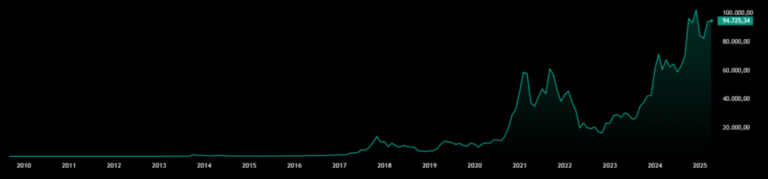
Given this scenario of systemic uncertainty, assets with limited supply gain greater importance, such as Bitcoin (BTC) that also highlights for being sovereign money.
Unlike money in a bank account, which is a bank liability and requires its permission to be moved (and can be frozen or become inaccessible during a bank run), Bitcoin allows its users to directly control their digital assets In an own Wallet (provided they manage their own private keys) and move them without the need for authorization of third parties, such as banks or governments
This capacity for self -ustody and transfer without permission becomes especially attractive to those who seek to protect their assets of the instability of the traditional financial system or possible capital restrictions.
At a time when trust in traditional financial institutions is threatened and the strength of banking foundations is discussed, the option of A decentralized digital asset and censorship emerges as an alternative.
So, today Bitcoin resonates, more and more as an option for individuals and even institutions, which seek to diversify their risks and ensure an independent form of the banking system. The question that many are asked is yes, before a severe crisis, this asset could act as a “digital lifeboat” or simply as another dragged by the tide.