‘They’re awash in cash,’ DEA says of Mexico’s cartels
Key facts:
-
US agencies intend to “paralyze” the financial channels of the cartels.
-
The use of cryptocurrencies and not cash by cartels worries FinCEN.
The United States Drug Enforcement Administration, known by its acronym DEA, is increasingly tracking the finances of Mexican cartels and the groups that trade with them. He has even created a specialized team that is responsible for following leads from the Sinaloa Cartel and other of the oldest drug trafficking organizations in Aztec land.
So, based on this, they claim that they have identified money laundering networks that were not previously known. “And so we discovered that, despite the growing use of cryptocurrencies in drug trafficking, there is still a lot of cash in circulation,” DEA chief of operations William Kimbell said recently.
The concerns of DEA officials and other entities revolve around the fentanyl crisis and its devastating effects on the American population. In this regard, security agencies and legislators agree that the battle against the production and trafficking of narcotics is now must target the financial corridors used by Mexico’s cartels.
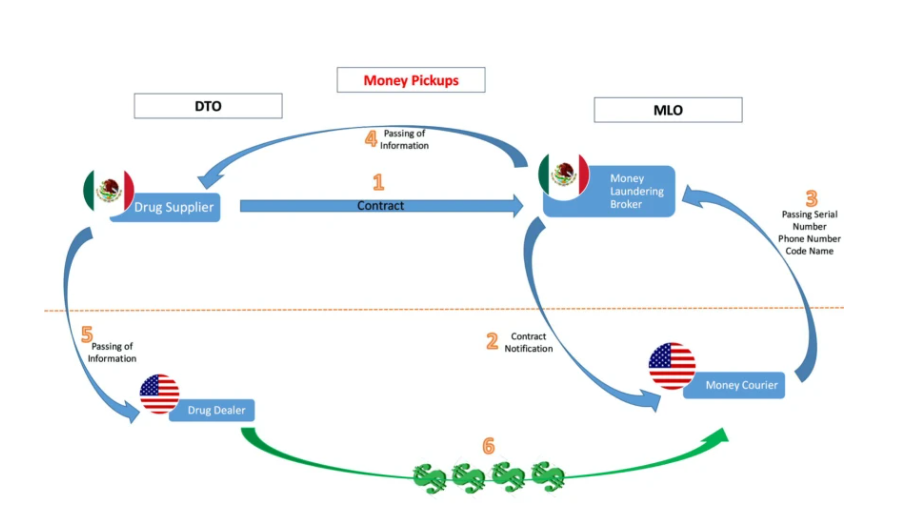
For the DEA, the scenario focuses on the large doses of cash and bank accounts who are using the networks of “money mules”, or messengers. These are in charge of collecting the green bills or dollars in cash that come from the sale of drugs to begin a multi-step laundering process, as detailed in the reports.
Those money mules “are opening accounts at banks large and small here in the United States,” some U.S. officials said. They believe that “without the services provided by these money laundering organizations, many of the cartels’ operations would come to a standstill,” as detailed in a court filing.
U.S. Treasury and Internal Revenue Service (IRS) officials say they began privately informing U.S. banks and social media companies, on whose platforms drugs are often bought and sold. They aim to get a clearer picture of how cartels are exploiting the financial system, officials told CNN.
One of the objectives of the meetings held between security agencies, said an official, is to determine how to use the intelligence provided by smaller banks to detect money laundering fronts in their communities.
Specialists say that the cartels operate with Chinese money launderers mastering the art of so-called mirror transactionswhich involve a series of deposits into multiple bank accounts to hide drug money.
For example, a “money mule” working for a Chinese money laundering network collects bills that a cartel agent obtained from the sale of fentanyl in a certain US state.
The money launderers will then transfer a comparable amount of money to a bank account in China in the name of a front company. Once this is received, members of the Mexico-based money laundering network will credit bank accounts controlled by the cartels with an equivalent amount of money in pesos.
The method means the money does not have to physically cross borders or the legitimate banking system. Mirror transactions allow “Chinese money launderers to circumvent international monetary rules,” said David Luckey, a security expert, adding that money launderers “create the ability to move money without moving money.”
Luckey adds that the tactics used by Chinese money launderers make it “very difficult to trace the money and gather intelligence on all the people involved.” She adds that some of the money laundering activity supposedly passes directly through the largest banks on Wall Street.
Mexican cartels and cryptocurrencies: FinCen’s favorite narrative
Although the DEA is quite clear about the financial preferences of the Mexican Cartels, the Financial Crimes Enforcement Network (FinCEN) insists that the illegal trafficking of fentanyl and its production is linked to the use of cryptocurrencies.
In fact, FinCEN accurately referred to the cryptocurrencies used by Mexican cartels and their allied organizations. These are bitcoin (BTC), ether (ETH), Monero (XMR) and USDT, Tether’s stablecoin.
In this sense, FinCEN calls for U.S. financial institutions identify and report suspicious activity. This is in line with the Anti-Money Laundering and Financing of Terrorism Law (AML/CFT).
It is noteworthy that, since 2019, the US organization published a guide applicable to various business models related to cryptocurrencies. Since then, the recommendations have been adopted by several countries, such that since then service providers are subject to the Bank Secrecy Act (BSA).
One cannot overlook the fact that FinCEN works closely with the Financial Action Task Force (FATF), an intergovernmental organization that sets international standards to combat money laundering and terrorist financing.
Based on this, FATF has been pressuring countries to adopt the so-called travel rule. The objective is share information with each other about usersthat carry out operations that exceed USD 1,000.
The FATF is an international organization whose recommendations are not binding, that is, they do not establish laws, since these are the responsibility of each jurisdiction. However, failing to comply with its guidelines can lead countries or private companies to be gray or blacklisted.
As reported by CriptoNoticias, the Sigapur Financial Authority highlights thatThe banking sector “represents the greatest risk of money laundering”. He states this because the role of these traditional institutions for cross-border transactions “makes banks a common channel for criminal exploitation.”
Additionally, the International Narcotics Control Board (INCB) noted that, although the Jalisco Nueva Generación Cartel and the Sinaloa Cartel of Mexico are using small transfers in bitcoin to avoid money laundering controls, traditional banks continue being the preferred mechanisms for money laundering.