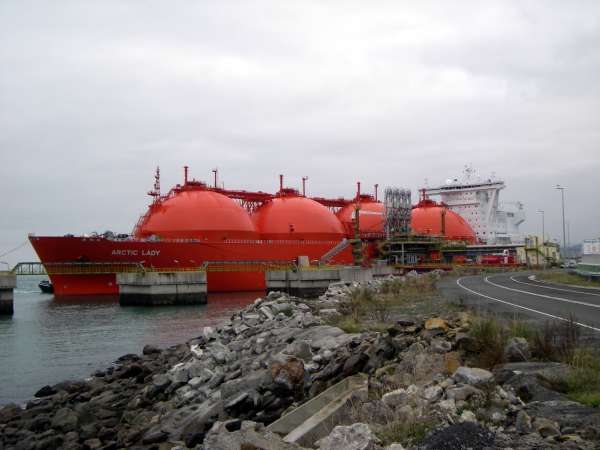
This Monday, the EU will prohibit the arrival at its ports of ships carrying natural gas from Russia that are destined for third countries.
The EU will restrict the arrival of natural gas from Russia for the first time through the agreement reached this Thursday in Brussels to prohibit the arrival at European ports of ships loaded with Russian liquefied natural gas (LNG) that have as destination a third countryso it will close a route that transports it to Asia, according to experts. The measurement appears within a new sanctions package against the regime Vladimir Putin which the ambassadors of the Twenty-seven agreed this Thursday and which the Foreign Ministers will endorse next Monday.
As confirmed by community sources, the ambassadors of the EU countries have closed the agreement on the first community measure against Russian gas, which will not be banned entirely nor for the purchases that operators make to supply the Member States, but it will close the ports to traffic of liquefied natural gas – which is transported in LNG tankers – that has another country outside the EU as its final destination. “The EU has finally realized the role its ports play in transporting Russian LNG to Asia“, have assessed the energy experts of the London-based think tank IEEFA, which prepares analyzes on Russian gas acquisitions.
This sanction is related to the discussion that a few months ago opened among European Energy Ministers about the possibility that the new renewable gases directive gives so that European governments that wish to do so can unilaterally prohibit gas imports from Russia and Ukraine, something that They reject countries like Spain and Belgium, whose energy operators remain the main buyers of Russian LNG. Their governments They didn’t want to make that decision alone.due to the damage that this could cause to their companies and also given the evidence that the gas would also reach the EU, but to ports in other countries.
This was indicated in March by the third vice president and minister for the Ecological Transition, Teresa Ribera, in the first Energy Council that was held after the rule that gives this possibility came into force and in which sought coordinated action from the rest of the countries. However, he could only confirm that there was no quorum to act together against imports to the EU of liquefied natural gas from Russia.
In an appearance in the Senate weeks later, Ribera pointed out that The EU continued to work on Russian LNG imports and shortly after it was learned that the High Representative for Foreign Affairs and Security Policy, Josep Borrellhad proposed to the EU countries a new package of sanctions against Russia -the fourteenth- which included the prohibition of ships loaded with LNG from Russia docking in European ports when their final destination is a country outside the EU. The proposal has been endorsed this Thursday by the ambassadors -in Coreper- and on Monday it is expected to be approved by the Foreign Affairs Council which will be held in Luxembourg.
Spain, among the first importers
This measure will not stop Russian gas from arriving by ship to EU countries, among which Spain continues to stand out as one of the main importers. According to IEEFA’s monitoring of European LNG imports, Russia was the second exporter to the EU after the United States and only Spain, France and Belgium received 80% of these imports, which between 2021 and 2023 grew by 11%. According to Enagás, in January 2024 Russia was the third main source of gas entering Spainafter LNG from the United States and the gas that arrives from Algeria by gas pipeline and 8,687 gigawatts of gas arrived from there, 26.9% more than in January 2023.

Last year, the EU spent more than 8 billion to import Russian LNG, of which Spanish operators paid the largest amount, 2.31 billion, ahead of France, Belgium and the Netherlands. According to the same IEEFA monitoring report, there are two Spanish ports among the five with the most Russian methane tankers with LNG they have received in these two years, the one in Bilbao and the one in Mugardos, in Ferrol.
The main recipients in the EU of methane tankers with Russian LNG, the Belgian port of Zeebrugge and the French port of Montoir-de-Bretagne, continue to receive gas from a Russian field in Siberia that last year ended up with 90% of the total in non-EU markets. Europeans, this London consultancy abounds to illustrate the effect of this new EU sanction, which can serve to strangle trade routes with Asia “without affecting the EU’s security of supply and that will prevent Russia from using its terminals [de GNL] for their own benefit.”
First measure against gas
In any case, with this new sanction the EU actsfor the first time explicitly against Russian gaswhich currently only arrives by ship, in a liquid state, after the sabotage that in September 2022 left the gas pipelines that link Russia and Germany, Nordstream 1 and Nordstream 2, unusable and through which it arrived in a gaseous state.
Until now, in the field of energy, the EU has acted through sanctions against Petroleum from Russia, by prohibiting its import by sea and refined petroleum products, as well as liquefied petroleum gas (LPG) and also coal Russian in all its modalities.