Tired of losing with Bitcoin? Stop guessing the price and get on the trend
Of course, if you had the ability to predict the future, you wouldn’t even have done click To enter and read this article.
And if you have already arrived until this second paragraph, it is time to ask yourself: are you going to continue playing to guess the price of Bitcoin (BTC) or are you going to start investigating already made founded decisions?
If the story has demonstrated, it is that price predictions usually fail. This is not an opinion, it is a numerical and statistical issue: if there are dozens of analysts making opposite projections (some announced a super bullish cycle and others warning a fall) it is clear that most will be wrong. They can’t be right at the same time.
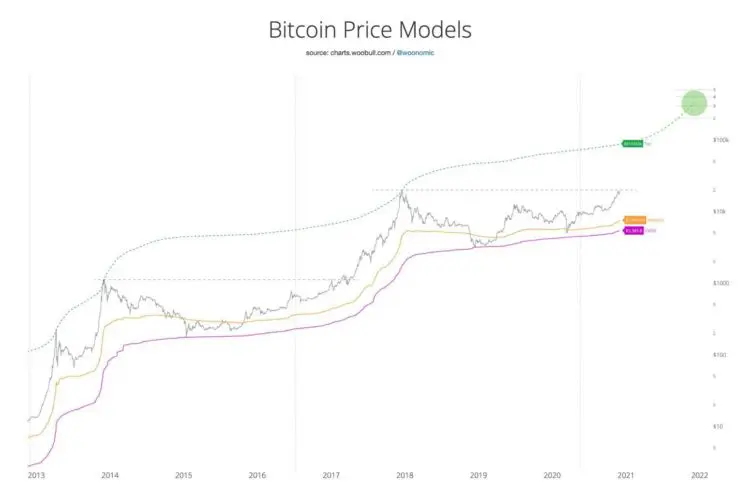
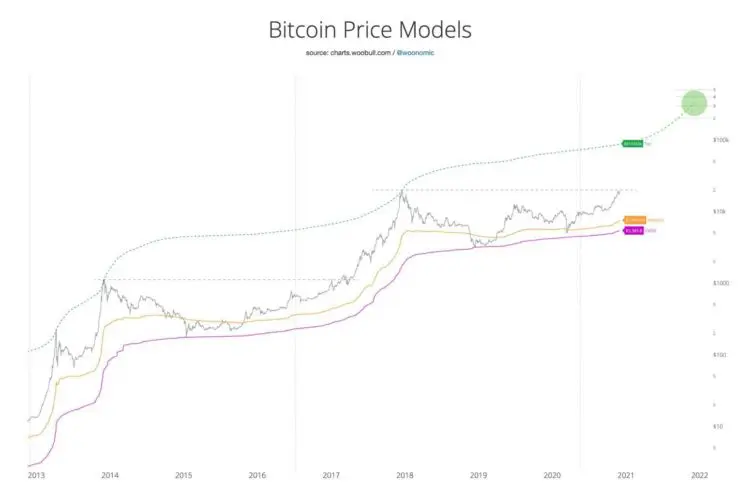
For example, at the end of 2020, Willy Woo, an influential market analyst from BTC, shared through its social networks a model on the price of the asset, which projected a price of 200,000 by the end of 2021.
To reach that figure, he used a predictive model based on the average capitalization and other metrics that, at least for those who just start taking their first steps in trading, sound sophisticated and complex.
These indicators, according to him, anticipated an explosive movement of the price. Was that prediction fulfilled in December 2021? No, Bitcoin was not even close to exceeding the $ 100,000 line at that time. The price just exceeded that barrier in December 2024, long after what Willy Woo had projected.
And far from having a personal issue with him, what is revealed is that operating based on specific predictions, however fun, exciting or convincing that may be for some, rarely leads to fruition. Even when that projection is done by someone as popular and respected as Woo. In case it is not clear: Not even complex models made by a recognized specialist guarantee success in the market.
The same goes for technical analysis. Social networks have become a true culture broth for projections that are rarely fulfilled. And here you can see all kinds of “sophisticated” patterns, such as: triangles, flags, Elliott waves, fibonacci setbacks. Many of them forecast precise movements, but in most cases they end up being useless.
Is that, in short, They are patterns that do not have strict rules and lend themselves to the interpretation of those who do them. For example, use a different temporal frame (1 hour, 4 hours or daily) to accommodate the analysis, according to the narrative.
An analyst can look at a BTC price chart and warn that a bullish flag is being consolidated. It is a technical analysis figure that arouses the interest of investors because it is an upward signal.
This pattern is characterized by a strong initial bullish impulse, followed by a consolidation phase in which the maximum and minimum prices are narrowed to converge in a point. This compression results in a triangular figure, which usually anticipates a price increase.
But just as someone sees a bullish flag, another can interpret the same structure as a descending channel, which indicates that the price could continue to fall.
Another issue to keep in mind is that these predictions do not consider unpredictable factors that can change the story in the blink of an eye, such as unexpected news, regulatory changes, movements of large investors or global events (such as a “war of tariffs”, to mention one). For this reason, base 100% of your decisions on technical patterns or price predictions (even if they are performed by yourself), usually does not end well.
If you are tired of losing with BTC, It is time to leave the exact forecasts aside and start analyzing the general behavior.
Outside the predictions, it is time to follow the trend
More than guessing the future, the important thing is to understand how to interpret the present. Or, rather, what is happening now. And precisely the trend indicators have proven useful for that: They send clear purchase and sale signals.
The trend monitoring strategy in investments is based on detecting the direction that the market is taking and operating aligning with that movement. In essence, it is about identifying whether the impulse is upward or the decline, and to take advantage of that dynamic.
If the trend is positive, opportunities are sought to buy, but if the market shows a negative trend, it is best to sell or stay out to minimize risks. This strategy, although a trader could consider it basic, is extremely effective. Who said that 500 indicators are needed together to be successful in the markets?
As Cryptonoticia explained, one of the most classic strategies to follow trends is the crossing between the 10 -day exponential (EMA) mobile average and the 20 -day.
When the 10 -day EMA crosses above 20 days, it is interpreted as a purchase signal, since it suggests the beginning of an upward trend. Otherwise, if the 10 -day EMA crosses below, it is considered a sale signal, anticipating a possible drop in the price.
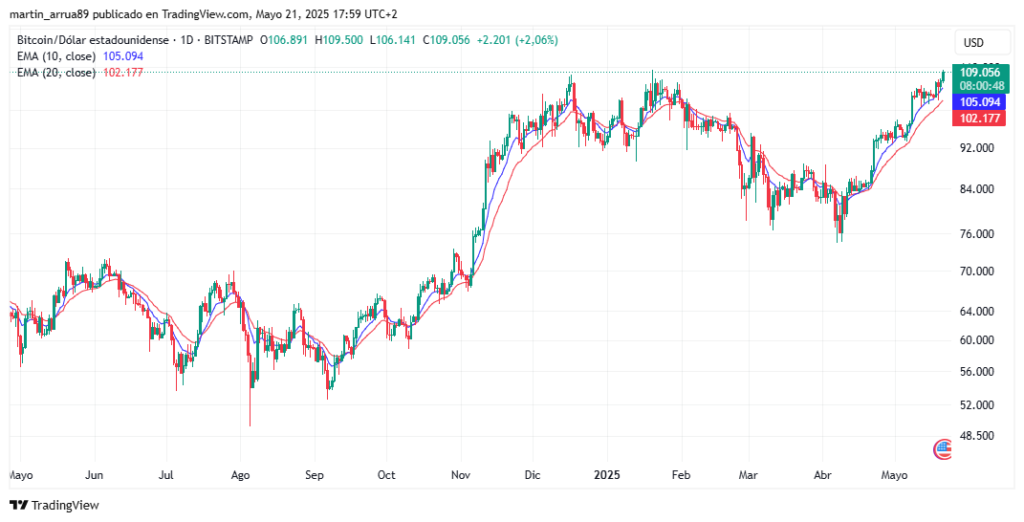
As seen in the following graph, at the time of writing this note, the 10 -day EMA (blue line) is above the 20 -day Ema (red line), indicating that the trend is bullish. With this strategy it is only a matter of getting up or getting off the “train” according to mobile sock crosses, signs signs.
Trend -based strategy is also useful for those who have a long -term approach and prefer to keep their BTC. Instead of a Hodl Liabilities, they can opt for a more dynamic approach: enter when the indicators show an upward signal and leave when the trend becomes bassist.
The fact of implementing this strategy is not to try to predict exact prices. It is a way to stay in the game in the long term, to avoid the worst moments of the market and reduce the margin of error and the risk of being caught in a new crypto -winter.
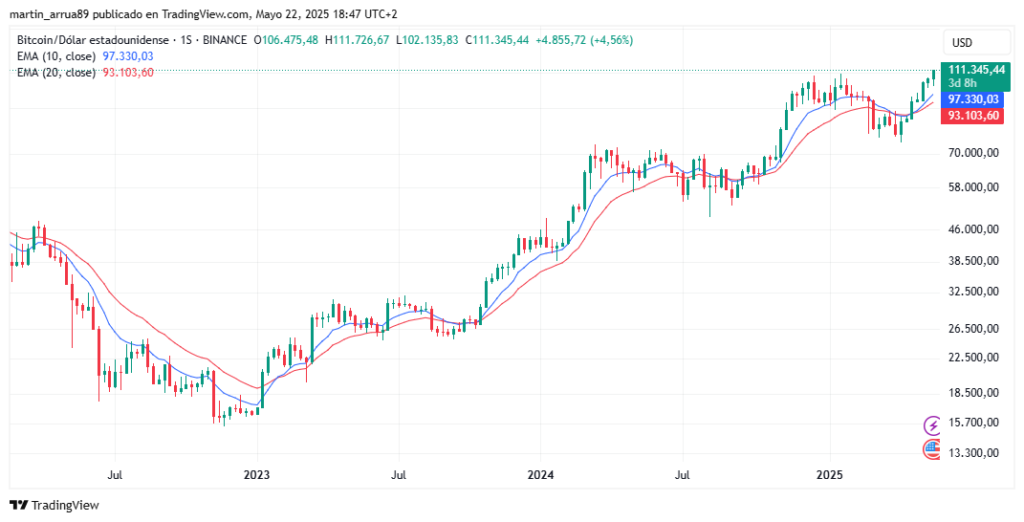
For example, let’s observe what happened in October 2023, the EMA of 10 days crossed above 20, given an entry signal to the market. A few months later, in April, the trend was reversed and the 10 -day EMA was below the 20 -day, a clear signal to go out with profits.
Of course there is no infallible method. The strategy presented here, for example, usually gives false signs in periods of lateralization. But these are compensated by the great profits that it has subsequently thrown.
With this strategy, as evidenced by a Backtesting Historical with the BTC price chart, you can avoid large price drops (cryptoinvian) and get on the wave when the Bull Rons.
Tired of losing with Bitcoin? Well, this strategy has proven effective, simple and Less exhausting than trying to decipher complex metrics or dizzy with so many price predictions.
Discharge of responsibility: The views and opinions expressed in this article belong to its author and do not necessarily reflect those of cryptootics. The author’s opinion is informatively and under no circumstances constitutes an investment recommendation or financial advice.