

Traditional banking is playing tetris with dynamite and bitcoin gains value
The current financial system, based on Fíat money (that is, forced course money without support issued by the states), resembles a game of tetris played with unpredictable pieces. Each movement seems to solve an immediate problem, but at the expense of creating another later.
We all know what this game is like: at some point, the accumulation of without fit parts occupies the available space and you lose the game, no matter how much you have taken it well for some time.
The tetris of the financial system, built on Fíat money, is sustained by force of different maneuvers, such as the inorganic issuance of money and economic decisions that seek to bind with wires an “prosperous” economic path.
When central banks print money, they are altering the money supply artificially. This practice, presented many times as necessary to stimulate the economy or face crisis, It has an obvious cost: inflation.
The result is that each monetary unit loses purchasing power, eroding the income and savings of millions of people. But, the machine to make money keeps in love not only rulers, but also economists who are those who should warn of their risks.
In recent years, this trend has intensified. After the financial crisis of 2008, and even more with the Pandemia of 2020, the monetary issuance in several countries, for example, in the United States, shot. This expansion, without a structural brake, presses rising prices and creates bubbles in financial assets.
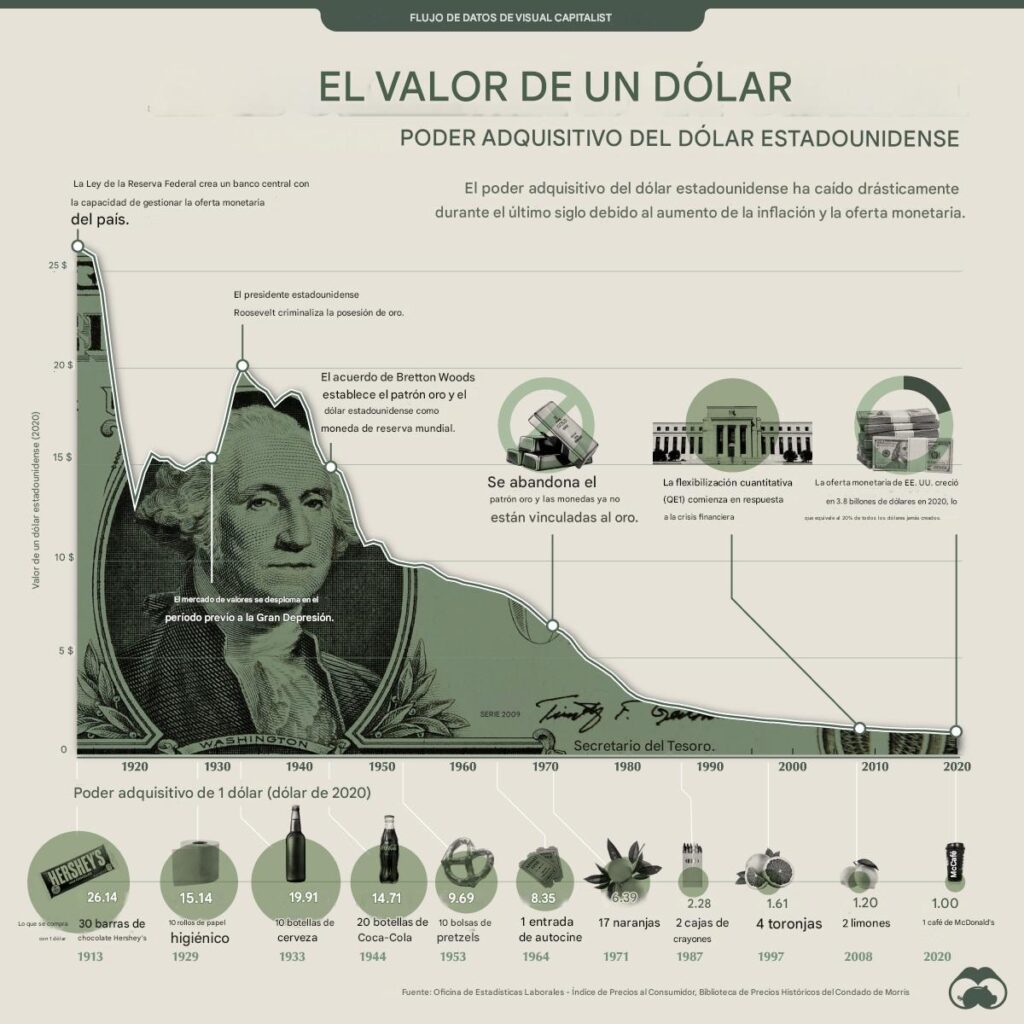
Even the US dollar (USD), the currency that accumulates more adoption in the world, is subject to devaluation due to its growing impression. Therefore, it is crucial to take into account that loses purchasing power, although it remains stronger than other coins Due to its greater demand.
The loss of purchasing value of the dollar can be seen below since the creation of the Federal Reserve (FED), American Central Bank, in 1913:
Along with the growing printing of money, central banks operate with tools that seem to give control, but can also aggravate the problem. Up or lowering interest rates has become its preferred form of molding the economy.
When there is inflation, interest rates raise; When the economy slows down, they lower them. But this logic creates distortions: increases can cool the economy more than necessary, while excessive decreases stimulate debt and irresponsible expense.
To this is added the economic measures of each government that can also distort the prices of the economy, such as financial restrictions or the recent import war war, reported by cryptootics.
The problem, in the end, is that It is not a system that responds only to technical calculations, but to the considerations of the ruler on duty. In addition, the economic decisions of countries are often motivated by short -term political interests.
Then, today a government imposes a policy and tomorrow another reverses it by establishing its own, an endless cycle that is unknown to where it can go. This sway introduces more volatility into a system that already has enough.
There is no one to save this tetris, but those who can play better
As is classic of the human being seeking to always go afloat, Traders and investors take advantage of these fluctuations to operate in the markets according to changing economic expectations. Although, yet, they are still tied to the uncertain panorama of this endless tetris.
But what is left for the rest? What remains for the common citizen who is not aware of how his money is devalued Fíat? While central banks and governments “play” with the rules of the economic system, the consequences are all lived.
Inflation is not just a statistic: it means that with the same income/salary you buy less. It means that savings lose value continuously, without the need for a visible financial catastrophe.
In addition, in countries with weaker currencies, economic powers decisions have an amplified effect. Uploads of rates in the United States, for example, can cause capital to leave emerging economies, affecting the exchange rate and further increasing local inflation.
Faced with this panorama, it is clear that the Fíat financial system faces structural problems that are not solved only with short -term patches. What is done then?
A possible solution is to demand greater fiscal responsibility and clear rules to the central governments and banks, limiting the inorganic issuance of money and reducing the political use of monetary policy. An example could be to prohibit the financing of public spending with the issuance of money, as Argentine President Javier Milei wants.
On a personal level, Maintaining a diversity of assets with possible appreciation or less loss of value is necessary to surf this tetris. Otherwise, savings can be devalued in a loud way.
For example, who stayed with 50,000 pesos (ARS) in Argentina in 2001 when they were equivalent to $ 50,000 (USD) and reached to buy a property, today would have 45 dollars that barely reach to pay a dinner for three people in a restaurant.
Bitcoin as an escape route
This crisis of the traditional financial system makes Bitcoin relevance (BTC), an asset that was born in 2009 as a different alternative from Fíat money. Considered as “digital gold” by its defenders, this currency has had a growing adoption since its origin for its unique attributes.
Unlike money Fíat, Bitcoin has a limited emission by design. No one can arbitrarily decide more. Its monetary policy is transparent, predictable and does not respond to the interests of a central bank, nor to the electoral cycles.
With its fixed supply, its growing demand has caused its price to rise around each halving, an event that reduces the broadcast of BTC every four years, as seen below.
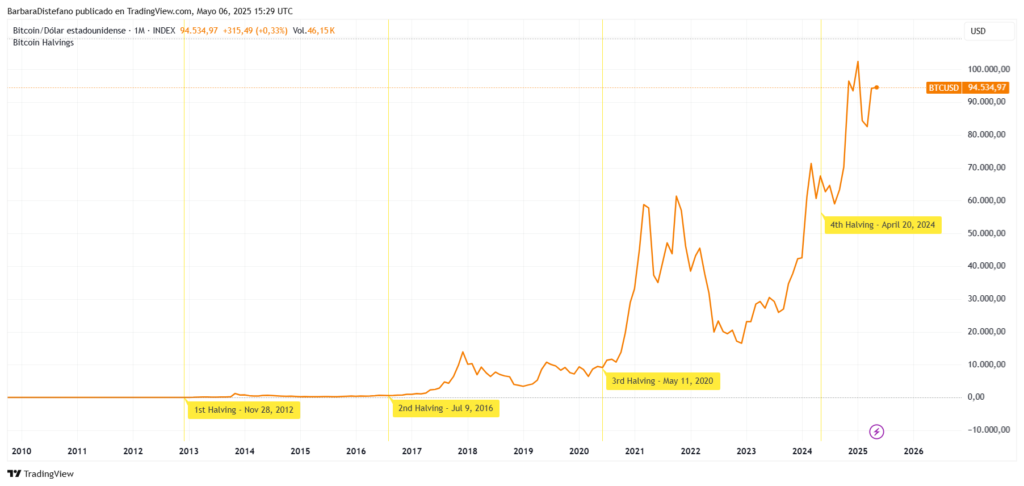
This does not mean that Bitcoin has no risks. Its price volatility based on its strong changes in supply and demand are real obstacles. But it is also true that, in the face of increasingly arbitrary and manipulable systems, having access to a form of decentralized money offers an exit.
It is not a utopia: it is a network designed to resist censorship, inflation and political control. It is also an asset that can self -state and transfer directly instantaneously without the need for intermediaries, authorizations or high costs.
In short, while traditional banks insist on playing tetris with dynamite, individuals have the possibility of looking towards other options. Bitcoin does not fix everything, but invites us to stop playing with explosives and building, perhaps, a stronger structure from the beginning.
In this sense, it would not be surprising that Bitcoin investment continues to rise over time, the more people discover the importance of having their money outside the Fíat system. Therefore, every saving should have even a small fraction in BTC so as not to miss its potential.
Discharge of responsibility: The views and opinions expressed in this article belong to its author and do not necessarily reflect those of cryptootics. The author’s opinion is informatively and under no circumstances constitutes an investment recommendation or financial advice.


