USD 12 billion entered bitcoin through ETF. How does it impact the market?
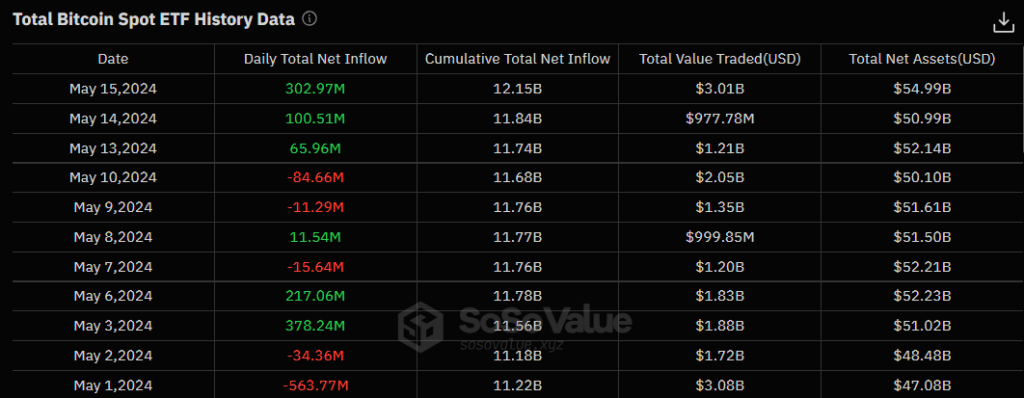
Bitcoin exchange-traded funds (ETFs) in the United States have already accumulated more than 12 billion dollars (USD) since their launch four months ago. This figure is approximately equivalent to 185,000 BTC and is reached despite the recent capital outflows they have experienced.
With such performance, In their short life so far, ETFs have become a capital attraction vehicle that drives up the price of bitcoin.. This is because, precisely, the companies that manage them buy the currency equivalent of the tickets they receive, which can be seen below.
In the following graph, you can see the influence of ETFs on the price of bitcoin. In periods of large inflows, the currency was pushed upward, unlike outflow scenarios where it showed downward pressure. This is because the ETF managers can decide to sell the bitcoin that backs the funds. That, by simple law of supply and demand, due to the magnitude of these sales, causes the price of BTC to drop.
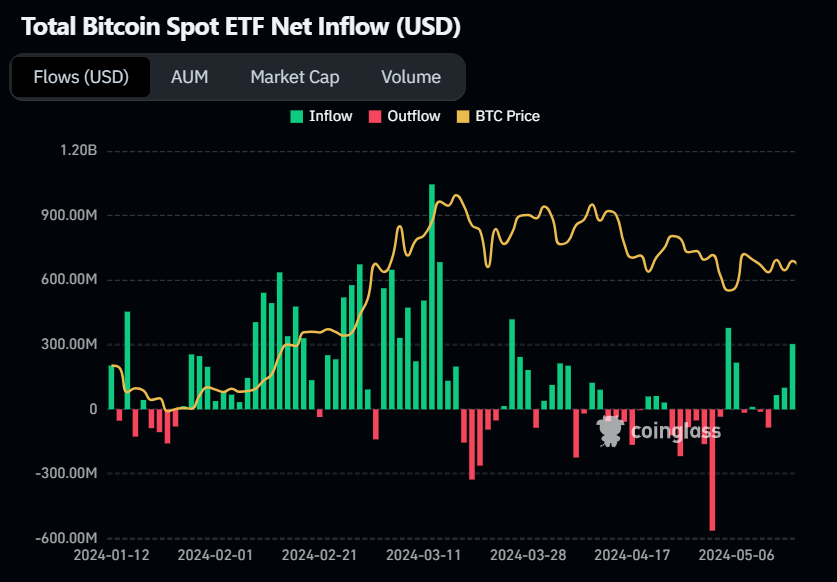
So far this week, ETFs have seen increasing daily inflows, which is positive for the market. These instruments They haven’t closed a full week of daily entries for two months when bitcoin reached all-time high price of USD 73,700. Therefore, a return of this would imply a bullish signal.
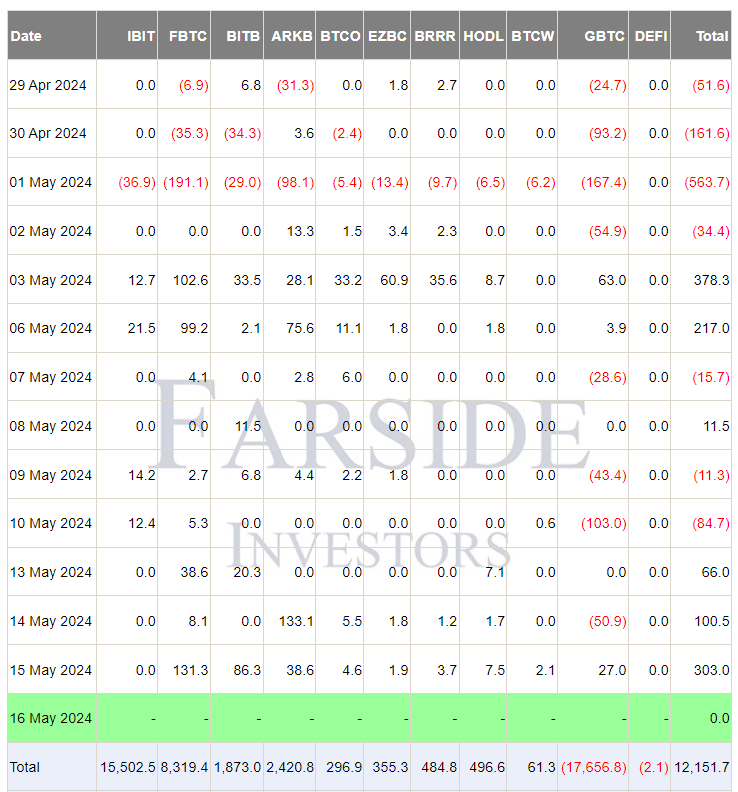
Something optimistic for the market is that the bitcoin ETF, Grayscale Bitcoin Trust (GBTC), recorded three consecutive days of positive capital flows in May for the first time, breaking the trend of continuous daily outflows since its launch due to high commissions operations that he charges.
Meanwhile, other ETFs such as Fidelity Bitcoin Fund (FBTC) have been seeing inflows this week, even though BlackRock’s iShares Bitcoin Trust (IBIT), which led demand since launch, had zero inflows. This, which can be seen below, shows that greater competitiveness is developing among the funds that attract new capital.
There is a wave of institutional investment in bitcoin that still looks “early”
In a new analysis, Matt Hougan, CIO of the Bitfinex exchange, highlights as a positive signal for the market that there is a wave of early institutional investment. It distinguishes that, in recent days, more than 560 investment firms reported, in their public asset reports, that they had USD 3.5 billion in bitcoin ETFs.
“This scale of holdings is off the charts for a new ETF,” Hougan warns. He contrasts that most new ETFs that launch attract very few reporting institutional investors in their first months on the market. In this sense, an unusually strong interest in these assets is exhibited from the beginning.
Furthermore, it highlights that retail holds the majority of the capital in bitcoin ETFs for now. He clarifies that The investors Institutionals hold only about 7%-10% of such assets, but these allocations could simply be an initial investment. He expects his positions to increase.
To put it in perspective, it indicates that investment firm Hightower Advisors has $68 million allocated to bitcoin ETFs, which is equivalent to 0.05% of its assets. An increase in its allocation to the minimum recommended percentage of 1% would be equivalent to USD 1.2 billion, he mentions.
“Multiply that by the growing number of professional investors participating in the space, and you can begin to see what is behind my enthusiasm,” concludes the Bitfinex CIO.
According to first quarter reports, The largest bitcoin ETF investors are Millennium Management with $1.8 billion and Susquehanna with $1.1 billion. This is shown by the following data collected by the flow researcher of these instruments, Julian Fahrer.
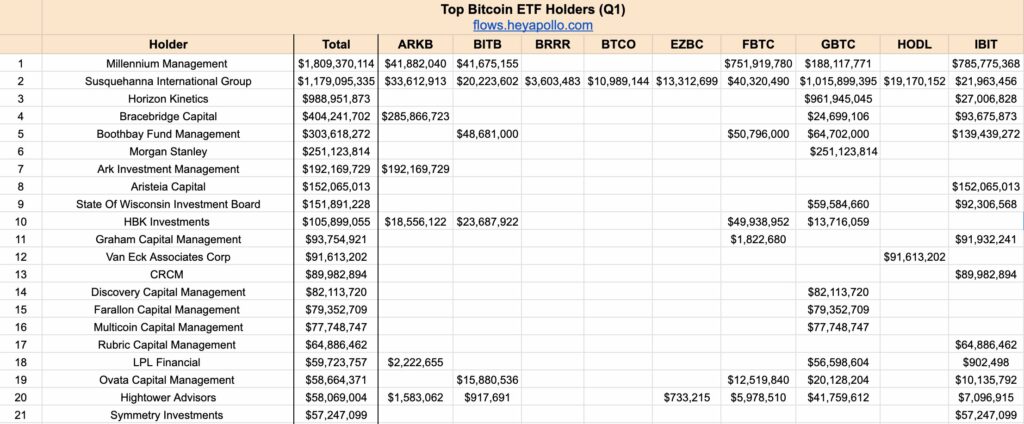
Among the largest investors are distinguished banks, such as Morgan Stanley. This banking entity, which is one of the largest in the United States, reported this week an exposure in bitcoin ETFs of USD 251 million. Growing institutional investment in bitcoin ETFs also comes from foreign entities of the United States, including several Canadian banks.
In this sense, as the adoption of large investors continues, this can take the price of bitcoin to new heights. According to analysts reported by CriptoNoticias, such as Florian Grummes, investment could increase when the summer in the northern hemisphere ends, a season in which markets tend to reduce their trading volume.