USDT fell in Argentina after the stocks of the stocks
On Friday, April 11, 2025, he marked a milestone in the Argentine economy: The Government announced the removal of the exchange ratea measure that restricted the purchase and sale of dollars since 2019.
This decision, communicated by the Minister of Economy, Luis Caputo, and supported by President Javier Milei, It seeks to normalize the exchange market, encourage the entry of investments and close a stage of strict controls that limited the economic growth of the country.
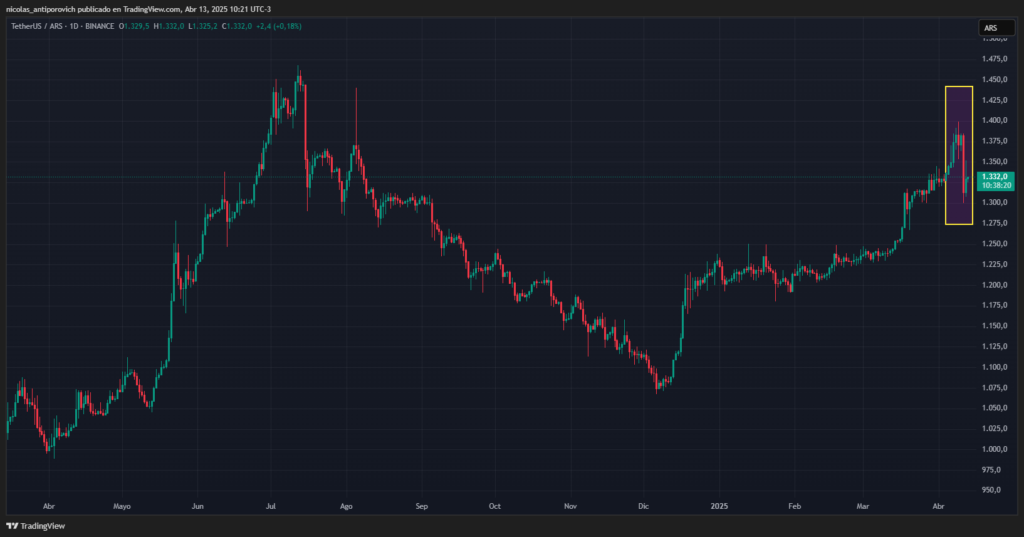
The impact of this measure is not only felt on traditional markets, but also on the cryptocurrency ecosystem. The price of “crypto dollar” (mainly the USDT stable, which is the most used) measured in pesos has fallen since Friday afternoonas seen in the graph below (yellow painted area):
At the time of this publication, at the Exchange Binance, Each USDT is traded by 1,333 pesos. On Wednesday, a couple of days before the ads of the Minister of Economy, it had reached 1,400 pesos.
Milei’s economic plan entered “Phase 3”
The exchange rateimplemented in September 2019 during the management of Mauricio Macri and hardened under the government of Alberto Fernández, as Cryptooticias reported it, Different restrictions imposed on foreign currency access.
Argentine citizens faced a monthly purchase limit of 200 dollars through the official market, with additional taxes that increase operations. This situation generated a parallel market, where the dollar “Blue” and other alternative exchange rates, such as the crypto dollar, reached significantly higher contributions than the officer.
The announcement of the uprising, made after an agreement with the International Monetary Fund (IMF) for a loan of 20,000 million dollars – of which 15,000 million will be available in 2025 – introduces a new exchange scheme.
Since Monday, April 14, natural persons can buy dollars without restrictions on amount in the single and free market (MULC), eliminating the quota of 200 dollars and the obstacles associated with subsidies, public employment or assistance during the pandemic.
In addition, the Central Bank of the Argentine Republic (BCRA) established a system of exchange bands, with an initial range of between 1,000 and 1,400 pesos per dollar, which will be updated monthly by 1%. This mechanism seeks to grant flexibility to the exchange rate, allowing fluctuating according to supply and demand, although under some official supervision.
Minister Caputo stressed that the measure, supported by a capitalization of the BCRA and a fiscal surplus, marks the beginning of the “phase 3” of the Economic Plan of the Milei Government, which prioritizes the economic opening and the attraction of capital.
However, not everything is absolute liberalization: Restrictions for companies persist, as limits for the payment of exterior dividends prior to 2025, and Tax surcharges are maintained for card and tourism consumption.