Who will dominate the Ethereum ETF market?
Key facts:
-
BlackRock leads the bitcoin ETF market. Will history repeat itself with ether (ETH)?
-
Retail investment in ether and bitcoin ETFs would not necessarily be the same.
The launch of spot bitcoin (BTC) ETFs seemed like a major milestone, but far from dampening excitement, it fueled interest in ether (ETH) ETFs, Ethereum’s cryptocurrency.
With the upcoming arrival of these funds, the world of cryptocurrencies is expectant. So investors will have to make several key decisions that will define who will dominate the market for these funds.
One of the most important movements will be the choice of issuing companies to invest in. This is where the rates offered by the companies play a crucial role..
ETF fees are costs associated with investing, usually built into the price of the asset. These fees are used to cover management, brokerage and administrative services expenses, providing profitability to the issuing company.
According to Roxanna Islam, an analyst at the analysis and investment company VettaFi, as with bitcoin ETFs, the biggest differentiating factor between the different options will be the fees.
“Fees could be similar for each bitcoin spot ether counterparty,” he notes in his report.
Fees boosted some bitcoin ETFs, hit others
With bitcoin ETFsthe lowest fees for ETFs issued by companies BlackRock and Fidelity have allowed them to dominate the digital asset-based fund sector, suggesting that they could dominate again with Ethereum ETFs.
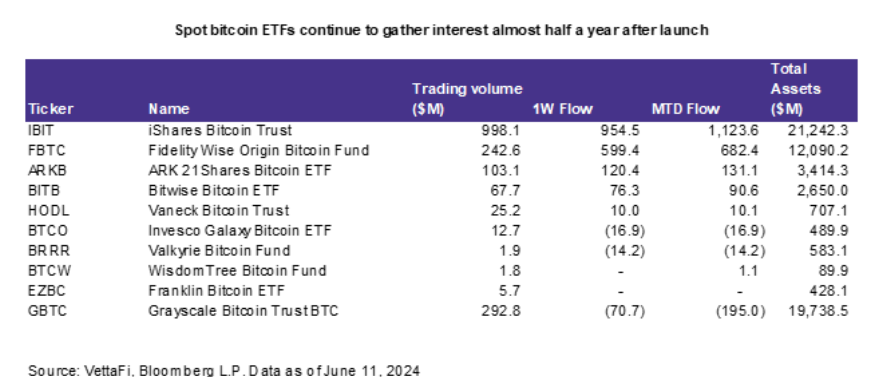
BlackRock, with iShares Bitcoin Trust (IBIT), manages 305,591 BTC, while Fidelity Wise Origin Bitcoin Fund (FBTC) has 171,529 BTC. Its success is due to the significant interest generated among investors due to its low fees.
In contrast, high fees can hinder an ETF’s success, as seen with Grayscale Bitcoin Trust (GBTC), which went from holding the most BTC to now falling behind IBIT in terms of BTC under management. , with 280,413 BTC.
In the following image you can see the behavior of bitcoin ETFs since their launch on January 11 in the United States.
Islam warns that not only fees should be considered by investors. “Bigger brands create an illusion of security, especially when investing in a higher risk asset,” he says.
“You can still see some interest in the ether ETF battle,” he says. The analyst points to Bitwise, for example, which has been very active in the cryptocurrency space, with several ETFs, including Bitwise Bitcoin (BITB).
ProShares, known for launching the first bitcoin futures ETF, was the last company to file to launch an ether ETF on June 11, 2024.
Retail investors prefer bitcoin, but that could change
Some retail investors seek exposure to bitcoin through ETFs without purchasing it directly. This group considers that the funds facilitate investment. The reasons why they invest in bitcoin include its diversification, inflation protection and growth potential.
According to Islam’s analysis, the high correlation between bitcoin and ether reduces diversification benefit by investing in both.
“Although the correlations have diverged recently, they are still relatively high between the two. “That means investors may not have diversification as a reason to invest in both,” he notes.
However, ether ETFs may still be attractive due to different use cases between BTC and ETH.
Bitcoin is an alternative to fiat currencies and offers an escape from major financial institutions traditional.
For its part, ether, being the cryptocurrency that powers the Ethereum network, serves as a platform for stablecoins, non-fungible tokens (NFT), decentralized autonomous organizations (DAO) and other decentralized applications (dApps).
In fact, Islam assures that “the growth potential of Ethereum applications could exceed that of bitcoin in the long term.”
ETF specialist Nate Geraci wonders why BTC and ETH can’t coexist? In their opinion they have completely different use cases.
“Don’t get carried away by the animosity between bitcoin and ether advocates,” he says. A clear example is that investors in gold and oil do not argue among themselves about which is better. “It doesn’t make sense,” he argues.
For now, we are still waiting for the final date on which Ethereum ETFs will be allowed to list on the stock exchange. According to statements by Gary Gensler, president of the United States Securities and Exchange Commission (SEC), they would be approved “at some point during the course of this summer,” as reported by CriptoNoticias,
Given the lack of clarity from Gensler, Bloomberg Intelligence analyst and ETF specialist Eric Balchunas noted that the new financial products will likely be approved during the first week of July.