Why are chickens confined, can I continue consuming eggs and what is the risk of contagion for people?

Avian flu has become one of the biggest headaches for the poultry sector in Spain. The Ministry of Agriculture has decided this Thursday, through a ministerial order published in the Official State Gazette (BOE)extend the confinement of poultry raised outdoors to all of Spain. The measure seeks, according to the department he directs Luis Planashe reinforcement of prevention measures against the spread of the virus. But what are the reasons behind this measure? How many outbreaks of avian flu are there in Spain? Can it affect humans? Below are all the keys to a virus, which has already impacted the price of products such as eggs and chicken meat.
Why has the decision to confinement been adopted?
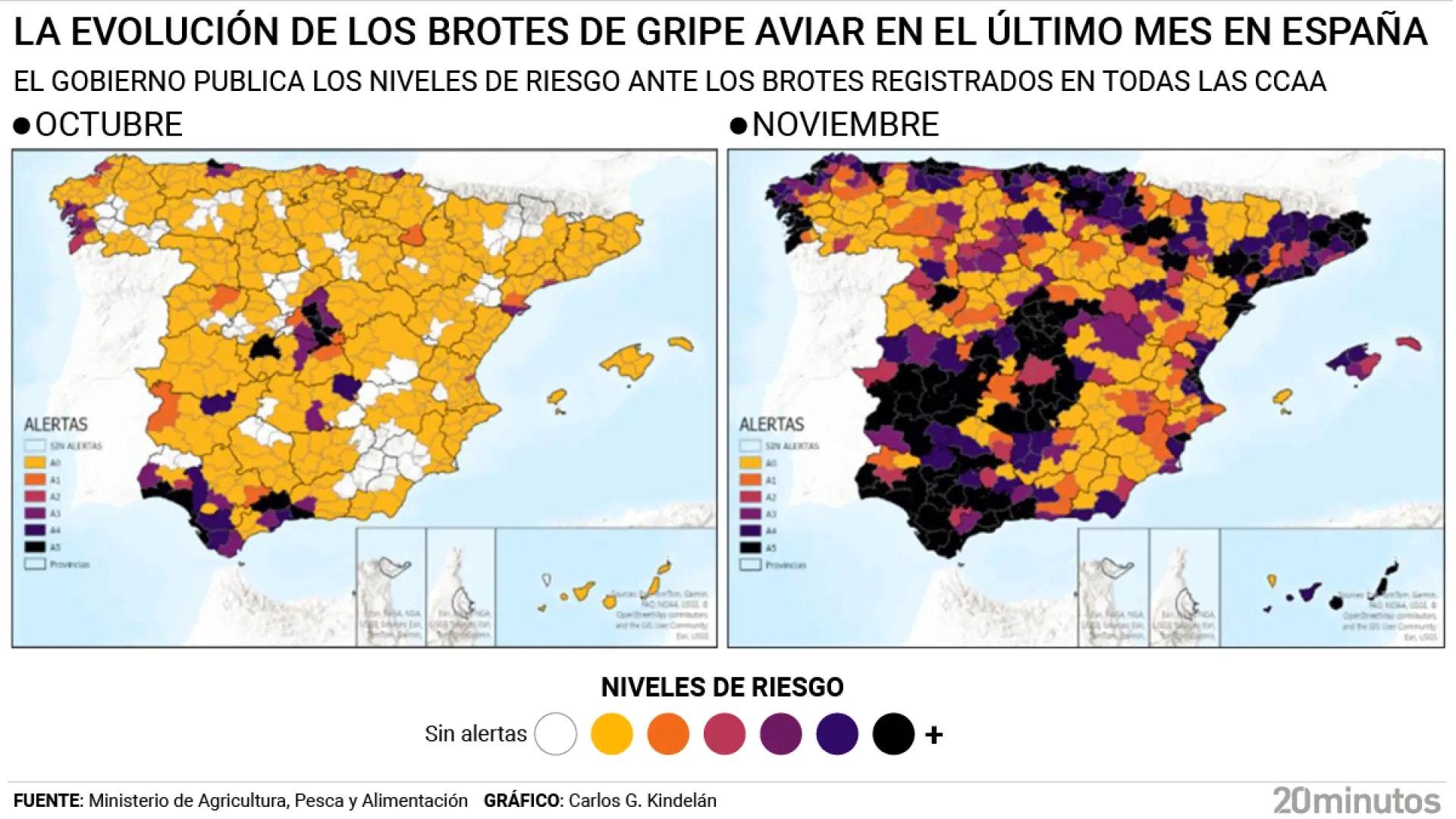
With the order published today in the BOE, the Ministry of Agriculture extends the prohibition of outdoor breeding to poultry throughout Spain, regardless of the type of exploitation or whether it is intended for self-consumption. A limitation that It was already in force in 1,201 municipalities throughout Spain starting this Monday, November 10. As pointed out in a meeting with the media by the general director of Health of Agri-Food Production and Animal Welfare, Emilio Luis García, “there is no deadline for the validity of the order” and clarified that the Government’s intention is to deactivate the measure. “as soon as possible, in a de-escalated manner probably”. The Ministry and autonomous communities maintain continuous monitoring of the situation. Among the reasons given for generalizing confinement is the worsening of the situation in European countries in recent weeks, with a total of 139 outbreaks in poultry farms mainly in Germany (59), Poland (17) and Italy (16). Furthermore, the abundant presence in our wetlands of migratory birds in Spain from countries in central and northern Europe adds new risks. It also doesn’t help that temperatures have dropped, as this helps the virus survive.
Is it something unprecedented in Spain? Will there be new measures in the future?
We are not facing an unprecedented measure either in Spain or in the European Union, according to sources from the Ministry of Agriculture. They have also chosen to confine Ireland, France and some German ‘länder’. Besides, in 2022, when 36 outbreaks were detected A similar decision was adopted within the Veterinary Health Alert Network (RASVE), which brings together those responsible for animal health in the autonomous communities. What is new is that, for this, it has been approved by means of a ministerial order published in the Official State Gazette (BOE). Regarding future decisions, if the epidemiological situation requires it, the Ministry of Agriculture opts for prudence, and assures in the words of Emilio Luis García that “We will evaluate week by week and look for proportionality between having the risk well controlled and economic activity.” In this sense, they will reevaluate and analyze the situation “so that as soon as we see everything much better, we will de-escalate the measures.”
If a new outbreak is detected, what steps are taken?
According to European regulations, as it is a notifiable disease and is the most pathogenic variant, when a new outbreak is located, what is called “biological emptying” of the affected farms must be carried out. That is, at mass slaughter of all birds present whether or not they are infected, as well as all the biological material that has been in contact with them. To which we must add the cleaning and disinfection in depth of the facilities with products such as bleach or aerosols.
What is the situation in Spain? And in the rest of Europe?
The epidemiological situation in Spanish territory does not reach the severity of countries like Germany or Poland. In the European Union (EU) a total of 139 outbreaks in poultry have been located, of which 59 have occurred in German territory, 17 on Polish soil and 16 in Italy. If we consider wild birds, in Europe there are already a total of 708 outbreaks, the majority also in Germany (306) and France (103). In the case of Spain, the Ministry of Agriculture counts to date a total of 14 outbreaks in poultryof which half have been produced in Castilla y León. All of them are of the H5N1 subtype, which is highly pathogenic and causes severe symptomatic symptoms as well as high mortality. This has meant the slaughter of 2.5 million poultry on a total census that is around 50.8 million laying hens at the end of 2024. To which it is worth adding 68 outbreaks in wild birds and 5 in captives (recovery centers, zoos…). The general director of Health of Agricultural Production has noted several differences with respect to the outbreaks of previous years: “In Spain we have had many outbreaks in laying hens, although the most explosive contagion this year has been more in turkeys than in chickens.” In wild birds, he added, “the virus has appeared a lot in seagulls.” For this reason, he has insisted on the need to take extreme biosafety measures on farms.
Can I continue eating eggs?
Yes, you can continue consuming eggs because every time a new outbreak is found all birds are removed from the affected farm and none goes to the agri-food chain to be marketed. Likewise, the official veterinary services (SVO) must authorize with previous analyzes the repopulation of those farms infected as well as any movement of birds within the surveillance zones established up to 10 kilometers away from the located outbreaks. That is to say, the appearance of the virus on a farm means not only the elimination of the entire herd but also paralyzing the activity for months.
How is the virus transmitted? Can it affect humans?
The virus is transmitted between birds through direct contact with infected secretions or by indirect contact, mainly through the contaminated water. Some wild birds can carry this pathogen in their respiratory or intestinal tracts without presenting any symptoms, so they can transport the virus over long distances on migratory routes. Hence, the measure adopted this Thursday by the Government. Regarding a hypothetical affectation in humans is quite low. García (Ministry of Agriculture) explains that “from bird to human, contact via respiratory, secretions and excretions must be quite close.” Which, in his opinion, denotes the relevance of common measures such as hand hygiene every time we enter and leave the place where the chickens are. Additionally, he urges poultry owners to call veterinary services if they observe unusual mortality. Likewise, it highlights the importance of prevent contact between wild and poultry birds especially in those places where the latter drink or feed.
Are poultry producers entitled to compensation?
Yes, but only those who are professionally dedicated to poultry production. Their amounts are published in the Official State Gazette (BOE) and will depend on the different stipulated categories such as laying hens. Furthermore, as it is a notifiable disease, according to European regulations, there is a certain co-financing from the European institutions in this area together with the autonomous communities and the Ministry of Agriculture. This does not mean that the affected farmer will have to wait long to get paid after completing the disinfection and cleaning of his farm, because the competent autonomous community advance economic compensation. In any case, from Luis Planas’ department, they explain that Brussels does take its time and carries out inspections,