Why more and more people go from Bitcoin Core to Knots?
-
Knots reached an unprecedented amount of nodes, exceeding 11% of the total in Bitcoin.
-
Core criticisms are based on the fact that Bitcoin is denaturing its main function.
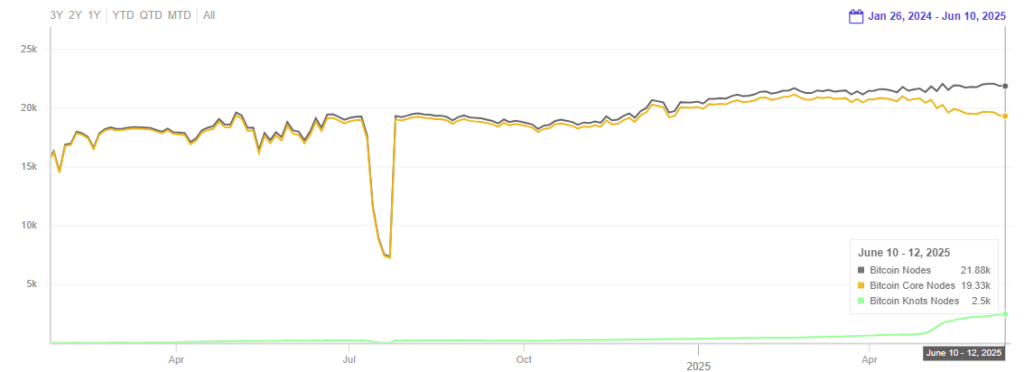
The Bitcoin Network has witnessed a notorious change in the choice of software by nodes. Of a total of approximately 22,000 active nodes, around 2,500 are using Bitcoin Knots, while Bitcoin Core, the reference client, maintains about 19,300 nodes, according to Coin.DANCE data.
This implies that Knots represents more than 11% of the total, a historical figure that reflects accelerated growth in its adoptionespecially since April and early 2025, coinciding with a decrease in the number of nodes that execute Core.
This data can be seen in the following graph (gray line, total nodes; yellow line, core nodes in fall; green line, rising Knots nodes):
What drives this change from Core to Knots?
A good part of user migration has to do with the transactions policies of both clients, which determine What type of transactions a node acceptsstores in its Mempool (the “waiting room” of unconfirmed transactions) and broadcasts to other nodes.
These policies do not alter the Bitcoin consensus rules, which are the ones that define which transactions and blocks are valid in the network, but they do affect how the nodes They manage their resources and prioritize network traffic.
Bitcoin Core, in terms of op_return transactions, which allow to include non -financial data on the network (such as metadata, texts or images), opted for a theoretical limit of 80 bytes per transaction. However, in its next version, V.30, Core will eliminate that restriction, allowing up to 100,000 bytes of data in Op_return.
Some Bitcoiners developers perceive that change as a permissive approach, facilitating a wide range of network activities, including those that those that are those that They could not align with Bitcoin’s original purpose. These developers interpret this permissiveness as a carefree position in front of the «spam«. In the context of Bitcoin, spam is called pejoratively to transactions that include non -financial data, such as embedded images or texts.
From Bitcoin Core allud that this change aims to harmonize retransmission policies with Current User Practicespromoting the freedom of use of the network.
In that sense, as cryptootics reported, during May, Bitcoin users flooded the network of non -monetary transactions, which reflects that many of those who interact with the chain created by Satoshi Nakamoto They intend to use it not only for value transmission purposes.
On the other hand, Bitcoin Knots adopts a more restrictive approach. In relation to Op_return, Knots imposes by default a limit of 42 bytes.
In addition, it includes an option called in particular «Reject parasites«, Which allows operators filter transactions considered low valuesuch as those associated with non -financial data protocols, including the popular ordinals, which embed images or texts in the Bitcoin file. These policies seek to reduce the load on nodes and prioritize monetary transactions.
Bitcoin Knots adopts an approach that gives nodes operators greater capacity to define the policies of their nodesboth in the retransmission of transactions and in the generation of mining templates.
This allows Knots users to exercise more granular control over which transactions prioritize or filter, aligning with a vision that points to the sovereignty of the node operator.
Luke Dashjr and his order to Bitcoin nodes runners
In a June 10 publication, Luke Dashjr, the main developer of Bitcoin Knots and the Ocean Mining Pool, did not hesitate to point out that “The only way out is now a massive migration to Knots”.
Dashjr, in turn, expressed concern regarding the changes implemented in version 30 of Bitcoin Core, particularly in relation to the parameter called “Datacarriersize“(It could be translated as” data size limit “).
This parameter, which defines the maximum allowed size for arbitrary data (such as embedded texts or files) in Bitcoin transactions, has a more restrictive limit in previous versions (such as Bitcoin Core V.29), limiting the inclusion of such data to approximately 92 bytes in total (which included 80 bytes of arbitrary data plus 12 bytes of structural metadata).
However, with the new changes, when establishing Datacarriersize = 83 The possibility of a transaction is enabled to include up to 83 individual exits, each of 10 bytes, which raises the volume of arbitrary data about 830 bytessomething that Luke considers a setback in terms of protection against spam on the network.
In addition, Luke warns that this function (Datacarriersize) was marked as obsolete and that the Core team plans to eliminate it in future versions And without notifying it in advance, he says. This decision, in his opinion, takes away nodes operators an important tool to limit the use of the network for non -monetary purposes.
He also criticizes that Core never approached what he calls “inscription vulnerabilities”, in reference to a technique used by ordinals, runes and other protocols to include arbitrary data in transactions in an non -standard way.
These vulnerabilities allow users to exploit failures in the code to include more data than allowed by the limit of Datacarriersizeoverloading the network with transactions that many consider irrelevant for financial operations.
In this way, the perspective of the creator of Ocean Pool, who argues that Bitcoin Knots offers a safer approach and aligned with the principles of decentralization compared to the decisions of Bitcoin Core, I could be resonating among other operators of nodes that share a similar vision.
This position is influencing the choice of those who are migrating from Core to Knots, reflecting a preference for Knots’ policies that promote user control and protection against non -monetary uses of the network.