8 months ago Maduro said he would resume the path of cryptocurrencies. What happened?
-
Legal uncertainty has been a constant for Venezuelans who use cryptoactives.
-
After a corruption scandal that exploded in 2023, the sector is drifting.
It has been almost a year since the Venezuelan president linked the pause that crosses the cryptoactive sector in Venezuela with the PDVSA-record corruption scandal, which resulted in the loss of billions of dollars in 2023.
In this plot, officials close to the Executive Power were even arrested, such as Tareck El Aissami, the alleged leader of the Operation and former Minister of Petroleum, whose detention occurred a year after he was pointed out for the first time in relation to the case. The strategy consisted of converting currencies from the sale of crude oil in cryptocurrencies, which were deposited in Exchange Kraken, preventing those profits from reaching the country.
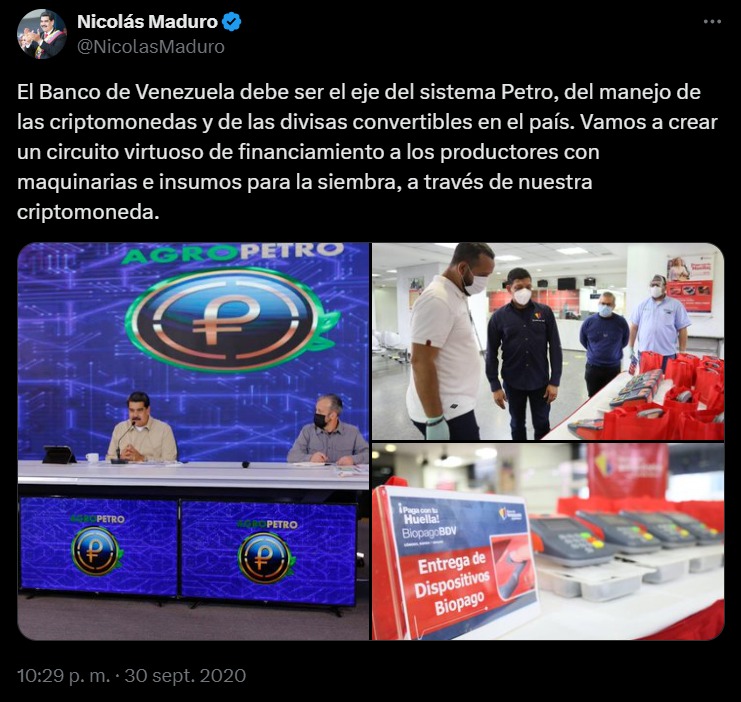
The truth is that, at that time, Maduro promised that Venezuela “would resume the path of cryptoactives.” Specifically, the president said that the country “had started that path and had to transit it again”, so “multimonnear systems” would be implemented.
When referring to “recovering”, Maduro alluded, among other aspects, to the failed experience with Petro, a digital currency launched by the Venezuelan government in 2018. This was conceived as A means of payment backed by the country’s oil reserveswith the aim of avoiding international sanctions, stabilizing the economy and offering an alternative to Bolívar, which was severely affected by hyperinflation.
However, Petro failed because of its low adoption. Despite the attempts of the Venezuelan government for promoting its use, both the population and the companies rejected it, especially due to the lack of confidence in the system and the limited technological infrastructure. In the end, Petro fell into oblivion until practically disappearing in 2024, leaving a very negative precedent towards cryptoactive initiatives promoted by the administration of Maduro.
This failure did nothing but reinforce the desire of Venezuelans to seek really sovereign alternatives to manage their finances, which explains the growing importance of BTC within the country. People want to protect their inflation money and not depend on a state system that has not tried to be effective.
The PDVSA-record corruption plot had repercussions both within the government itself and the Venezuelan cryptocurrency ecosystem. The scandal directly hit the exchanges operating in the country, as well as the miners, who faced greater restrictions and a climate of growing uncertainty.
In that case, both the state Petróleos de Venezuela (PDVSA) were involved and the National Cryptactive Superintendence (Sunacrip). According to official research, this agency performed a key role in the conversion to cryptocurrencies of the funds obtained through irregular businesses with the sale of oil. In response, Maduro ordered not only the dismissal and detention of Joselit Ramírez – then superintendent of the agency – for alleged corruption, but also a total restructuring of the regulatory entity.
Lack of clarity …
Although Maduro announced several months ago his intention to resume the path of cryptocurrencies, Until now, concrete or official advances have been observed that indicate real progress in that direction.
As for Sunacrip restructuring, which was initially scheduled to complete in six months, it has not been publicly informed about its conclusion or about the restoration of its functions. This keeps the sector in a regulatory limbo, especially in key areas such as mining and cryptoactive operations in authorized exchanges.
The case of cryptocurrency mining in Venezuela is particularly striking. Currently, the sector is going through a high degree of uncertainty, while The government continues to confiscate equipment under the argument of protecting the national electrical system.
In mid -2024, the governor of the Carabobo state, Rafael Lacava, declared that some 11,000 mining machines had already been seized. At that time, the official was emphatic in stating that these operations were “absolutely prohibited” in their jurisdiction. A year later, the situation has not changed too much.
All this legal uncertainty has generated an environment conducive to the proliferation of scams related to cryptoactive. In 2024 the collapse of Solesbot left hundreds of affected Venezuelans, and this year the story was repeated with HV Ijex, a platform that captured funds from some 80,000 users in Venezuela and Colombia with fast -out promises. The company suspended withdrawals in early April and the scammers emptied the money of thousands of people.
These cases highlight the urgent need to promote financial education in the country. The combination of ignorance about the functioning of cryptocurrencies and economic despair has made many people vulnerable to scams that take advantage of the lack of effective supervision and regulatory gaps.
In a context marked by institutional opacity, project collapse and fraud proliferation, financial education becomes not only a tool, but an urgent need. Instead of waiting for solutions from above, citizens must assume an active and critical roleinforming on their own, learning to identify risks and making conscious decisions on how to protect and manage your money.
As for Venezuela, we will have to see if in the coming months there are news, but for now there are no reasons to excite themselves.