Why is the price of bitcoin falling? 3 bearish forces impact the market
The price of bitcoin (BTC) entered a period of lateralization that has been going on for three months, after reaching its all-time high (ATH) of $73,700 in March. Since that moment, the digital currency experienced ups and downs and Its current price is $64,800..

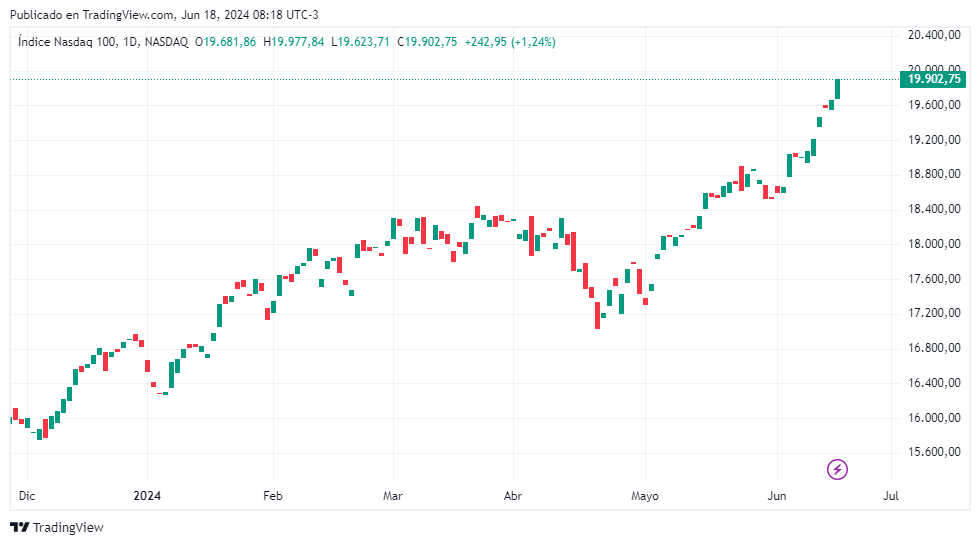
All this occurs while the NASDAQ index, which brings together the main companies in the technology sector, continues to mark ATH in its price, as seen in the graph. These stocks that make up the index are considered risk assets, like BTC, but in the last two weeks there was no correlation between the two.
In this framework, Colombian analyst Juan Rodríguez asked in his most recent video: “Why is BTC not doing the same and not looking for historical highs?”
According to his analysis, There are three factors that influence the price of BTC: the behavior of the miners, the outflow of money in exchange-traded funds (ETF) in the United States and the developments in the case whose main defendant is the businessman and founder of Terraform Labs, Do Kwon.
Miners put selling pressure on bitcoin
For Rodríguez, this wave of BTC that is put up for sale is influencing the price of this asset and explained the reasons why this is happening. “The miners received 900 BTC as payment, after the halving they started to earn half for their activity and since April 450 BTC.” In that sense, he added:
“If the price of bitcoin does not rise, they have economic problems and they will have to sell more of these 450 BTC that they receive per day to pay for electricity, maintenance and their operating expenses. “They did that with 900 BTC, now they do it with 450 BTC.”
Juan Rodríguez, cryptocurrency market analyst.
As explained in Criptopedia (educational section of Criptonoticias), the halving is the mechanism written in the Bitcoin code through which the amount of bitcoins received by miners as a reward for their work is reduced by half (the newly created bitcoins ). This reduction process occurs every 210,000 blocks (approximately every four years) and Its purpose is to reduce the rate of issuance as part of the Bitcoin money supply.
Continuing with the analysis, Rodríguez points out that the miners’ profits began to fall since March and, since that moment, they are receiving the same profits as in the second half of 2023. “There are many more miners than there are in 2023, which What is happening is that there is a capitulation of miners: they sell more BTC than they produce and that causes additional downward pressure. This capitulation also occurred in the last halving in 2020,” he detailed.
In the following graph, you can see how miners’ sales (blue candles) increased from May to today:

For miners to stop selling their BTC, It is key that purchases in spot ETFs of the digital currency in the United States return. “If the outflow of money in ETFs joins the issue of miners, even if the macroeconomic situation goes up, we will have problems with the price of BTC,” Rodríguez completed.
The positive streak of ETFs was broken
As CriptoNoticias already reported, bitcoin ETFs in the United States experienced a net capital outflow of $580 million last week, ending their 4-week winning streak of positive money flows.
This drop occurred after the meeting of the Federal Open Market Committee (FOMC), where it was decided maintain the interest rate between 5.25% and 5.50%. According to CoinShares analyst James Butterfill, this meeting was “more aggressive than expected”, leading investors to reduce their exposure to financial instruments based on bitcoin and cryptocurrencies.
This Monday, ETFs recorded net outflows of $145 million. According to data from SosoValue, Fidelity’s FBTC, which lost $92 million, was followed by Ark Invest and 21Shares’ ARKB with $50 million, while Grayscale’s GBTC and VanEck’s HODL also recorded negative flows of around $4 million. .
The only net inflows were from Bitwise’s BITB, for a total of 3 million dollars.
These negative days reduced the cumulative total net inflows of spot bitcoin ETFs. They went from almost 16 billion to 14.96 billion dollars.

The uncertainty in the United States macroeconomy is due to the fact that the FOMC anticipated a single interest rate cut for 2024, below the projection of three reductions mentioned months before and the two expected by the market.
The price of bitcoin may be affected by the acceptance of ETFs Due to the way they work, they are backed by the underlying asset. This means that if more investors put money into these funds, issuing companies must acquire more BTC to maintain adequate support. On the other hand, if there is capital outflow in the ETFs, the companies that manage them could sell the surplus BTC.
This reduces or increases the amount of assets available on the market, which can lead to an increase or decrease in the price of BTC.
News in the Do Kwon case affects the price of bitcoin
Finally, Rodríguez did not rule out that the news in the Do Kwon case have influenced this drop in the price of the digital currency.
The businessman founded the Terraform Labs organization, the institution was behind the launch of the successful LUNA token and the dollar-anchored stablecoin TerraUSD (UST), assets that in 2022 starred in a tragic collapse that pushed the market into a downward trend.

In this regard, Rodríguez explained that the United States Securities and Exchange Commission (SEC) reached an agreement with Terra Labs and imposed a fine of $4.47 billion, a sum greater than 65,000 BTC. “Terra Foundation in 2022 created a currency that went up to 120 dollars and from there it went to 0. With the money they raised they bought 80,000 BTC and other cryptocurrencies. At that time, that guy told us that they sent those BTC to the exchanges and to pay the fine they were going to sell part of those 60,000 bitcoins.”
According to CoinDesk, a Terraform Labs representative declined to comment on the proposed deal or what it means for the future of Terraform Labs. “It is an unconfirmed hypothesis but the data is in that line,” Rodríguez concluded.