

Application submitted to launch a solana ETF in the United States
The investment firm VanEck filed with the United States Securities and Exchange Commission (SEC) a application to launch the first solana (SOL) exchange-traded fund (ETF).
The document was published on the official site of the SEC. In this context, the head of Digital Asset Research at VanEck, Matthew Sigel, explained that they submitted this application because “it is a competitor to Ethereum, it is an open source blockchain software designed to handle various applications, including payments, trading, gaming and social interactions.
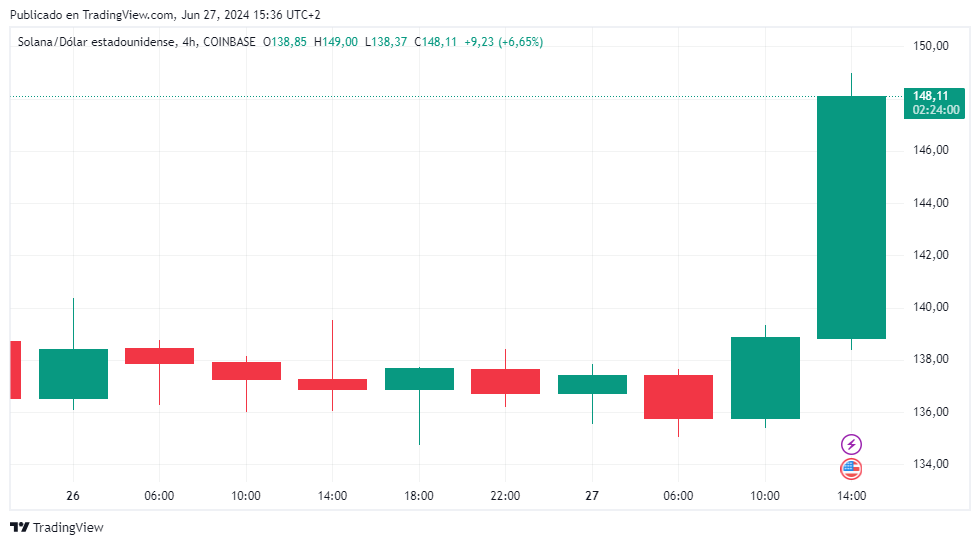
After the announcement, cryptocurrency price skyrocketed and at the time of publication of this note it registered an increase of 9% in the last 24 hours as seen in the following graph. Its price is 148 dollars.
VanEck’s filing puts the SEC’s decision back in the spotlight. As CriptoNoticias already reported, For this body, SOL is an unregistered security and for this reason it must be regulated by the United States Securities Law., unlike what happens with bitcoin (BTC) and ether (ETH). In this regard, Sigel stated:
“We believe that the native token, SOL, functions similarly to other digital products such as BTC and ETH. It is used to pay transaction fees and services. Like ether on the Ethereum network, SOL can be traded on digital asset platforms or used in peer-to-peer transactions.”
Matthew Sigel, Head of Digital Asset Research at VanEck.
For his part, the president of the SEC, Gary Gensler, expressed months ago what the differences are between BTC and cryptocurrencies, in his opinion. “Anything other than bitcoin you can find a website, you can find a group of entrepreneurs, they can establish their legal entities in an offshore tax haven, they can have a foundation, they can present a lawyer to try to arbitrate and hinder jurisdictionally, etcetera”, he explained. And he argued that it is for this reason, everything that is not BTC, should be under the control of the SEC.


