Back with the criminal investigation in the hands of prosecutors

On the eve of the opening of the oral trial against the State Attorney General, Álvaro García Ortiz, the last Council of Ministers in October has approved the referral to the Cortes of the draft organic law on Criminal Procedure (LOCrim). The reference of the Council of Ministers refers to the new LOCrim, as the norm that regulates criminal procedure and defines the rules and guarantees to investigate and prosecute crimes.
It is, he says, a historic project, a complete modification of an essential law for the legal system. The current one, although it has undergone more than 80 adjustments, has been in force since 1882. To do this, he continues, the new LOECrim attributes criminal investigations to prosecutors.… and modernizes the criminal justice system with the simplification of processes, the regulation of new investigation and testing instruments (DNA, Artificial Intelligence, etc.) and the strengthening of procedural guarantees for those investigated and victims.
The prosecutor will focus on the investigation, an autonomous process always controlled by a judge of guarantees. Once this phase is over, a second judge (preliminary hearing judge) will be responsible for deciding whether to open the oral trial.. If so, a third judge will judge the facts.
Up to this point the official reference, which, as is the case with the Adamist Spain that this Government represents, does not recognize the merit that Alonso Martínez’s LECrim represented in 1882, which has survived to this day, and which introduced, within the framework of a liberal conception of the criminal system, the accusatory principle and which split the inquisitorial procedure in force until then, into a different one in which the judge or impartial official – says the Explanation of Reasons attributed to the Minister of Justice himself – who achieved his approval- investigates or instructs and another resolves.
It is true that many of the liberal purposes and in line with the reforms of the criminal procedure legislation of the time in which it was approved, were not always in force, partially modified, and that many of its commandments were not carried out.
The current LECrim requires, as occurred with the Civil Procedure Law, to be replaced by a new Law. The current LEC (Law 1/2000) approved during the time of the Marshal of Ghent Ministry in the first Aznar Government, a work promoted by the illustrious professor of Procedural Law, Andrés de la Oliva, who sadly died a few days ago.
Now well. It is one thing that the current LECrim, after so many reforms in the democratic period, sometimes accommodated to the doctrine of the TC, must be modified, and quite another that it must be modified in the present political moment, where what is intended beyond the historical change that the change of the instruction of the Judge by the Prosecutor would mean, is the guarantee of impartiality that today the Prosecutor’s Office is being sued, institutionally very deteriorated since that self-reflection of President Sánchez:
Who does the Public Prosecutor’s Office depend on? Well that’s it…
As the former President of the Second Chamber of the TS, Manuel Marchena, (career professional prosecutor), recalled in his book, Justice threatened, Espasa, 2025, we live in times where the conception of State Attorney General as a delegate the Government called to relentlessly pursue the crimes committed by the opposition political party and at the same time condescend to the crimes attributed to the government team that appointed him, endangers the stability of this institution.
In such a situation, it is difficult for the Bolaños Ministry to be able to approve a reform that should be the subject of a new conception of justice, since, first of all, the impartiality of the Public Prosecutor’s Office should be guaranteed through the reform of its Statute as well as making a forecast and planning of the staff of judges and prosecutors and some of their functions.
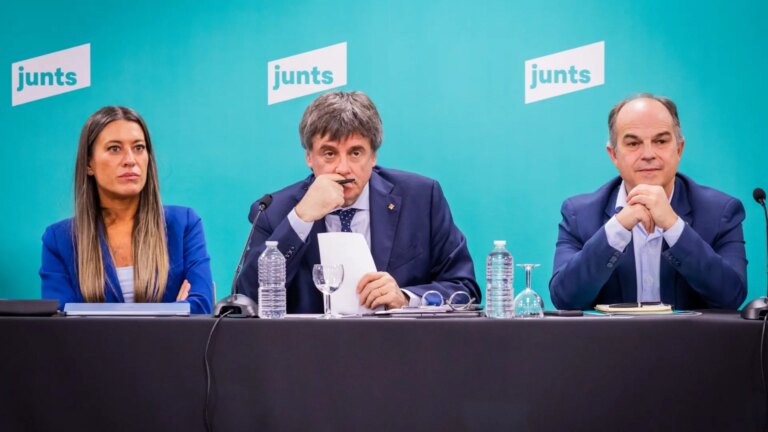
In Spain there are less than 3,000 career prosecutors (2,765 data from 2024), surely insufficient to take charge of the investigation as well as the need to provide them with new means and budgets in addition to redefining the functions of the current investigating judges. It is a work of Romans, which cannot be carried out with a simple parliamentary ‘click’if the law is approved, which is not going to happen, especially after the disagreement between Junts and Sánchez…
As happened with the Preliminary Project prepared by the Caamaño Ministry with R. Zapatero, this project will remain in the water and we will have to wait for better times and greater consensus to carry out a reform agreed upon not only in political terms, but also redefining the function of Justice in the 21st Century.
The conjurer Minister continues to play with Justice…