BBVA already notices the effects of the takeover bid for Sabadell and loses more than three quota points in Catalonia this year
One of the main obstacles that BBVA has encountered in the takeover bid for Banco Sabadell has been the rejection on the part of Catalan society. The hostile operation – an unusual procedure in the banking sector – was released on May 9, 2024four days before the holding of the regional elections in Catalonia. Precisely, the chosen timing further increased the pressure on this corporate movement, which has hurt sensitivities at practically all levels in said region. This has caused Sabadell to find in its home territory a good defense shield to stand up to the offer posed by the group of Basque origin, whose outcome will be known on Friday.
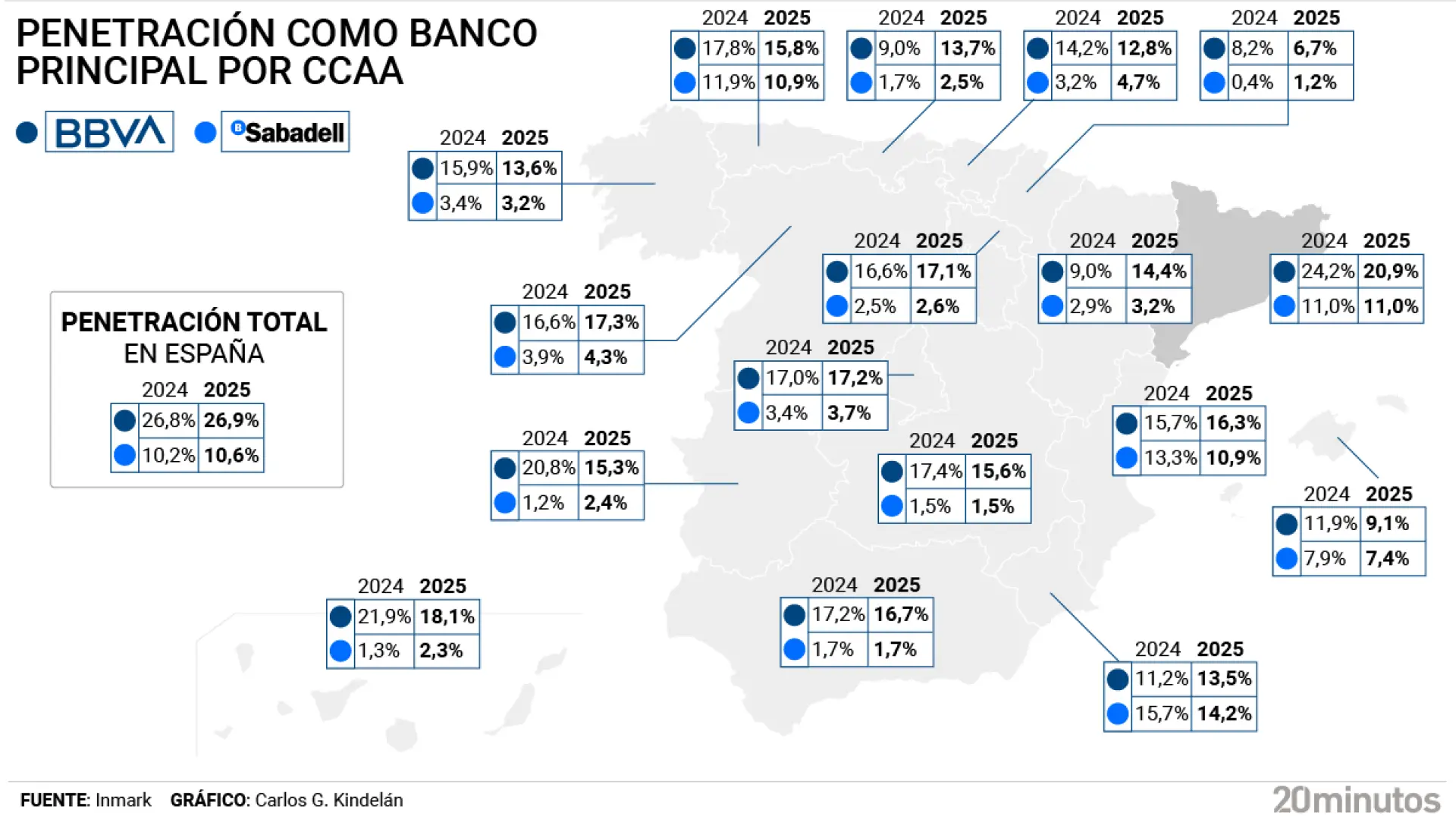
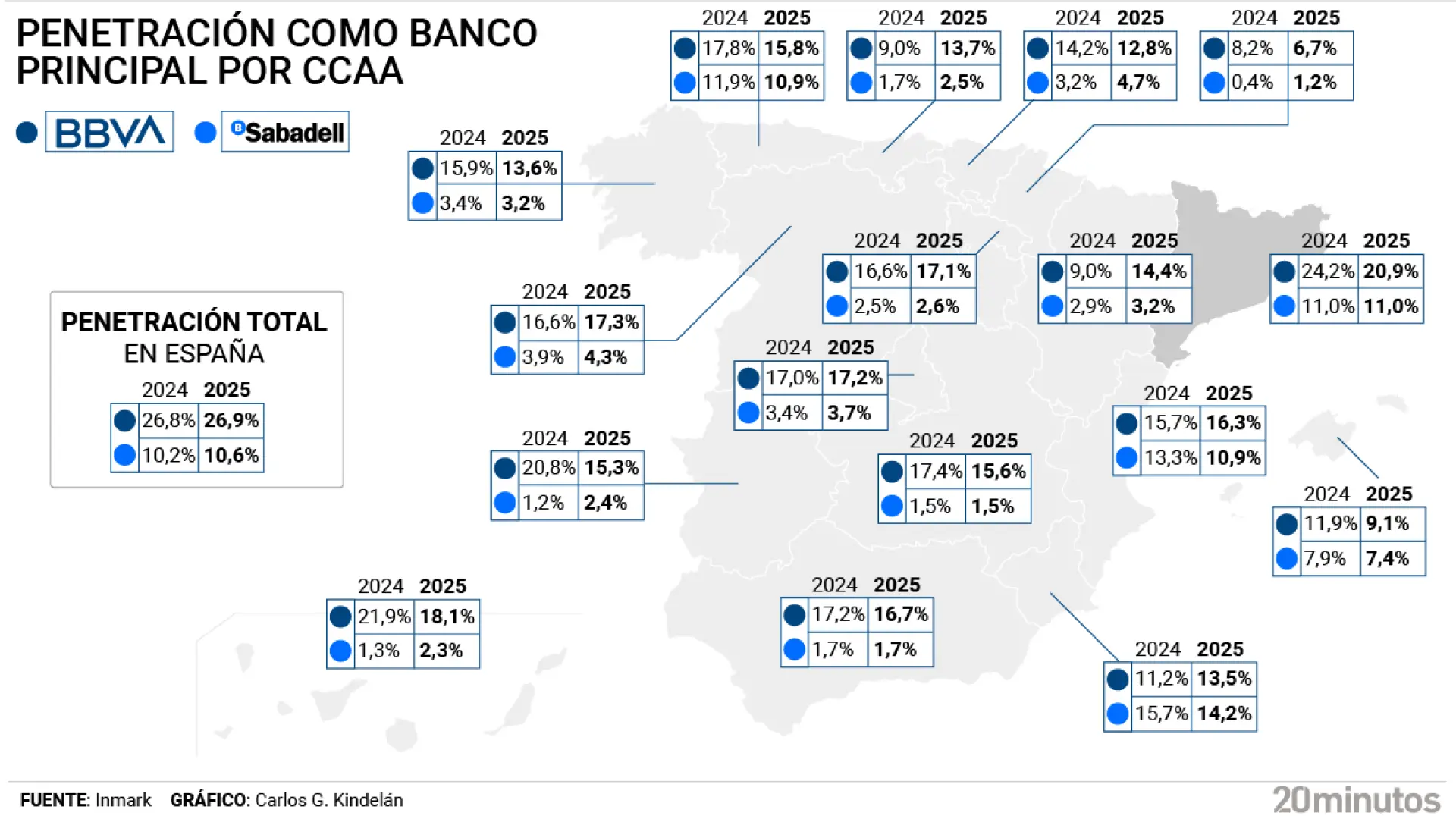
The takeover bid has cost BBVA the loss of a good handful of clients in Catalonia, especially among those with the greatest ties, which are usually the most profitable. According to the report ‘Financial behavior of individuals in Spain in 2025’prepared by the consulting firm Inmark, its penetration as the main bank (the one used for receipts or payroll direct debit) in this Sabadell fiefdom it has been reduced to 20.9%. The wear and tear resulting from the delay in the calendar has led it to lose more than three percentage points compared to last year, when the quota reached 24.2%, which does not prevent it from remaining the second entity behind CaixaBank and ahead of Sabadell, which remains practically unchanged at the 11% threshold.
The verbal confrontation, which has intensified in recent weeks, the Legal offensive and the Government’s intervention in the takeover bidwhich has prohibited the merger between both entities for at least three years, extendable for another two, has taken its toll on BBVA, which sees its business in Catalonia suffer. The piece of cake that has been left behind is divided between CaixaBank, which goes from 37.9% to 38.6%, Imagin – its digital bank – (2.2%), Banco Santander (10% compared to 9.1% last year) or neobanks such as Revolut (1.3%). Rural savings banks also lose weight from 2.6% to 1.8%.
He Sabadell’s emotional attachment to Catalonia has been reinforced with the return of its headquarters to the Barcelona municipality that gives its name to the bank from Alicante, where they were installed as a result of the instability of the independence process of 2017. The move did not sit well at all in the Valencian Community, where the bank headed by Josep Oliu has suffered a significant cut with a penetration that exceeds 13.3% to 10.9%, although it remains in fourth position on the list. Its presence in the area was consolidated with the acquisition of the Caja de Ahorros del Mediterráneo (CAM) in the 2012 financial crisis.
In contrast, BBVA comes out stronger and consolidates its second position with a share of 16.3%. However, it is Banco Santander that emerges the most strengthened among the ten main groups after going from 12.6% to 15.3% and establish itself as a third entity in this CCAA. In fact, this autonomy is one of the few in which the entity with corporate headquarters in La Vela has gained ground in recent months, which also includes La Rioja, Murcia, Cantabria, Castilla y León, in addition to Aragón and the Community of Madrid. In the rest the behavior is downward, with Extremadura being where the most sees its business cut from 20.8% to 15.3%.
In this sense, its ‘opado’ improves in up to nine Autonomous Communities, including Cantabria, the Basque Country, the Foral Community of Navarra, Castilla y León, Aragón, La Rioja, Community of Madrid, Extremadura and Canary Islands. Extrapolated to the national group, for which the South Korean company has used the information obtained from 12,000 interviews carried out between between April and June of this year, the penetration of BBVA It has fallen one percentage point to 16.5% and returns to 2023 levels, while in Sabadell it has been more stable with one tenth less, up to 5.8%.
The takeover bid faces its final blows while waiting for this Friday the National Securities Market Commission (CNMV) to publish the guarantees that BBVA has managed to unite their cause. It hopes to reach 50% of the voting rights, for which it needs a good part of the active investors, who control more than 35% of the capital, to have attended the share exchange, a package that includes institutional investors. To these would be added the index funds, of which they estimate that half of them could attend, that is, 10% in total; the Mexican businessman David Martínez, who has exchanged the 3.8% he holds; as well as some minority shareholders. Of the 42% of individuals remain to be known the position of 12% of them, given that the rest are Sabadell clients, among whom acceptance has been low and only the equivalent of 1.1% of the capital have said ‘yes’.