Bitcoin had a “rupture of historical norms” in the midst of the tariff war
-
Bitcoin’s idea is consolidated as digital gold and value reserve.
-
In the future, there could be a bitcoin less and less sensitive to politics.
The financial markets are savoring a brief respite after the economic turbulence caused by the “tariff war” unleashed by the president of the United States, Donald Trump.
As Cryptonotics reported on April 2, the president applied reciprocal tariffs to several countries, including China, Canada, the European Union (EU) and Latin America.
Just when the conflict between the United States and several nations seemed to climb at unthinkable levels, the Trump government announced trade agreements with the authorities of China and the United Kingdom, which brought some relief to financial markets.
In one of his latest reports, Galaxy Digital specialists, a digital asset management firm, indicate that Trump’s tariff ads revived volatility in financial markets, but left a certainty: Bitcoin (BTC) evolved as coverage instrument in the face of growing macroeconomic instability and geopolitical risk.
To support this statement, they pointed out that, after the announcement of Trump’s tariffs, traditional markets showed mixed signs. For example, the Nasdaq, an index that groups the main technology companies in the United States, managed to stabilize after a fall at the beginning of the month. In parallel, the Bloomberg Dollar Indexwhich measures the strength of the dollar against a basket of global currencies, recorded a 4%decline, reflecting less confidence in the US currency.
For its part, gold, traditional active refuge in contexts of economic uncertainty, reached a new historical maximum (ATH) of $ 3,500 per ounce. Although he then retreated slightly, he closed April with an accumulated gain of 5.75%.
“Meanwhile, BTC rose about 11% during the same period, which underlines the growing attraction of decentralized assets in an environment characterized by a growing skepticism towards US fiscal policy and the independence of the Central Bank,” the analysts said.
They also stressed that the volatility of the currency created by Satoshi Nakamoto, from May 2 to May 11, was 43.86%. Here it is necessary to clarify that the indicator does not reflect whether the price went up or down, but how much it moved.
This is relevant because The volatility of BTC was lower than that of the S&P 500 index (47.29%) and Nasdaq 100 (51.26%), “an unusual position for a digital asset traditionally known for its huge volatility.”
For specialists, this relative calm marks “A significant break with historical norms”while explaining:
“BTC has frequently moved more drastically together with the variable income, reacting strongly to risk and risk aversion environments. However, unlike large corporations represented in stock market indices, BTC and other digital assets are, to a large extent, structurally isolated from direct tariff impacts and changes in commercial policies. This makes them more and more relevant. in portfolios seeking exposure not correlated with policy -sensitive sectors ”.
Galaxy Digital, investment company.
As cryptootics has reported, Galaxy analysts are not the only ones who warn these changes in the market. Ki Young Ju, CEO and founder of the analysis firm Cryptoquant, recently recognized in an X publication that was wrong in one of its projections on the price of Bitcoin.
“I said that the bullish cycle was over, but I was wrong,” he admitted. As he explained, he had not considered the complexity and diversity that characterizes the current BTC market.
It is that, currently, the market has diversified much more by ETFs, BTC’s purchases by Strategy and other government agencies and agencies. “Previously, earning cycles were triggered when the whales charged in the peak, which caused a massive sales chain reaction and a price drop,” he added.
These changes also reinforce the narrative that BTC is considered “digital gold”an idea based on the characteristics that it shares with precious metal: it is a decentralized currency and resistant to the censorship of banks and governments.
It should also be noted that it is an asset that is not devalued by the monetary issuance or political decisions of a government or a central bank. It is a factor that, as highlighted by Galaxy analysts, makes it attractive to diversify investment wallets, especially in times of geopolitical tensions or economic uncertainty.
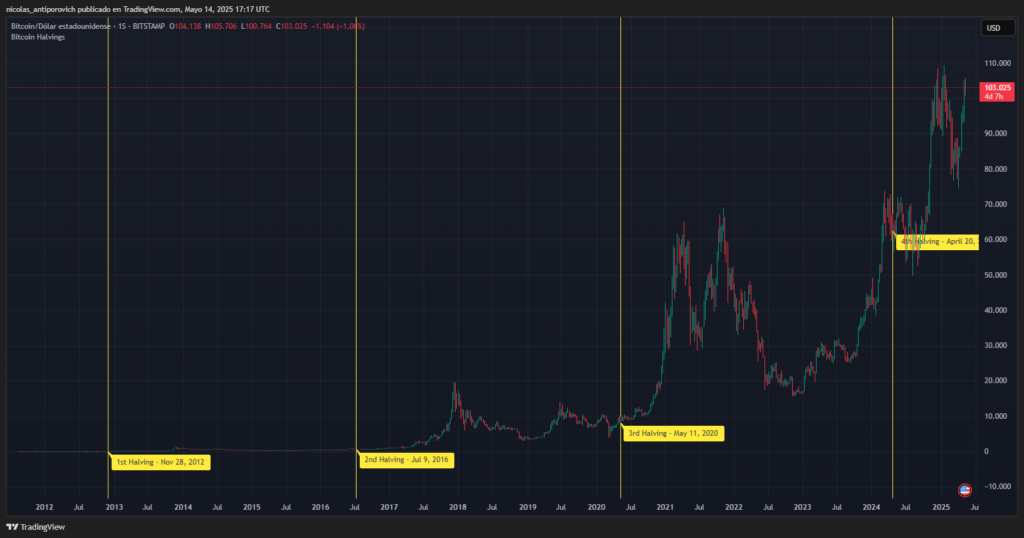
In addition, it should not be omitted that BTC has a supply limited to 21 million units, whose broadcast is reduced every 4 years in an event called Halving. It is a factor that influences its medium and long term price. For these reasons, and their inherent shortage is that more and more investors (large and small) are interested in adding BTC to their portfolios to protect their heritage.
For these reasons, it would not be unreasonable to see that, in the short term, BTC’s narrative as shelter asset grows even more and the digital currency is less sensitive to geopolitical conflicts.
“In short, BTC’s yield in April could be more than a simple reaction to policy holders. It could represent a growing recognition that digital assets are not only speculative tools, but fundamental components of portfolios that browse a new macroeconomic environment,” concludes the report.
Alex Leishman, CEO of River Financial, argues that BTC has ceased to be considered a purely speculative asset, and highlights as an example the growing interest of the corporate sector. “Companies are accumulating at an unprecedented rate. Today we serve more than 2,000 companies, and that number grew 154% only in the last year. And they are real, small and medium -sized companies, from all over the United States: construction companies, real estate, biotechnology companies, plumbing, farms, restaurants, of everything you can imagine. All these owners and business operators are reaching the same conclusion: Bitcoin, ”he details.
This marked increase in institutional adoption reflects the growing recognition of BTC as a strategic financial tool, and in part, it helps to explain the strength that the asset showed in the midst of the tensions that unleashed the “war of tariffs.”
Having a limited offer, any significant increase in demand (such as institutional investment), It will result in a bullish impulse for your price.
In simpler terms, the entry of new actors to the market is a price catalyst, especially at the time when the BTC narrative as a shelter asset gains more and more strength.
In fact, an OKG Research analysis anticipates that in 2025 about 2.28 billion dollars could flow to the market (Trillionsin English), mainly due to the growing interest of institutional actors. If this scenario is specified, the price of BTC could climb to the 200,000 dollars area.